 There are so many good poets who write in relative obscurity. Bill Dickey (whose poem I posted yesterday), was part of Berryman’s famous class at Iowa and taught poetry for over 30 years at San Francisco State. Don’t confuse Bill with another poet, James Dickey, who is very well known (and in my view a much lesser poet). Bill published 15 volumes of poetry, and was well thought of by fellow poets, but his work is almost unknown to the general public. Larry was lucky enough to study with him in 1968, and then again in the late 70s. He says of Bill:
“He was a wonderful teacher. He took teaching seriously and was able always to find something praiseworthy in a poem. If he didn’t like something, he might show you other poems that dealt with a similar topic in another way. He would point you towards doing better without putting you or your work down. And when you submitted something to him, the next week you’d get a full written comment from him about your work.”
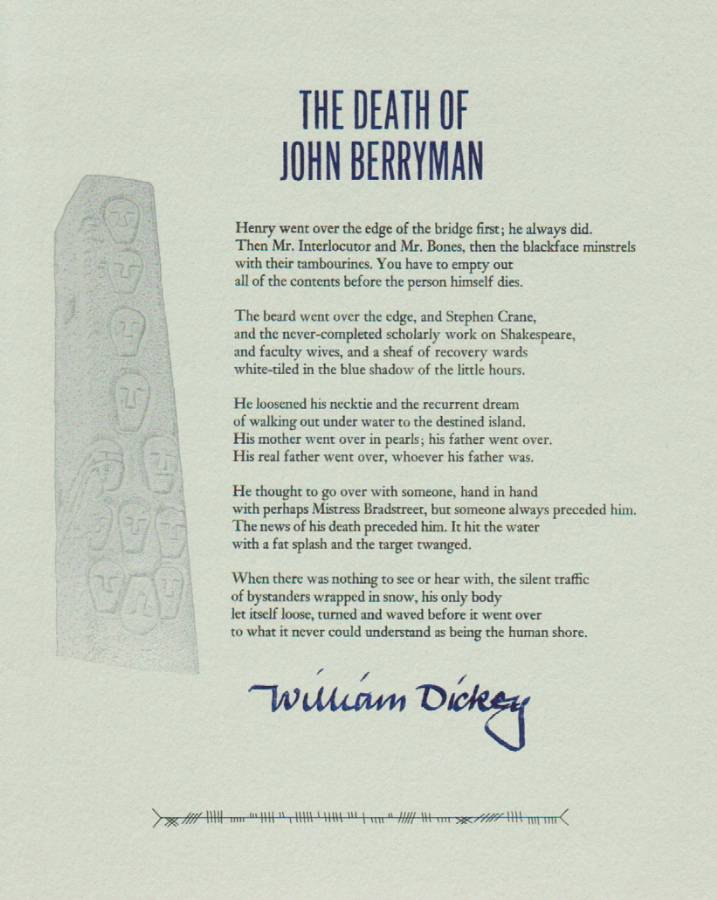
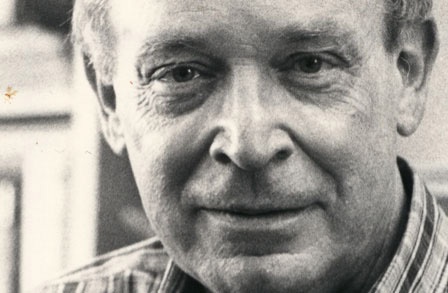
This is a rare quality. I think you can see the kindness in the photo above, from the Poetry Foundation. Larry printed a broadside of his poem “The Death of John Berryman,” which he gave out at Bill’s retirement party, shortly before his death.
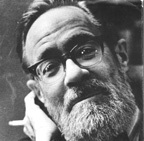 To understand this poem, it helps to know a bit about Berryman. His father committed suicide when Berryman was a boy, and this suicide and alcoholism were demons that haunted him and his work. He was raised by his mother and stepfather, whose name he took. Berryman wrote his a critical biography of Steven Crane, and his first major work was called “Homage to Mistress Bradstreet,” in which he channels the voice of this first American woman poet. He is most famous for his Dream Songs (and these are the poems I love–I’ve published one of my favorites here before). They take the sonnet form and fracture it to Berryman’s particular needs. There is a leading character in these poems called Henry, a sort of alter ego for Berryman. In many of the poems, there is a question and answer between a minstrel character, referred to as Mr. Bones, and another, unidentified authorial voice, that Bill Dickey calls “Mr. Interlocutor” in his poem. For example, in one poem, the lines appear:
Where did it all go wrong? There ought to be a law against Henry.
–Mr. Bones : there is.
It also helps to know that Berryman eventually committed suicide himself, jumping off a bridge in Minneapolis into freezing water. All of this background information is simply to set the stage for this Bill Dickey’s elegy. I love the way the language unfolds the story, and then when the body hits the water, that amazing phrase “the target twanged.” Here’s the poem: