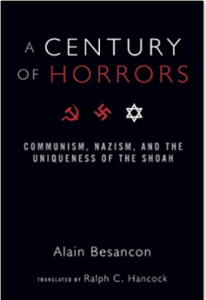
 I know that you’re supposed to take up some frivolous books for the summer, but perhaps influenced by the morning and evening fog that characterizes coastal California, my reading has been more dour. I mentioned these books in an earlier post: A Century of Horrors, by Alain Besançon, Hope Against Hope, by Osip Mandelstam’s wife, Nadezhda, and most of Secondhand Time (I couldn’t get through all of it), by Svetlana Alexievich. I also just reread Czesław Miłosz’ The Captive Mind. All of these books deal with the phenomenon of Communism as it has been practiced since the Russian Revolution. Besançon’s thesis is that while Nazism was horrific, it was a brief nightmare compared to Communism. The Shoah was intense, killed millions, but was defeated and rejected.
Communism, on the other hand, while originating in an idealistic set of premises, has for over a century imprisoned, murdered, and instilled terror in many more millions, and is still doing so. It’s a powerful book, and lays out facts in a reasoned argument that’s hard to deny. Continue reading “Summer reading”
 Larry has been doing a series of poetry broadsides–letterpress copies of poems, suitable for framing. He has selected poets of roughly his age group, and this one is on his upcoming list.



 I was at a wedding this weekend, and had to choose a poem to read. I chose Cantatrice, by Berryman, but this was in the running till the last day:

 This poem by William Carlos Williams is new to me, arriving in my email from the American Academy of Poets. I like it especially because of the last lines, which I might be in myself. And I like this very dorky picture of him, too.
 World War II and Poland seemed to create a unique environment for poetry. That unfortunate Catholic country, smack between Russia and Germany, produced dozens of wise, chastened, articulate writers, many of whose poems I’ve posted in the past. One I hadn’t read before is Ryszard Krynicki. He mostly writes short, bitter, ironic poems, like salt on the rim of the glass: