Into the Mystery

Here is the final poem from Tony Hoagland’s new book, Priest Turned Therapist Treats Fear of God.

Into the Mystery

Of course there is a time of afternoon, out there in the yard,
a time that has never been described.

There is the way the air feels
among the flagstones and tropical plants
xxxxxxxxxxxxxxxxxxxxxxxwith their dark, leathery-green leaves.

There is a gap you never noticed,
dug out between the gravel and the rock, where something lives.

There is a bird that can only be heard by someone
who has come to be alone.

Now you are getting used to things that will not be happening again.

Never to be pushed down onto the bed again, laughing,
and have your clothes unbuttoned.

Never to stand up in the rear of the pickup truck
and scream while blasting out of town. Continue reading “Into the Mystery” →

The Garden Master

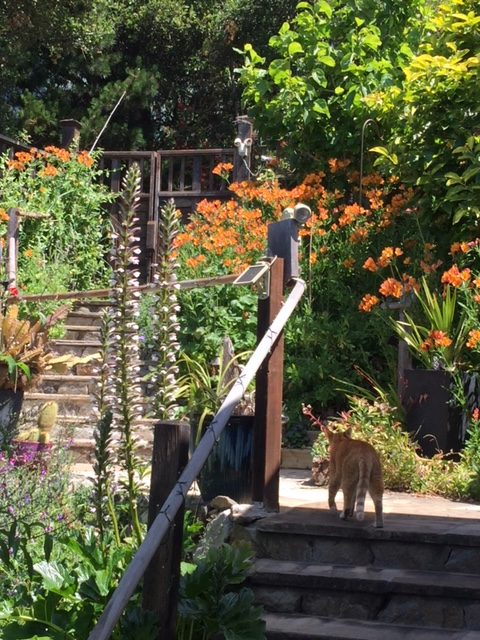
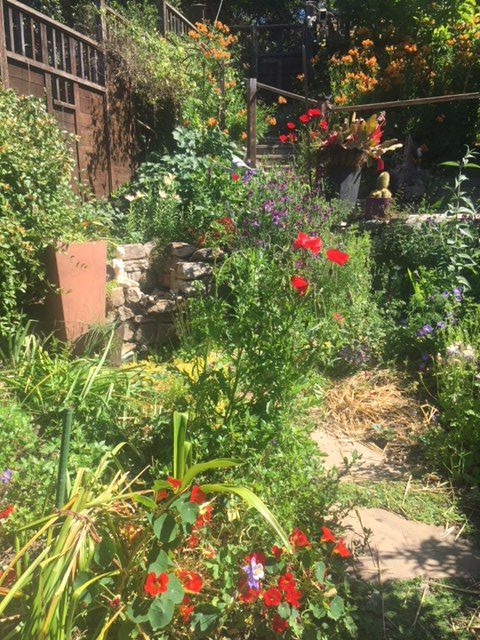
I want to post some photos of my garden, and thought about what poem to go with it. Theodore Roethke was the great poet of gardens, his father ran a nursery. This one came to mind, earthy, slightly menacing.

Florist’s Root Cellar

Nothing would sleep in that cellar, dank as a ditch,
Bulbs broke out of boxes hunting for chinks in the dark,
Shoots dangled and drooped,
Lolling obscenely from mildewed crates,
Hung down long yellow evil necks, like tropical snakes.
And what a congress of stinks!— Roots ripe as old bait,
Pulpy stems, rank, silo-rich,
Leaf-mold, manure, lime, piled against slippery planks.
Nothing would give up life:
Even the dirt kept breathing a small breath.

Theodore Roethke

And here are the photos, not menacing at all.


The other wedding poem

I was at a wedding this weekend, and had to choose a poem to read. I chose Cantatrice, by Berryman, but this was in the running till the last day:

For What Binds Us

There are names for what binds us:
strong forces, weak forces.
Look around, you can see them:
the skin that forms in a half-empty cup,

nails rusting into the places they join,
joints dovetailed on their own weight.
The way things stay so solidly
wherever they’ve been set down—
and gravity, scientists say, is weak.

And see how the flesh grows back
across a wound, with a great vehemence,
more strong
than the simple, untested surface before. Continue reading “The other wedding poem” →

The garden at its best

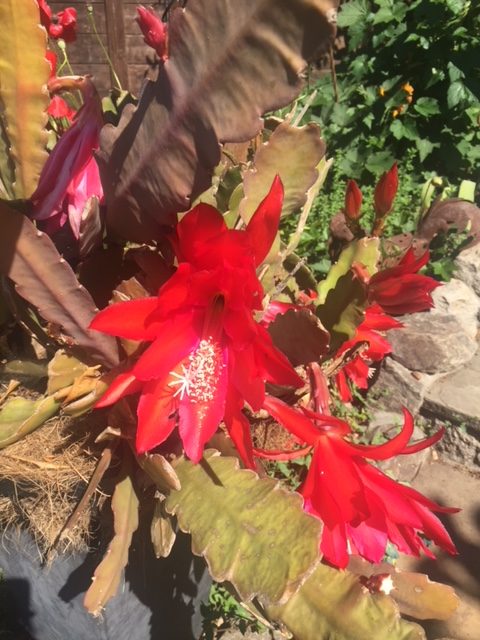
The Epiphyllum, an air plant, blooms once a year. The rest of the year it’s dull, flat brownish green. When it blooms, the whole garden glows.

One year, while auditing a class on prosody, I wrote a cinquain about it:

Bee in the Epiphyllun

From squat
slabs of cactus
they flame up, these giant
scentless siren calls. Even I
want in.


From the wine-red selvage of the west…

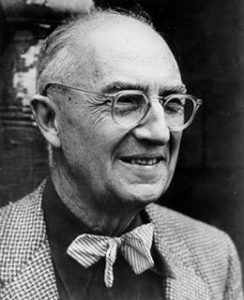
This poem by William Carlos Williams is new to me, arriving in my email from the American Academy of Poets. I like it especially because of the last lines, which I might be in myself. And I like this very dorky picture of him, too.

A Love Song

I lie here thinking of you:—

the stain of love
is upon the world!
Yellow, yellow, yellow
it eats into the leaves,
smears with saffron
the horned branches that lean
heavily
against a smooth purple sky! Continue reading “From the wine-red selvage of the west…” →

Those Polish Poets

World War II and Poland seemed to create a unique environment for poetry. That unfortunate Catholic country, smack between Russia and Germany,  produced dozens of wise, chastened, articulate writers, many of whose poems I’ve posted in the past. One I hadn’t read before is Ryszard Krynicki.  He mostly writes short, bitter, ironic poems, like salt on the rim of the glass:

Rights

–What rights?
do you mean?
The right to life?
You can’t extend it even by an instant,
though you’re dying of curiosity:
who won, who killed.
–The right to fight?
The right of the fittest comes first…
So you’re speaking not of human
rights, Continue reading “Those Polish Poets” →

Children’s Poetry

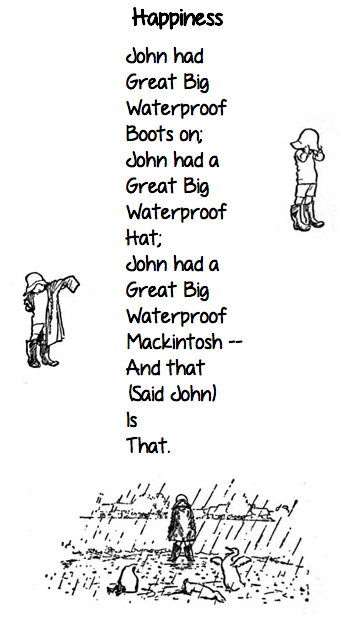
I’ve been thinking a lot about rhyme lately, how it’s almost impossible to write a contemporary poem with conventional rhyme, but songs and nursery rhymes still rely on rhyme. Children especially love rhyme, and some of my favorite children’s poetry is by A.A. Milne, who in addition to Winnie the Pooh, has two books of children’s verse, Now We Are Six and When We Were Very Young.

I was reciting these to my grandson the other day, to both of our delight:

Disobedience

James James				
Morrison Morrison			
Weatherby George Dupree			
Took great				
Care of his Mother			
Though he was only three.		
James James				
Said to his Mother,			
"Mother," he said, said he;		
"You must never go down to the end of the town, if
you don't go down with me."		


James James				
Morrison's Mother			
Put on a golden gown,			
James James				
Morrison's Mother			
Drove to the end of the town.		
James James				
Morrison's Mother			
Said to herself, said she:		
"I can get right down to the end of the town and be
back in time for tea."			

King John				
Put up a notice,			
"LOST or STOLEN or STRAYED!		
JAMES JAMES				
MORRISON'S MOTHER			
SEEMS TO HABE BEEN MISLAID.		
LAST SEEN				
WANDERING VAGUELY			
QUITE OF HER OWN ACCORD,		
SHE TRIED TO GET DOWN TO THE END OF	
THE TOWN - FORTY SHILLINGS REWARD!	


James James				
Morrison Morrison			
(Commonly known as Jim)			
Told his				
Other relations				
Not to go blaming him.			
James James				
Said to his Mother,			
"Mother," he said, said he,		
"You must never go down to the end of the town with-
out consulting me."			


James James				
Morrison's Mother			
Hasn't been heard of since.		
King John				
Said he was sorry,			
So did the Queen and Prince.		
King John				
(Somebody told me)			
Said to a man he knew:			
"If people go down to the end of the town, well, what
can anyone do?"				

(Now then, very softly)			
J. J.					
M. M.					
W. G. du P.				
Took great				
C/o his M*****				
Though he was only 3.			
J. J.					
Said to his M*****			
"M*****," he said, said he:		
"You-must-never-go-down-to-the-end-of-the-town-if-
you-don't-go-down-with ME!"
 

Monday poem

This was one of the poetry selections by the American Academy of Poets for Mother’s Day–it seems to me a sort of love poem from a mother to a teenage child. I like its strange title.

Hours Days Years Unmoor Their Orbits

tonight I’m cleaning baby portobellos
for you, my young activist

wiping the dirty tops with a damp cloth
as carefully as I used to rinse raspberries

for you to adorn your fingertips
before eating each blood-red prize

these days you rarely look me in the eye
& your long shagged hair hides your smile Continue reading “Monday poem” →

Poem in your pocket

3Poetry month just ended, and the Berkeley Library printed some wonderful poems by local poets. When soliciting work, they sent out a sample of last year’s choices and I liked this one by Ed Hirsch:

Cotton Candy

We walked on the bridge over the Chicago River
for what turned out to be the last time,
and I ate cotton candy, that sugary air,
that sweet blue light sun out of nothingness. Continue reading “Poem in your pocket” →

Essy Stone

Thanks to a workshop with David St. John, I heard about a poet who is currently his student at USC. Essy Stone’s book, What It Done to Us, is a group of gripping, tough poems that seem to be written by someone who came up hard and made something of it.

Here’s a sample. Reading it, I wondered if the title came from the Tracy Chapman song, but perhaps not.

Fast Car

At 15, you are skinny & never loved enough,
with the loss of it burning you up & pounding
between your ribs like your daddy’s heavy footsteps
as he comes up on your door. You bite holes
in the sleeves of a hand-me-down homeschooler’s sweatshirt
to sate this hunger, but it don’t fill you,
a little outsider in a brown land—brown without end,
full of brown horses & cattle & trees, the houses wooden
& their tin roofs rusted the same orange-brown
as the clay & the sunburnt skin of the people who live here,
while you try, oh, desperately, to coax something green
into being, to make a thing as green & new as yourself,
or if not green, if not alive, then shiny & mechanical
& humming along fast like your mama’s Singer, Continue reading “Essy Stone” →

Another Monday poem on Tuesday

At a workshop this weekend someone brought this poem, by Lynn Emanuel, and I remembered how much I like her work.

Why it took me so long to get the poem up here, I don’t know. The days seem to melt away. Perhaps I should take up drinking:

Frying Trout While Drunk

Mother is drinking to forget a man
who could fill the woods with invitations:
come with me he whispered and she went
in his Nash Rambler, its dash
where her knees turned green
in the radium dials of the 50’s.
When I drink it is always 1953,
bacon wilting in the pan on Cook Street
and mother, wrist deep in red water,
laying a trail from the sink
to a glass of gin and back.
She is a beautiful, unlucky woman
in love with a man of lechery so solid
you could build a table on it
and when you did the blues would come to visit.
I remember all of us awkwardly at dinner,
the dark slung across the porch,
and then mother’s dress falling to the floor,
buttons ticking like seeds spit on a plate.
When I drink I am too much like her—
the knife in one hand and the trout
with a belly white as my wrist.
I have loved you all my life
she told him and it was true
in the same way that all her life
she drank, dedicated to the act itself,
she stood at this stove
and with the care of the very drunk
handed him the plate.

Lynn Emanuel, from Hotel Fiesta