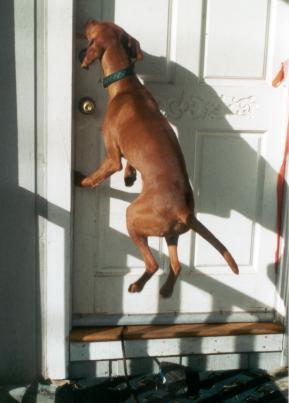
 At my piano lesson early this week, my teacher’s dog saw her dog friend and the dog’s owner pass by the window. She often walks with them, but not that day. It was hard for her to understand why they were going without her, and she pranced around unhappily, left behind. It made me think of this poem, from What the Living Do, by Marie Howe. The book deals (for the most part) with poems about her brother’s death. What I love about this one is it’s oblique approach to mourning.
Buddy
Andy sees us to the door, and Buddy is suddenly all over him, leaping
and barking because Andy said: walk. Are you going to walk home? he said.
To me. And Buddy thinks him and now, and he’s wrong. He doesn’t
understand the difference between sign and symbol like we do–the thing
and the word for the thing, how we can talk about something when it’s not
even there, without it actually happening–the way I talk about John.
Andy meant: soon. He meant me. As for Buddy, Andy meant: later. When he
was good and ready, he said. Buddy doesn’t understand. He’s in a state
of agitation and grief, scratching at the door. If one of us said, Andy,
when Andy wasn’t there, that silly Buddy would probably jump up barking
and begin looking for him.
Marie Howe
I memorized this poem years ago, but one line has always bothered me: “He doesn’t /
understand the difference between sign and symbol like we do” because it seems to me that sign and symbol are analogous, not opposites. I happened to take a workshop with Marie Howe and asked her about it, but her explanation didn’t make any sense to me. It still seems to me that the difference is between action and the symbol, “the thing / and the word for the thing.” What do you think?