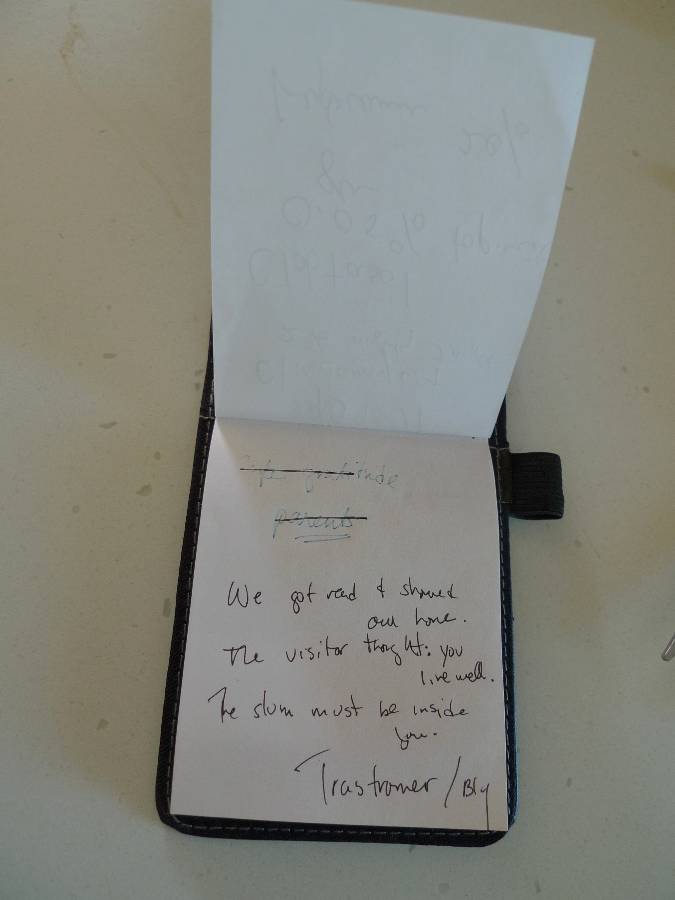
 Here are some notes from the little pad I keep inside my purse to capture the stray sentence or idea, or in Brenda Hillman’s words, to be a rancher of phrases. These are all the more pleasing to me because they are surrounded by directions, movie and book titles, stray phone numbers.
We got ready and showed our home.
The visitor thought: you live well.
The slum must be inside you.
… Tomas Tranströmer, “The Scattered Congregation” (translated by Robert Bly)
Words make things happen. We must weigh them carefully.
… Pascal Mercier, Night Train to Lisbon (see more of these)
Maybe he better get out of here
before it’s too late, but maybe too late
was what he wanted.
… Philip Levine
What a gulf between the self which experiences and the self which describes experience.
… Edmund Wilson, I Thought of Daisy
Of course, it’s easy to tell a story when it turns out well.
… Louise Glück, talking about a difficult period in her life when she was not writing.
This last reminds me of something I heard Marie Howe say that she learned from Stanley Kunitz (her mentor and also Louise Glück’s). We tell ourselves stories about our lives, and we tell the same story over and over. Sometimes, it helps to see a different story. She said she wrote this poem after turning a story inside out. It’s one of my favorites of hers from What the Living Do:
The Attic
Praise to my older brother, the seventeen-year-old boy, who lived
in the attic with me an exiled prince grown hard in his confinement,
bitter, bent to his evening task building the imaginary building
on the drawing board they’d given him in school. His tools gleam
under the desk lamp. He is as hard as the pencil he holds,
drawing the line straight along the ruler.
Tower prince, young king, praise to the boy
who has willed his blood to cool and his heart to slow. He’s building
a structure with so many doors its finally quiet,
so that when our father climbs heavily up the attic stairs, he doesn’t
at first hear him pass down the narrow hall. My brother is rebuilding
the foundation. He lifts the clear plastic of one page
to look more closely at the plumbing,
–he barely hears the springs of my bed when my father sits down–
he’s imagining where the boiler might go, because
where it is now isn’t working. Not until I’ve slammed the door behind
the man stumbling down the stairs again
does my brother look up from where he’s working. I know it hurts him
to rise, to knock on my door and come in. And when he draws his skinny arm
around my shaking shoulders,
I don’t know if he knows he’s building a world where I can one day
love a man–he sits there without saying anything.
Praise him.
I know he can hardly bear to touch me.
Marie Howe
hey Meryl,
What about the Gluck poem? The one clipped from the NYTimes?
Tower prince, young king, praise to the boy
who has willed his blood to cool and his heart to slow.
I love these words. They bring to mind, my own brother, adolescent,
and tormented by a reckless father. One thing, his domain was a
basement bunker.
Basement or attic, young prices endure as best they can until they can overthrow the king.
I love how she has turned the story around so that she can praise him…
“The exhilarated tragic experience” He wrote, “is for me the only source of art.”
MARK ROTHKO
But what is that exactly–the exhilarated tragic experience?
It has it’s root in madness. I have experienced it. It’s a desperate head long plunge. Could be just a tiny unhinging or a complete breakthrough of a previously stalled state.
it’s not random or unfocused. You need to return to sanity to make use of your findings. Thats what it means to me. Very fragile findings, ghosty. Now our man Rothko could have meant something completely different.
Thanks for explaining–although I’ve had breakthroughs of stalled states, and tiny unhingings galore, perhaps “exhilarated tragedy” is an experience I haven’t had. So it would be sad if that’s the only source of art. I’m glad he used the “for me,” modifier.
yeah, the modifer, is the thing. Important for the idea to work. I often like a passage or sentence, it just hits me like a dart, quick, sharp stinger. I may take it in entirely the wrong way, but what can I do, it still moved me.