Opinionated cooks

Some of the most charmingly biased writing can be found in the prose of great cooks. Here is Marcella Hazan’s aria on vegetables:
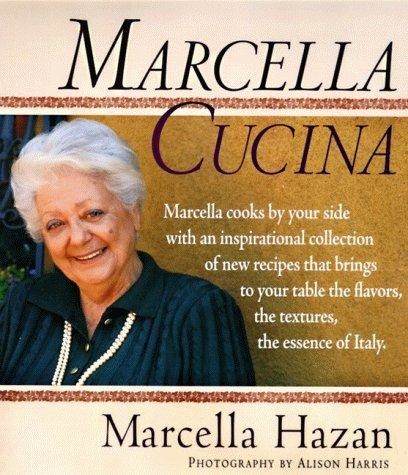
“Perhaps one day the vitality of these still-flourishing markets will be replaced by the pallor of deep-freeze counters, those cemeteries of food, where produce is sealed up in waxed boxes marked, like some tombstones, with photographs of the departed. But I hope it never happens. I would sooner be deprived of all the marvels of Michelangelo.

“The quality of Italy’s produce is matchless. Only that of France comes close…Do not waste your efforts on second-rate materials. Buy carefully, avoiding any vegetable that is wilted, badly bruised, ill assorted, tired-looking, soggy, flabby, or overgrown.  Shopping for good fresh vegetables in this country may be frustrating at times, bit that does not mean we must deliver ourselves up in thralldom to the frozen-food shelves.”

Or the final paragraph of her page-long disquisition (worth reading!) on Parmesan cheese: “The recipes in this book call for freshly grated Parmesan cheese.  Do not under any circumstances use ready-grated cheese sold in jars. Even if this commercially grated cheese were of good quality, which it is not, it would have lost all its flavor long before getting to the market. It is of no interest whatever to Italian cooking.”
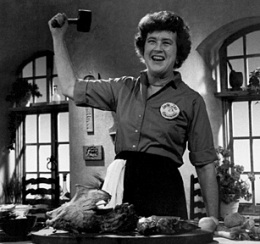
Here’s Julia Child on wine: “Food, like the people who eat it, can be stimulated by wine or spirits. And, as with people, it can also be spoiled…If you have not a good wine to use, it is far better to omit it, for a poor one can spoil a simple dish and utterly debase a noble one.”

And here’s Elizabeth David on the same subject: “Nobody has ever been able to find out why the English regard a glass of wine added to a soup or stew as a reckless foreign extravagance and at the same time spend pounds on bottled sauces, gravy powders, soup cubes, ketchups and artificial flavorings. (She adds a long footnote on the poisonous nature of these flavorings, which employ putrid cheese, gas tar and nitric acid.) If every kitchen contained a bottle each of red wine, white wine and inexpensive port for cooking, hundreds of store cupboards could be swept clean for ever of the cluttering debris of commercial sauce bottles and all synthetic aids to flavoring…Sherry is a good addition, but should be used in cooking with the utmost discretion; it is useless to think that the addition of a large glass of poor sherry to the contents of a tin of soup is going to disguise it.”

And I love David’s short paragraph at the end of her “Batterie de Cuisine” section, after she has spent five or six pages detailing essential kitchen tools: “Some sensible person once remarked that you spend the whole of your life either in your bed or your shoes. Having done the best you can by shoes and bed, devote all the time and resources at your disposal to the building up of a fine kitchen. It will be, as it should be, the most comforting and comfortable room in the house.”

If I were ever to teach writing again, I’d include excerpts from these writers along with my favorite essays of George Orwell and Adam Gopnik and some of William Logan’s biting, accurate, and fearless evisceration of contemporary poets (analysis and praise, too, when warranted). The command of grammar (Marcella Hazan, not even a native speaker, makes excellent use of the subjunctive, and Elizabeth David uses the slippery semi-colon perfectly), the passion and the richness of their prose make reading their books not only instructive but pure pleasure for those who love words as much as food.

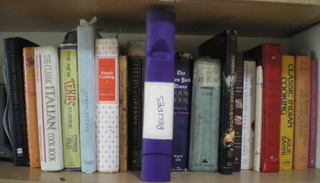
In case you might want to create the syllabus for such a ravishing course, the selections above are from The Classic Italian Cookbook, Marcella Hazan; Mastering the Art of French Cooking, Volume One, Julia Child, Louisette Bertholle, Simone Beck; and French Country Cooking, Elizabeth David. From Orwell’s essays I’d include “How the Poor Die,” “Some Thoughts on the Common Toad,” “Revenge is Sour,” “Reflections on Ghandi,” and “Such, Such Were the Joys,” in addition the much anthologized (but perhaps slightly too didactic “Politics and the English Language.” Some of these are hard to find, but available in the four volume set of letters and essays, which is worth owning. My favorite Gopnik essays include “Last of the Metrozoids,” “The Rules of the Sport,” “Barney in Paris,” and “Bumping Into Mr. Ravioli.” These are available in Paris to the Moon and Through the Children’s Gate: A Home in New York. You can often find William Logan’s criticism online in “The New Criterion,” as well as his books: Our Savage Art: Poetry and the Civil Tongue and The Undiscovered Country: Poetry in the Age of Tin.

 

Peas and poetry

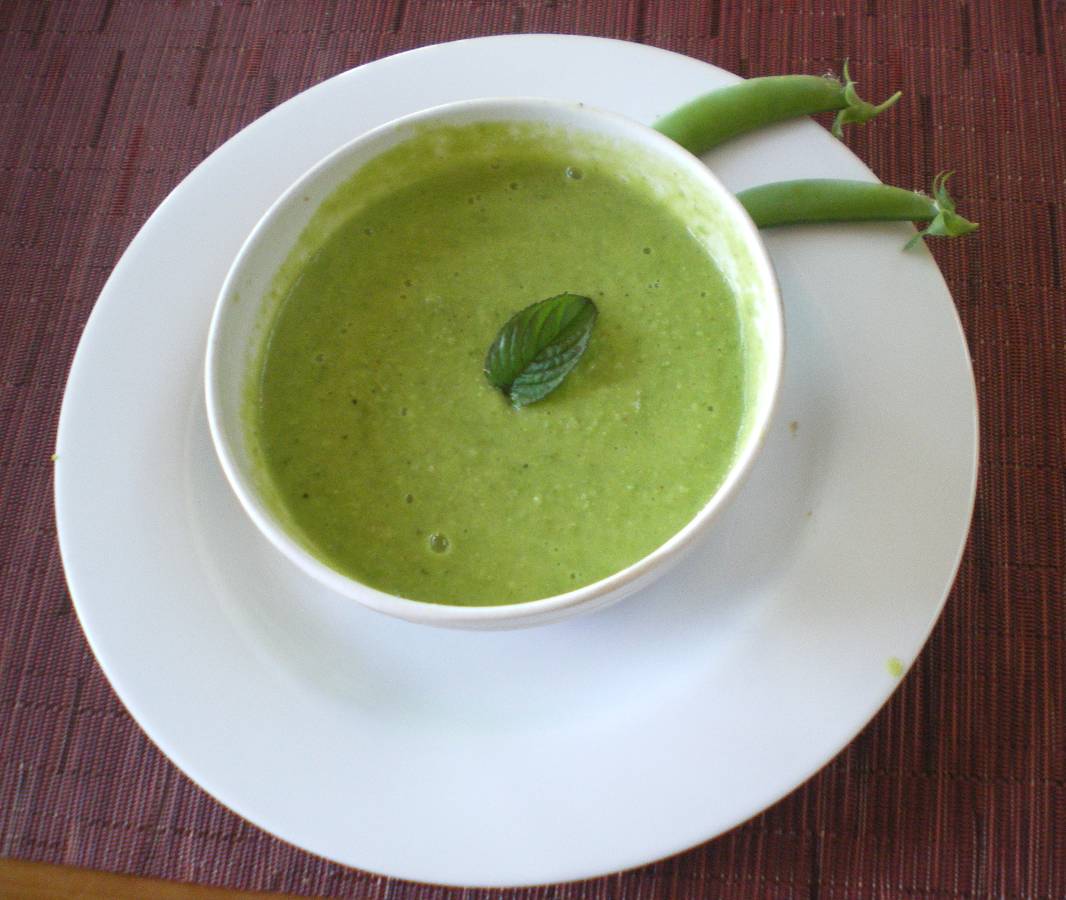
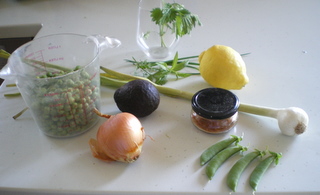
I saw what looked like an irresitable recipe for fresh pea soup on jfeldt’s blog, Progress and Procrastination. As it’s the season of fresh peas, I decided to try it with excellent results.  It turned out every bit as enchanting a green the original. I made a few modifications to the recipe, so repeat it below. The virtues of this recipe include:

  • takes about 10 minutes start to finish (not counting shelling the peas)
  • is a delectable green color
  • tastes fabulous and is relatively low calorie

Fresh Pea Soup

1 onion, chopped
1 to 2 cloves garlic or ½ a green garlic head, crushed
1 Tbsp olive oil
2 3/4 Cups fresh peas (you can use frozen)
small handful of herbs (I used thyme, lemon verbena and garlic chives)
1 avocado
1 Cup water
1 Tbsp lemon juice
2 tsp fresh ground pepper
1 tsp salt
1 tsp cayenne pepper

Put the olive oil in a saucepan and heat. Add chopped onion and garlic and cook gently till softened but not brown (2-3 minutes) Place frozen peas in on top of the onion and garlic, add herbs, and just cover with water. (I didn’t use vegetable stock because I thought it might ruin the green color.) Bring to a boil until peas are bright green and al dente (about 5 minutes).

Add all to blender with the avocado and 1 cup of water and liquefy. Return puree saucepan and add salt, pepper, cayenne, and lemon juice. Stir constantly until just boiling. Serve warm.   I put a mint leaf on top just for fun. Mint might be a good addition.

Several years ago, I heard an NPR broadcast about Gregor Mendel and wrote this poem about him and his peas and his bees. It occurs to me that I now also have both bees and peas, though not with the same objectives!

Sexing the Pea

Mendel in his monk’s robes strolled
amid hermaphroditic peas, tweezed open
each pea flower keel, snipped filament and anther
and shoved the pollen deep into the womb
of his pocket.  Then, bending to the female
flower parts—not yet sticky, immature—
he twisted over stigma, style and ovary
a calico cap, to protect the pea’s virginity.

Pudgy, stooped above his flowery flock,
he chose the moment and the father strain
for each sweet pea. He touched
each fragile, trembling pistil
with his tiny brush. When the flowers
turned to fruit, he sorted out
three hundred thousand peas.

His single published text, eye-crossed
with figures, was ignored for almost forty years.
But Mendel spent his sun-blessed days
amid the odor of pea blossom,
deep in the unembarrassed sex of flower and bee,
and puzzled out the logic of genetics,
before we had the word for gene.

Meryl Natchez

Rainy day soup

This is a strange, rainy month here in Northern California—usually the rain stops mid-March except for a shower or two, and doesn’t start up again until October or November. But this year, it’s as if the Monsoon keeps drifting across the Pacific. It just isn’t stopping.

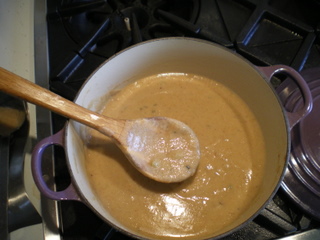
Because it was so cold and wet, I decided to make soup, looked at what was around and came up with a really yummy roasted garlic and cauliflower soup.


1 small cauliflower, washed and sliced
1 head garlic
oil or coconut ghee
1 leek
1 small onion
6 or 7 crimini mushrooms, sliced
1 very small potato, peeled and sliced thin
handful of fresh peas, shelled
juice of half a lemon
good splash of sherry
½ teaspoon of fresh ginger
chopped chervil and chives (about a tablespoon)
salt, pepper
stock and/or water

Heat oven to 425 degrees. Put the cauliflower slices in a bowl and coat with oil or melted ghee. Spread the cauliflower on a baking sheet on a Silpat or tin foil. Oil a head of garlic and put it on there, too. Set them in the oven to brown (about 20-30 minutes).

While they are roasting, slice the leek, the onion, the mushrooms and sauté them in a heavy saucepan over medium heat in just enough oil to cover the bottom of the pan.  Add some salt, grate in the ginger. Stir as they brown, and when they are lightly browned (about 5-10 minutes, depending on your heat), add the sherry to deglaze the pan.  Once the alcohol has boiled off, add the lemon juice. Take about half the vegetables out and reserve them. Add the potato and about 4 cups of stock (I used a handful of chicken stock ice cubes and about 2 cups of water, but you can use plain water or vegetable stock). Simmer while the cauliflower and garlic roast in the oven.

Once the cauliflower is lightly browned (the small pieces may brown first, if so, take them out and add them to the soup), add all the cauliflower to the soup and continue to simmer while the garlic cools.  Squeeze out the garlic from the peels into a blender. Add about ¼ of the soup. Blend till smooth.  Add the rest of the soup (you may need to do this in two batches; it just about fit in my blender). Once everything is blended and smooth, return the soup to the pot. If the soup is too thick, add some more stock or water—it should be creamy but not too thick.  Add the reserved onion/leek/mushroom mix, and the shelled peas.  Add the herbs.  Taste and add salt and pepper as needed. Simmer another few minutes.

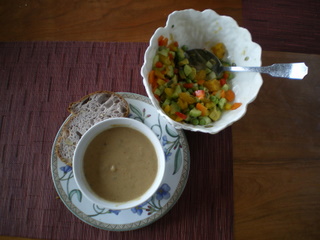
A wonderful cure for spring chill.  I served with slices of whole wheat walnut levain and a salad.  The sherry was Larry’s idea, and a really good one. When I asked him to taste the soup to see if it needed anything, he said, “It needs to be in a bowl.”  I agree!

Pear Tart and Poetry


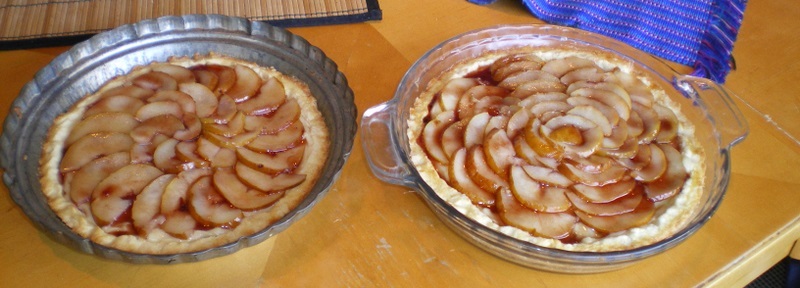
I’ve written a lot about food and cooking, and wrote this poem after
making a Julia Child tart.

Loaves and Fishes

This weekend, while I poach the perfect pears
in wine and sugar and ginger,
while I bake paté brisée, whip
crème anglaise with its spice-imbued milk,
carefully slice crescents of cooled, softened pear,
and layer them in geometric circles,
armies of hungry children roam the streets
for trash to eat
somewhere far from here.

I know they’re out there.
My whole generation had to finish
what was on our plates
because children were starving
in India, as if we had to eat
for everyone.

If I could, I would take
this perfect tart and transform it
into loaves and fishes. I don’t pretend
to understand why it’s fallen to me,
this cornucopia of succulent fruit,
of scapes and green garlic, tender baby
lettuces spread on folding tables
at outdoor markets four days a week,
while others probe gutters for crusts.

I think if I were out there, scrabbling
for enough to eat, I would be cunning
and merciless. I would be one
who survives.

Meryl Natchez

Cheap Eats

It occurs to me that along with a ruinous national debt, we’re leaving our children untold reams of blather that they’ll have to pick through to find any useful advice. So I’m going to post at least some practical information here. For example, how to eat very well and very cheaply, assuming you cook at all. The key is good stock. Stock is simple, it’s made from the cheapest meat and vegetable matter you can buy, and you can freeze it and add it to beans, rice, sauces, or make tasty soup or stew quickly.

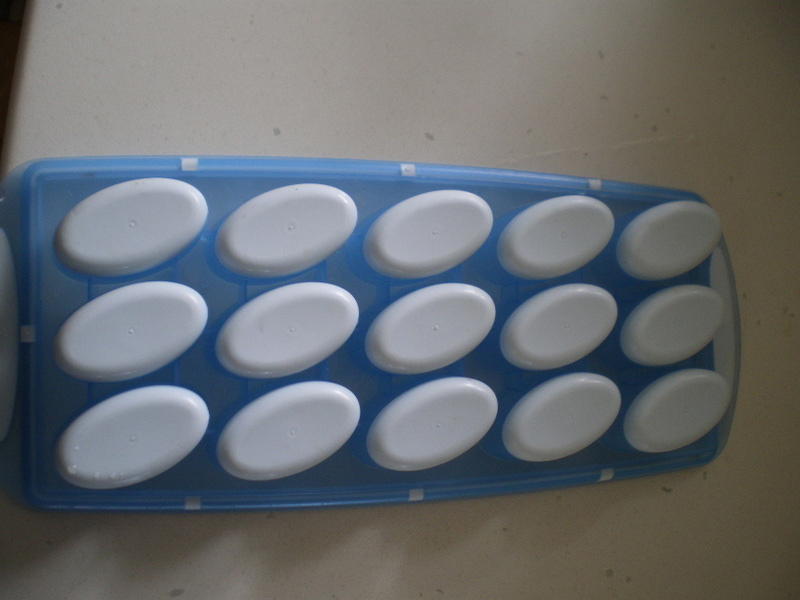
I’ve read a lot of recipes for stock, but you don’t need a recipe. You can make it from almost anything. Chicken stock is my favorite because it’s light and versatile—and Jewish penicillin, of course. If you don’t have a place where you can buy chicken feet or necks or other bony pieces, you can start with the bones of cooked chicken you’ve eaten (even from KFC) and maybe some wings or thighs. Take a couple of pounds of bones and meat and add enough water to cover them along with a tablespoon or two of vinegar. Bring to a simmer, and then lower to just below boiling. Cook for awhile—at least an hour, but more if you like. Then add vegetables. These can be trimmings—the skins and roots and stalks and greens of onions, carrots, celery—the parts you would throw away. You can (one of my favorite methods) just keep your pot on the back of the stove, and throw in the leavings from whatever vegetables you’re using, and bring it to the almost boil for at least 15 minutes a day over a few days time. Or if you’re in a hurry and want to make good stock fast, cut up and add a whole onion, a couple of carrots, some celery, whatever, leaves, peels, etc.  Cook for at least an hour, but no upward limit really.  You can ladle out some stock and strain it into whatever you’re making. For example, put a ladle full of stock into your rice water to add flavor.  Or you can decide you’re done. Then strain the stock, and let it cook down to concentrate (without actually boiling). If it’s fatty, let it cool in the fridge overnight and peel off the top layer of fat. They heat it slightly, put it in ice cube trays, and freeze it.  You have cubes of instant flavor.

There are now great covered ice cube trays with rubbery bottoms that make it easy to pop out a cube or two or twelve whenever you want to make sauce or stew or add flavor to anything on the stove. You can buy these from Amazon—is it still ok to buy from Amazon? they seem to own the world.

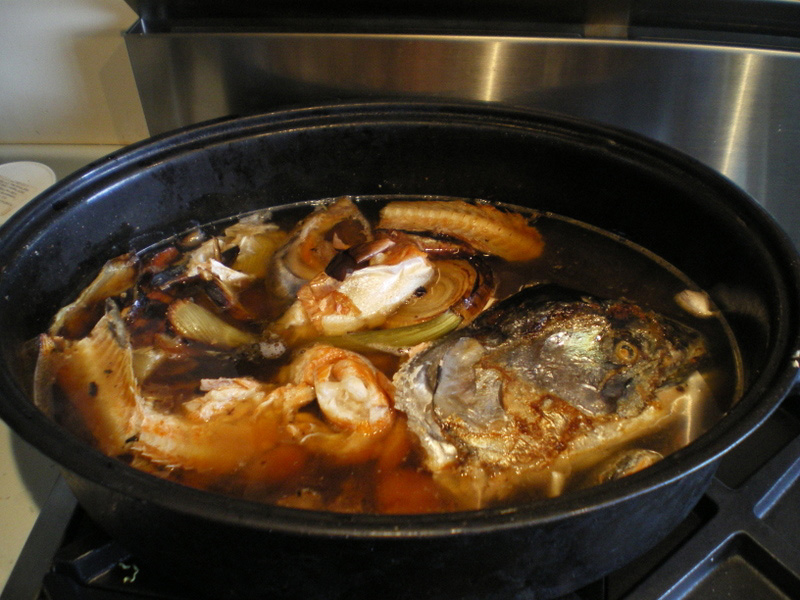
If you like beef stock, do the same thing with beef bones; for fish, use heads and tails. You can make plain vegetable stock the same way, just no bones or vinegar. Corn cobs are a great addition to stock, the hearts of celery or cauliflower, carrot tops, onion skins. I’ve even thrown in avocado skins.

If you like your stock rich and dark, roast whatever you’re starting with in the oven for about 45 minutes at 425 degrees first, so it slightly carmelizes before you start simmering (nice to add at least one whole onion). That’s what I did with the fish in this picture.

The only somewhat gross thing about stock is getting rid of the remains that you’ve strained out. These can get smelly if you don’t get them out of the house, especially if you’re using fish heads and tails. More about this when I show you my amazing compost blaster. But this is enough practicality for one day.