An essay or a prose poem?

This was listed as an essay in Five Points journal, but I think of it as a prose poem:

What I Think About When Someone Uses “Pussy” as a Synonym for “Weak”

At the deepest part of the deepest part, I rocked shut like a stone. I’d climbed as far inside me as I could. Everything else had fallen away: Midwife, husband, bedroom, world: quaint concepts. My eyes were clamshells. My ears were clapped shut by the palms of the dead. My throat was stoppered with bees. Continue reading “An essay or a prose poem?”

Heat by Hirshfield

Your Monday poem on Wednesday, by Jane Hirshfield, Worth the wait, I hope.

Heat

My mare, when she was in heat,
would travel the fenceline for hours,
wearing the impatience
in her feet into the ground.

Not a stallion for miles, I’d assure her,
give it up.

She’d widen her nostrils,
sieve the wind for news, be moving again,
her underbelly darkening with sweat,
then stop at the gate a moment, wait
to see what I might do. Continue reading “Heat by Hirshfield”

A little perspective

It’s hard not to feel that things are worse now than they’ve ever been. But looking back at the fifties, I remember feeling they were pretty terrible then. This poem, from that period by Robert Lowell, gives a good description of that feeling:

Skunk Hour

(for Elizabeth Bishop)

Nautilus Island’s hermit
heiress still lives through winter in her Spartan cottage;
her sheep still graze above the sea.
Her son’s a bishop. Her farmer is first selectman in our village;
she’s in her dotage.

Thirsting for
the hierarchic privacy
of Queen Victoria’s century
she buys up all
the eyesores facing her shore,
and lets them fall.

The season’s ill–
we’ve lost our summer millionaire,
who seemed to leap from an L. L. Bean
catalogue. His nine-knot yawl
was auctioned off to lobstermen.
A red fox stain covers Blue Hill. Continue reading “A little perspective”

From Tony Hoagland’s new book

There is nothing to say about this poem–just buy the book.
The Age of Iron

When I see an ironing board
folded in the closet of a motel room,
and the iron resting like a sledgehammer on the shelf above,

I think of the Age of Iron
and my mother standing in the kitchen,
folding clothes on the green table,
a bottle if spray starch at her elbow, not even the radio on—

Continue reading “From Tony Hoagland’s new book”

Of resolutions and poetry

I have a system for New Year’s resolutions that works well for me: Aim small and succeed. I’ve discussed this before.  But to update the list, I’ve since added: drive courteously (three years ago), no movie theater popcorn (two years ago), and better socks (last year). I’m still working on last year’s resolution, slowly replacing my ragtag collection with better socks, so I don’t need a new resolution this year.

The point is that these resolutions seem to last, not just for a year, but integrated into my life–unlike the grand, doomed resolutions I used to make. Of course, I have many projects and activities planned for 2018, both personal and political, but these are not resolutions, but practice.

I am also pleased that most Mondays for over six years, I’ve found and posted a poem I like. I almost always post poems that are contemporary, or at least 20th century. But last week Larry received a packet of broadsides that included one of my favorite poems by John Donne. So here is your New Year’s vitamin. It is the opening of the second stanza that I love most:

The Good-Morrow

I wonder, by my troth, what thou and I
Did, till we loved? Were we not weaned till then?
But sucked on country pleasures, childishly?
Or snorted we in the Seven Sleepers’ den?
’Twas so; but this, all pleasures fancies be.
If ever any beauty I did see,
Which I desired, and got, ’twas but a dream of thee.

And now good-morrow to our waking souls,
Which watch not one another out of fear;
For love, all love of other sights controls,
And makes one little room an everywhere.
Continue reading “Of resolutions and poetry”

About angels

It’s that season–all the old cliches brought out with music and glitter. On that note, there are very few poems that contain angels that are not overwrought, too fanciful or just plain schmaltz. But this, by B. H. Fairchild, avoids all that:

Angels

Elliot Ray Neiderland, home from college
one winter, hauling a load of Herefords
from Hogtown to Guymon with a pint of
Ezra Brooks and a copy of Rilke’s Duineser   
Elegien on the seat beside him, saw the ass-end
of his semi gliding around in the side mirror
as he hit ice and knew he would never live
to see graduation or the castle at Duino. Continue reading “About angels”

From Berkeley’s Lunch Poems

I went to hear Rita Dove, a former US Poet Laureate, read at the UC Berkeley Lunch poems series this week.  Here is one of her poems:
Exit

Just when hope withers, the visa is granted.
The door opens to a street like in the movies,
clean of people, of cats; except it is your street
you are leaving. A visa has been granted,
“provisionally”-a fretful word.
The windows you have closed behind
you are turning pink, doing what they do
every dawn. Here it’s gray. The door Continue reading “From Berkeley’s Lunch Poems”

Rainy Monday

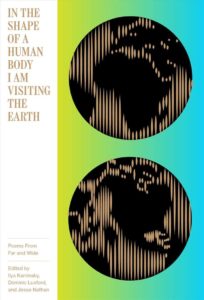
Rain seems so appropriate at the end of a holiday weekend, but this Monday poem is not about rain, but a selection from a new anthology I just finished reviewing for ZYZZYVA, In the Shape of a Human Body I Am Visiting the Earth: Poems Far and Wide, published jointly by McSweeney’s and Poetry International. The review will appear soon on their blog. In the meantime, here is the title poem:

In the shape of a human body I am visiting the earth

In the shape of a human body
I am visiting the earth;
the trees visit
in the shapes of trees.
Standing between the onions
and the dandelions
near the ailanthus and the bus stop,
I don’t live more thoroughly
inside the mucilage of my own skull
than outside of it
and not more behind my eyes
than in what I can see with them. Continue reading “Rainy Monday”

Of Jazz and Poetry

We are back home, and happy to find that David Juda has completed a wonderful project of posting poems and music from For Jazz on his website, Voetica.

Just click on an artist to see and listen. This area of the site features woodcuts by Nina Mera, poetry by Peter McSloy, and accompanying music by jazz greats.

This site is a terrific resource to hear many recordings of contemporary and significant poems from the past.  With a background in theater, David has found extraordinary talent and there are new additions all the time. Worth going back to many times.

A sonnet?

Photo by Milos Bicanski/Getty Images for Homefront TV

Troy Jollimore used this poem by A. E. Stallings to illustrate what the modern sonnet can do. Even though the lines are short, and the “turn” comes at line three, it does seem like a sonnet:


Fire Safety Drill

It ought to be easy to learn:
Freeze, drop where you stand,
And roll yourself in a rug;
But acting as you’ve planned
When the glib tongue licks your hair
Or rubbles up your sleeve
Is difficult—the tug
Of heat unravels thought—
And all that you were taught
Comes brilliantly undone.
And in the moment’s flare
Somehow you believe
That it can be outrun,
And you’ve got time to burn.

A. E. Stallings

Making an enemy?

I hope not, but I am going to repost a poem here from the poem-a-day feature of the Academy of American poets. Reading it, I had an idea about what I would suggest were I an editor and this poem came to me. But poets are rarely open to suggestions as radical as mine. Editing others’ work as I see it is part of my belief that poets are all really working on one big quilt of words, and it’s important to be open to others thoughts about one’s particular needlework. Of course, it’s easier to be open to editing others’ work than to accept suggestions about one’s own.

In any case, here is the poem as written, followed by my suggestion.

Early Fall

Rain decays dawn—
everything in the yard

leaning, beaded, broken in.
A lucid dream

the weather
assembles; a pain particular

as light seeping
into an alley

narrowed by overgrowth.
To articulate what slips

the instant
speech moves

to apprehend it.

Cinder blocks stacked
by a metal shed door

totem-like
in haze

of evaporated rain.

Joseph Massey

My suggested edit: Continue reading “Making an enemy?”