Raw

In a workshop once, Marie Howe suggested: write a poem from the point of view of someone who throws trash out the car window. Nobody could. But here Frank Bidart manages a harder task–write a poem in the voice of a pedophile.

Herbert White

“When I hit her on the head, it was good,

and then I did it to her a couple of times,—
but it was funny,—afterwards,
it was as if somebody else did it…

Everything flat, without sharpness, richness or line.

Still, I liked to drive past the woods where she lay,
tell the old lady and the kids I had to take a piss,
hop out and do it to her…

The whole buggy of them waiting for me
made me feel good;
but still, just like I knew all along,
she didn’t move.

When the body got too discomposed,
I’d just jack off, letting it fall on her…

—It sounds crazy, but I tell you
sometimes it was beautiful—; I don’t know how
to say it, but for a minute, everything was possible—;
and then,
then,—
well, like I said, she didn’t move: and I saw,
under me, a little girl was just lying there in the mud:

and I knew I couldn’t have done that,—
somebody else had to have done that,—
standing above her there,
in those ordinary, shitty leaves…

—One time, I went to see Dad in a motel where he was
staying with a woman; but she was gone;
you could smell the wine in the air; and he started,
real embarrassing, to cry…
He was still a little drunk,
and he asked me to forgive him for
all he hadn’t done—; but, What the shit?
Who would have wanted to stay with Mom? with bastards
not even his own kids?

I got in the truck, and started to drive,
and saw a little girl—
who I picked up, hit on the head, and
screwed, and screwed, and screwed, and screwed, then

buried,
in the garden of the motel…

—You see, ever since I was a kid I wanted
to feel things make sense: I remember

looking out the window of my room back home,—
and being almost suffocated by the asphalt;
and grass; and trees; and glass;
just there, just there, doing nothing!
not saying anything! filling me up—
but also being a wall; dead, and stopping me;
—how I wanted to see beneath it, cut

beneath it, and make it
somehow, come alive…

The salt of the earth;
Mom once said, ‘Man’s spunk is the salt of the earth…’
—That night, at that Twenty-nine Palms Motel
I had passed a million times on the road, everything

fit together; was alright;
it seemed like
everything had to be there, like I had spent years
trying, and at last finally finished drawing this
huge circle…

—But then, suddenly I knew
somebody else did it, some bastard
had hurt a little girl—; the motel
I could see again, it had been

itself all the time, a lousy
pile of bricks, plaster, that didn’t seem to
have to be there,—but was, just by chance…

—Once, on the farm, when I was a kid,
I was screwing a goat; and the rope around his neck
when he tried to get away
pulled tight;—and just when I came,
he died
I came back the next day; jacked off over his body;
but it didn’t do any good…

Mom once said:
‘Man’s spunk is the salt of the earth, and grows kids.’

I tried so hard to come; more pain than anything else;
but didn’t do any good…

—About six months ago, I heard Dad remarried,
so I drove over to Connecticut to see him and see
if he was happy.
She was twenty-five years younger than him:
she had lots of little kids, and I don’t know why,
I felt shaky…
I stopped in front of the address; and
snuck up to the window to look in…
—There he was, a kid
six months old on his lap, laughing
and bouncing the kid, happy in his old age
to play the papa after years of sleeping around,—
it twisted me up…
To think that what he wouldn’t give me,
he wanted to give them…

I could have killed the bastard…

—Naturally, I just got right back in the car,
and believe me, was determined, determined,
to head straight for home…

but the more I drove,
I kept thinking about getting a girl,
and the more I thought I shouldn’t do it,
the more I had to—

I saw her coming out of the movies,
saw she was alone, and
kept circling the blocks as she walked along them,
saying, ‘You’re going to leave her alone.’
‘You’re going to leave her alone.’

—The woods were scary!
As the seasons changed, and you saw more and more
of the skull show through, the nights became clearer,
and the buds,—erect, like nipples…

—But then, one night,
nothing worked
Nothing in the sky
would blur like I wanted it to;
and I couldn’t, couldn’t,
get it to seem to me
that somebody else did it…

I tried, and tried, but there was just me there,
and her, and the sharp trees
saying, ‘That’s you standing there.
You’re…
just you.’

I hope I fry.

—Hell came when I saw
MYSELF…
and couldn’t stand
what I see…”

Frank Bidart
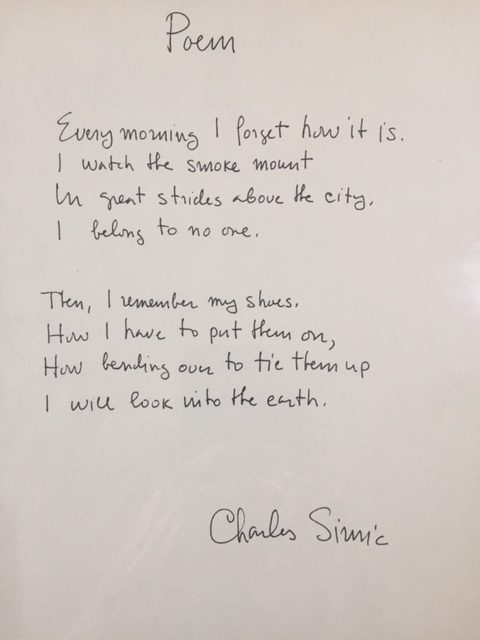
Ilya Kaminsky

A fellow poet recommended his work to me, and I have been reading his book, Dancing in Odessa. Here’s a poem from that book that I really like:
Envoi

xxxxxxxxxxxxxxYou will die on a boat from Yalta to Odessa.
xxxxxxxxxxxxxxxxxxxxxxxxxxxxxxxxxxxxxxx–a fortune teller, 1992

What ties me to this earth? In Massachusetts,
the birds force themselves into my lines–
the sea repeats itself, repeats, repeats.

I bless the boat from Yalta to Odessa
and bless each passenger, his bones, his genitals,
bless the sky inside his body,
the sky my medicine, the sky my country.

I bless the continent of gulls, the argument of their order.
The wind, my master
insists on the joy of poplars, swallows,– Continue reading “Ilya Kaminsky”

Waking to fog

After two summery days in a row the fog is back. It made me think of this by Marvin Bell:

People Walking in Fog

They try to watch themselves, drifting in a white sigh,
the boats and trees, themselves, too,
when they think of it, spun from sheets of gauzy droplets
with which to tar the morning white and walk upon it.
The horizon yawns. The earth is liquid. They can feel
it, and not just it but the blanket meaning of it.
Here, bravado is the pretense of the immortal
before the infinite. There being no other side,
they just surrender to this, seeing they cannot
see far, find a door, hack a hole, or mark a spot.
Goats love fog. Parked lovers and beachcombers
love fog, and those who fear the authorities,
and the camera-shy love it, and they adore it
who wish to be wrapped in beauty so delicate
one must step outside to be able to see it.

Marvin Bell, from Mars Being Red

New work and old

I’m going to be reading at the Tiburon-Belvedere Library this Thursday, the 17th, at 7 pm. Mostly, I’m going to read new work. I’ve been writing some prose poems inspired by Carlo Rovelli’s wonderful books on physics. I’m including one here. But you can also see some of my older work (and some interesting work by others) at this site, created by Beate Sigriddaughter.

Here’s the prose poem:

Lying on the massage table at the mudbaths

after 12 minutes immersed in a tub of hot volcanic mud and 12 minutes in a bath of hot mineral water my heart thumps against the padded surface and I remember that I have a heart that I am a thermodynamic system that chugs along with little conscious thought blood in blood out every artery vein tiny capillary breathe in leafy oxygen and breathe out CO2 and I understand with my hot pumping body that we exist in relation to every other thing that we weave together a universe of beginnings and endings in a ever changing reality composed of individual particles that know nothing of heat or up or before or tomorrow that what I call self is inextricable from the body here on this table the flannel blanket absorbing particles of me as I slowly cool the new age music bothering my sensibility like a persistent gnat the laugh track last night on the episode of Friends the forgotten French vocabulary and Pythagorean Theorem the anxieties waiting to swarm when I return to my usual state every encounter and memory since my small hot self emerged on this planet till the engine finally stops and I cool for good and the cells of me transform into earth ash air as my spirit into yours as you read these words

Back from camping

I forgot to hang out my “Gone Camping” sign this year but now I’m back with a poem today from a book my granddaughter is reading, Milk and Honey, by Rupi Kuar. She cautioned me that some of the poems are “pretty rough.”
Here is the poem she selected:

you tell me to quiet down cause
my opinions make me less beautiful
but i was not made with a fire in my belly
so i could be put out
i was not made with a lightness on my tongue
so i could be easy to swallow
i was made heavy
half blade and half silk
difficult to forget and not easy
for the mind to follow

rupi kuar


Cherries

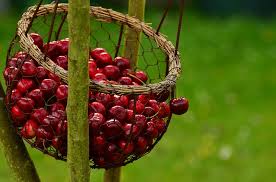
While there are many wonderful blackberry poems,  I know only three poems about cherries, all from previous centuries–one by Thomas Campion, one by Robert Herrick, and this one, by D. H. Lawrence, that Larry mentioned as we were eating the exceptionally sweet cherries of this summer:

The Cherry Robbers

Under the long, dark boughs, like jewels red
In the hair of an Eastern girl
Shine strings of crimson cherries, as if had bled
Blood-drops beneath each curl.
Continue reading “Cherries”

Maggie Smith on Monday

I happened on this poem last week, and here it is for you:

Good Bones

Life is short, though I keep this from my children.
Life is short, and I’ve shortened mine
in a thousand delicious, ill-advised ways,
a thousand deliciously ill-advised ways
I’ll keep from my children. The world is at least
fifty percent terrible, and that’s a conservative
estimate, though I keep this from my children.
For every bird there is a stone thrown at a bird.
For every loved child, a child broken, bagged, Continue reading “Maggie Smith on Monday”

Monday on Tuesday

Once again, Monday slipped by me before I could post a poem, here are two worth waiting for. Everyone thinks of Philip Levine as the poetic champion of the blue-collar worker, but I vote for Dorianne Laux.

The Shipfitter’s Wife

I loved him most
when he came home from work,
his fingers still curled from fitting pipe,
his denim shirt ringed with sweat
and smelling of salt, the drying weeds
of the ocean. I’d go to where he sat
on the edge of the bed, his forehead
anointed with grease, his cracked hands
jammed between his thighs, and unlace
the steel-toed boots, stroke his ankles
and calves, the pads and bones of his feet.
Then I’d open his clothes and take
the whole day inside me — the ship’s
gray sides, the miles of copper pipe,
the voice of the foreman clanging
off the hull’s silver ribs. Spark of lead
kissing metal. The clamp, the winch,
the white fire of the torch, the whistle,
and the long drive home.


Oh, the Water

You are the hero of this poem,
the one who leans into the night
and shoulders the stars, smoking
a cigarette you’ve sworn is your last
before reeling the children into bed.

Or you’re the last worker on the line,
lifting labeled crates onto the dock,
brown arms bare to the elbow,
your shirt smelling of seaweed and soap.

You’re the oldest daughter
of an exhausted mother, an inconsolable
father, sister to the stones thrown down
on your path. You’re the brother
who warms his own brother’s bottle,
whose arm falls asleep along the rail of his crib. Continue reading “Monday on Tuesday”

After the Solstice

I always feel the turn of the year after the summer solstice. Even though it is still bright summer, each day is a little shorter now, the early spring crops are over, and I get an acute sense of the brevity of summer, the impending autumn.  I think this delicate poem by Jane Kenyon captures that:

Wash Day

How it rained while you slept! Wakeful,
I wandered around feeling the sills,
followed closely by the dog and cat.
We conferred, and left a few windows
open a crack.
xxxxxxxxxxxxNow the morning is clear
and bright, the wooden clothespins
swollen after the wet night.

The monkshood has slipped its stakes
and the blue cloaks drag in the mud.
Even the daisies—good-hearted
simpletons—seem cast down.

We have reached and passed the zenith.
The irises, poppies, and peonies, and the old
shrub roses with their romantic names
and profound attars have gone by
like young men and women of promise
who end up living indifferent lives. Continue reading “After the Solstice”

Will you still need me…

I was with my 5-year old grandson this weekend, and my daughter (probably for my sake) put on a Beatles playlist. I remarked to her that that song, “Will you still need me, will you still feed me when I’m 64…” was really a joke to us at the time. Who was ever going to be 64?

Then today, I happened on this prose poem by C. K. Williams:

Sixty

When I offhandedly remarked to my father how sad it was that his good friend Sol would be dying next year he startled and asked what do you mean and I answered well he’ll be sixty sixty that’s when you die everybody knows that and then my father “disabused” me– Continue reading “Will you still need me…”

Fred Marchant

My mind works this way, too.

Here is What the Mind Does

when my laptop opens to a small red car
a tight street in Jenin gray-yellow dust
an electric window half-open and five
lean-to cards where on each a number
denotes a round spent or the place where
it began to travel at the speed of its idea
while by an open car door the blood pools
pools and follows a tilt in the road—not
far—more a lingering as if blood could
choose not to leave could hang around
be curious and puzzled like the children
who stop to watch the men who have duties
do them as quickly as they can in a slow
reluctant and deliberate picking through
which is what the mind does at moments
like this—really little more than nothing

Fred Marchant

Continue reading “Fred Marchant”