R. D. Laing, Philip Larkin, and exploring the psyche

When I was reading psychology in college, I remember being impressed with R. D Laing. Forty years later I vaguely remember that he believed that the person labeled as mentally ill was simply the one acting out the illness of the family. Finding The Politics of the Family on my daughter’s bookshelf made me curious to revisit his work. Much of this writing seems dated–definitely coming out of the revelations of the sixties–but I found the following passages extraordinarily thought-provoking. Maybe you will, too, despite the pesky overuse of commas! This is from the chapter on “Family Scenarios”:
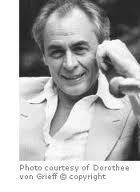
Laing “One way to get someone to do what one wants, is to give an order. To get someone to be what one wants him to be…is another matter. In a hypnotic (or similar) context, one does not tell him what to be, but tells him what he is. Such attributions, in context, are many times more powerful than orders (or other forms of coercion or persuasion). An instruction need not be defined as an instruction. It is my impression that we receive most of our earliest and most lasting instructions in the form of attributions. We are told such and such is the case. One is, say, told one is a good or bad boy or girl…it is not [even] necessary to be told to be what one has already been ‘given to understand’ one is. The key medium for communication of this kind is probably not verbal language…

One may tell someone to feel something and not to remember he has been told. Simply tell him he feels it. Better still, tell a third party, in front of him, that he feels it…” Continue reading “R. D. Laing, Philip Larkin, and exploring the psyche”

Talking to the dead

altarWe have a small alter in the living room with photos of the closest group of our beloved dead, parents, my older brother.  I put flowers there daily, and think of them, sometimes talk to them. But this is different than what goes on in the movie, The Sixth Sense, in which a young boy saw dead people, that is physically saw them and spoke with them. Or the TV series, Medium, that was based on the real-life Allison DuBois, in Phoenix, who helps police solve crimes because she sees and speaks to the dead, mostly in dreams, but sometimes just sitting in her kitchen.

Friends and I were talking about this phenomenon and what it could mean. Is it possible for someone to actually see and talk to the dead? We talked about physicists’ current theory that there is no matter–that everything is just energy bumping around and jostling and causing random events–a belief that is also posited in the Secret Oral Teachings of Tibetan Buddhist Sects, by Alexandra David-Neel. If this is true, then pretty much anything is possible–someone could have an unusual sensitivity to that energy stream. In fact, death and life and time and matter are all pretty much up for grabs. The amazing thing is that in this astounding chaos, we are able to build bridges that hold weight, catch planes on an agreed upon schedule, and recognize and cherish our loved ones.

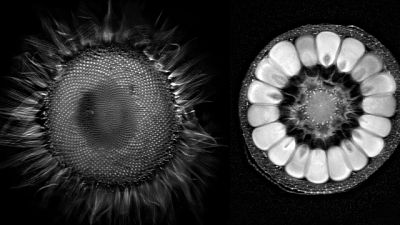
sunflower and corn MRI_optIn any case, we had an interesting evening talking about it. And this morning, I found these animated MRI scans of vegetables (via the Bennington Garden blog) that seem appropriate to this discussion. You might call them, the inner life of vegetables. I especially like the garlic.


Resolution vs. intent

new-years-resolution-appleIt’s a strange custom we have, resolutions at the New Year.  About 10 years ago, I took a tip from my daughter: “Aim small and succeed.” Since then, several excellent small resolutions have become part of my life:

  • Only eat good chocolate
  • No biopics
  • Keep a bottle of water in the car
  • Always pee before leaving the house

Those last two sort of go together. Continue reading “Resolution vs. intent”

Election reflection

I’m not a politically engaged person as a rule, but once in awhile something grabs my attention and moves me to action. Two years ago, right around this time, it was the management of our local famers’ market. The terrific market manager was suddenly and inexplicably fired, and I worked with a few other local residents to stage a takeover and transformation of the market. Today, the manager (who we restored to his role) has made the market a thriving local community resource. It was satisfying to effect a positive change in my neighborhood.

This year, we have a similar situation on the governing board of our town. Continue reading “Election reflection”

In search of an almond croissant

20121004-162657.jpg

We’ve been in Paris for almost a week seeing extended family, drinking cafés crèmes and looking at the amazing art. I mentioned to my cousin yesterday that the last time I was in Paris, almond croissants were everywhere, but this time I’d yet to find one. That evening I finally came across some at the Boulanger, bought one for each of us and brought them home for breakfast. My cousin had found them, too, right around the corner, and this morning we had an embarrassment of croissants aux almondes.

We took a couple for the train. But really, one a day is rich enough. I told Larry if we met a beggar, of which Paris has it’s share, I’d offer a croissant. We barely sat down when a man approached asking for change for food. I produced the bag with almonds croissants, but he declined. He would prefer a Euro for a sandwich. Tant pis!

As for art, I’d like to post some photos, but it will have to wait. My computer was stolen from the hotel the first day, and I have no way to upload photos at the moment.

My grand transformational process

This morning, Larry read part of David Brooks’ column on the driving economic force of grandiose entrepreneurs. Of course, Steve Jobs would be a prime example, but Brooks focused on Elon Musk, whose serial entrepreneurship has made him a billionaire. While still in college (or maybe graduate school) he identified three areas that he felt would most transform humanity: the Internet, sustainable energy, and space exploration. He’s proceeded to create hugely successful enterprises in all three.

Brooks asks if maybe some reader will think “What grand transformational process do I want to be a part of?” Of course, Brooks is talking in terms of economics, of the forces that create opportunities, jobs, and progress, but whether consciously or not, doesn’t each of us transform the world we live in? Continue reading “My grand transformational process”

Luminous vegetables

In past gardens, I’ve planted rows of things–many of each plant. In this year’s garden, I limited myself: one zucchini, two eggplant, three cucumbers, five tomatoes.  I didn’t want to get overwhelmed at harvest. As it is, the productivity of these few plants is astounding. And an unexpected benefit, when you only have a few plants, the miraculous nature of each burgeoning vegetable comes into its own. I couldn’t resist making a little yin/yang symbol with these glossy eggplants. Or is it yin/yin or yang/yang? Continue reading “Luminous vegetables”

Morning cup of joe…

This morning, Larry read me a terrific column by David Brooks, The Credit Illusion, about who gets credit for personal achievements. Really, it was more of a philosophical essay on the stages of maturity–I don’t think Nietzsche could have done it any better.

Larry prefaced the reading by saying, “Those of us who read the news and watch TV know there has been a big brouhaha about Obama’s saying that individuals don’t deserve credit for their achievements as much as the government and the society that make them possible.” This was a little dig, as I don’t read or listen to news–I prefer mine filtered through Larry.

After breakfast, Larry let showed me the camera-ready copy of the art book he is publishing through hit & run press to accompany upcoming shows of Roberto Chavez’ work. You may remember we saw his exhibit at the Autry a few months ago. We’ve known Roberto for over 30 years, and it was a bit of a shock to look through the amazing selection of his work and recognize the extent of his talent. Mostly, when you know someone on a daily basis, you don’t really think of them as a genius. Yes, Roberto always has a pen or pencil in hand, creating amazing sketches. Yes, he has some marvelous work, and I’ve appreciated it through the years. But to see the book as a whole was staggering. His talent is so enormous. This witty, sometimes troublesome and frustrating person, with all his personal quirks is a major artist, whose book will be right in its proper place among the other masters on our art book shelf.

An Exemplary Sentence

It’s been awhile since I came across a sentence or paragraph that made me really stop and consider.  This one did:

Most people assume that meaning is embedded in the words they speak. But , according to forensic linguists, meaning is far more vaporous, teased into existence though vocalized puffs of air, hand gestures, body tilts, dancing eyebrow, and nuanced nostril flares. The transmission of meaning still involves primate mechanics worked out during the Pliocene era.
Jack Hitt
“Words on Trial”

I love this idea. Any other exemplary sentences out there, primates? Continue reading “An Exemplary Sentence”

Mandelstam, Olympic trials, memories of Oregon

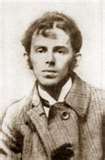
The other day I mentioned the poem about Stalin that led to Mandelstam’s exile and eventual death. Mandelstam recited it to a gathering of intellectuals at Boris Pasternak’s home one evening. Someone at that gathering informed on him. (Someone will always inform, and have their reasons. We each think it would not be us.) In any case he was first exiled to a remote village, and later, after a short reprieve, sent to a camp in Siberia, which led to his death. This is the poem. In Russian it has the rhythm and sweetness of a nursery rhyme, which contrast with its content: Continue reading “Mandelstam, Olympic trials, memories of Oregon”

Poetry, repression and fame

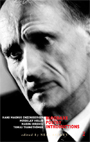
I stumbled across a small set of chapbooks called Bloodaxe Poetry Introductions edited by Neil Astley in the UC stacks the other morning. The first one I opened had several interesting poets new to me, including a German, a Czech, and a Romanian poet. Thinking about the poetry of Eastern Europe, one has to take into account the forces of invasion, dictatorship, and the repression of the state. A quote from a translator of Miroslav Holub, the Czech poet, highlights the latter:

Eward Osers, recalls how Czech authorities ‘always had an uneasy feeling that in his surrealist way, Holub might be poking fun at them. When in one of his poems he spoke of “a crowd of dwarves [applauding] in the king’s palace” he was somewhat to his surprise summoned to the censor’s office. It turned out that many of the members of the Communist Party Central Committee were rather short and that passage would therefore have to be changed.

In the western world, we really don’t have to consider censorship, except self-censorship. Poetry has very little practical impact. Poetry in the west is basically ignored–the political and cultural weight that causes the Central Committee to ask that a passage be changed just doesn’t apply here. No one goes to jail here for what they say. No one, like Mandelstam, is exiled and eventually dies in a camp for his work.

And for poets who achieve recognition here–that is, that their poetry is widely read and praised–that recognition can be a kind of trap, counter to the intensely personal process of writing. The poet begins writing what the audience wants, and there is nothing worse for the creative process than that.

Holub was also a well-respected immunologist, and had this to say about his work:

“I prefer to write for people untouched by poetry… I would like them to read poems in such a matter-of-fact manner as when they are reading the newspaper or go to football matches. I would like people not to regard poetry as something more difficult, more effeminate, or more praiseworthy.”

An interesting aesthetic. In any case, here’s a short poem of his from 1961.

A helping hand

We gave a helping hand to grass–
and it turned into corn.
We gave a helping hand to fire–
and it turned into a rocket.

Hestatingly,
cautiously,
we give a helping hand
to people,
to some people…

Miroslav Holub

Favas and Fussell

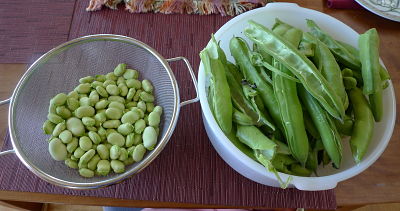
In the garden, the favas are burgeoning. They’re a pleasure to pick, shell, peel, and eat, though a bit of work. They have a wonderful nutty texture and a lovely green taste. They are great sautéed with a little garlic, or added to a salad or stir fry.

While I was peeling them I was thinking about Paul Fussell, whose obituary was in the NY Times today. Continue reading “Favas and Fussell”