Calamondins, epigraphs, and Destiny

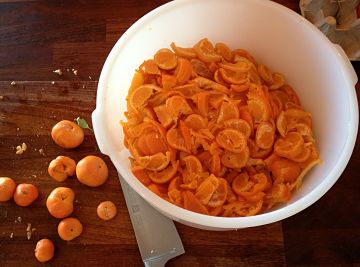
My neighbor has a tree of tiny, seedless, tangerine-like fruit, called Calamondins. Another neighbor had a grandmother who supported their family through the Great Depression by selling Calamondin Marmalade, so that’s what I’ve been making today–a wonderful fall treat.  You could probably use the same recipe for kumquats or key limes. Let me know if you want a copy–it’s really delicious, and I don’t even like marmalade as a rule.

Larry’s contribution was to read to me while I sliced. My favorite was an article on epigraphs, and my favorite epipgrah was one from Vladmir Nabokov’s The Gift, taken from a Russian grammar book: “An oak is a tree. A rose is a flower. A deer is an animal. A sparrow is a bird. Russia is our fatherland. Death is inevitable.”  Continue reading “Calamondins, epigraphs, and Destiny”

A murder of crows

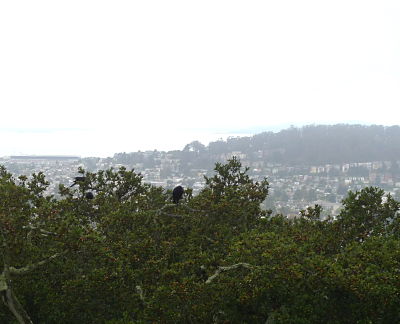
This morning, Larry noticed a group of crows on top of the oak behind our house. They were grabbing acorns, holding them on the branch between their feet, and stabbing at them with their beaks to get to the acorn meat inside.

Larry wondered if you can’t consider that using a tool. I wondered about that noun for a group of crows, a murder of crows–which probably comes from their role as scavengers. Continue reading “A murder of crows”

Camus in Provence

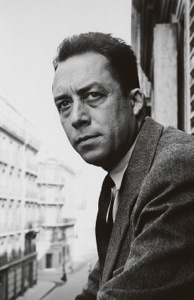
I’ve been reading a copy of Camus’ Notebooks, 1935-1942, while we tootle around Provence.He was in his early 20’s when he wrote these. I came across this passage on travel:

20121010-211929.jpg“What gives value to travel is fear. It is the fact that, at a certain moment, when we are so far from our own country…we are seized by a vague fear, and an instinctive desire to go back to the protection of old habits… This is why we should not say that we travel for pleasure.”

There’s more, but this was the part that struck me, and I talked about it with Larry over coffee at one of the numberless outdoor cafes, under the warm sun of Provence. It’s true that travel produces some anxiety. You don’t know how to do the simplest thing, or get anywhere. In some cases, you don’t know the very words you need to ask for something.

As Larry said, travel lets you separate what is human from what is cultural. The lulling protection of cultural habituation is stripped. But the intense pleasure of unfiltered experience is the reward. In any case, home tomorrow, and back to the welcoming arms of habit!

Tournament ball

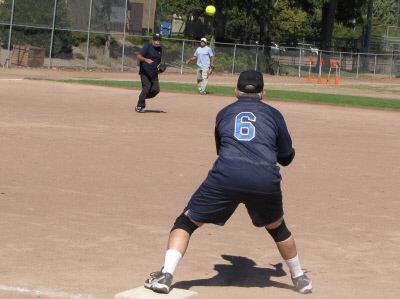
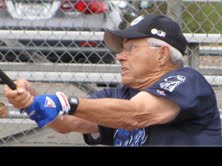
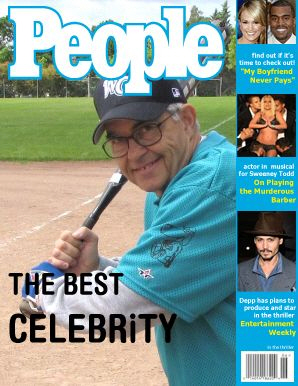
Yesterday I went to watch Larry’s team (the Blue) play in the championship game for his over-65 league, the Creakers.  They pulled it off in the bottom of the 9th, winning by one run.  Because women were doing the photography, I got this shot of Larry making a key play at first base.

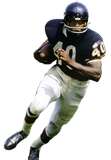
Women tend to keep pretty quiet about the pleasure of watching men’s butts in sports. But I remember being able to identify Gale Sayers about a decade after he quit pro football just seeing him bend over to hit a putt on TV. It was one of those TVs in a bar with the sound turned off, but it was unmistakably Gale.  All the pictures I could find of him online were clearly taken by men. So I’m doubly grateful to the wives who took this shot of Larry.


The Sunday paper

Larry has been playing in an over-70 softball tournament in Manteca (think 100 degrees in the sun). His team beat all but one rogue over-65 team. And even though he’s tired after 6 games in the heat, he’s been reading me excerpts from Jim Murray’s autobiography. Larry grew up reading Jim Murray’s sports columns in the LA Times.

My favorite line so far is how he started his speech after winning the Pulitzer; “Well this is sure going to make it easier for whoever writes my obituary.”

Continue reading “The Sunday paper”

We’re #9

Although I don’t go so far as to attend Larry’s softball games, I’m very happy to cheer from afar. So let me announce that of all the over-70 softball tournament teams in Northern California, from Fresno to the Oregon border, Larry’s team, Direct Floors, is #9.  There are many teams, but only the top 15 are listed on the honor roll. Continue reading “We’re #9”

Monday, Monday

Does anyone remember the Mamas and the Papas? Of course, but only with nostalgia. Back in the 70s Larry commented that their music was dated. It startled me at the time, but of course, he was right. They are their period. This morning, talking about the implications of the election in Egypt, Larry said, “I predict a dysfunctional government. Anyone taking bets?”

But Monday is also a day I look for a new poem to send to my poetry friends, and this is what I came up with today and am hereby adding to my anthology of radically accessible poetry.

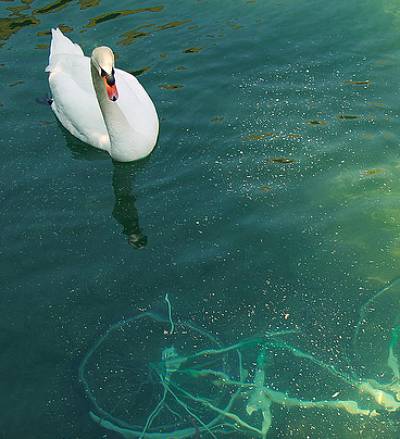
The Swan at Edgewater Park Continue reading “Monday, Monday”

What’s in a metaphor?

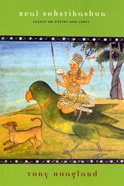
I have been rereading Tony Hoagland’s essays on poetry, called real sofistikashun. I’ve quoted from his poetry before. It’s a wonderfully readable book: lucid, insightful, and packed with analysis that actually illuminates what it discusses. I read it a few years ago, but it was during a bad time for me, and I didn’t absorb much. Then I loaned it to a friend, forgot about it, and recently got it back. It’s almost as if I never read it. (The benefit of failing memory, as Larry says, is that you can hide your own Easter eggs.)

Here’s the passage that opens the chapter on metaphor:

“There is something irreconcilably, neurologically primal about the act of metaphor. This primal wildness conceals it from us. Of the hinterlands of the gray matter, where metaphors roam free, our data is all rumor, conjecture, and anecdote. Because metaphorical speech is such a commonplace, because almost anyone can and does produce metaphor on a daily basis, we assume that it is scrutable.  Because it is a mental process, because it takes place in our own heads (on our property), because it leaves our own authorial lips, we assume we know something of its workings. But we do not. Invariably, the only adequate way to describe the metaphorical event is by another metaphor. It’s a mystery hand going into a black mystery box. The head says, “Fetch me a metaphor, hand,” and the hand disappears under a cloth. A moment later, the hand reappears, metaphor on its extend palm. But despite the spontaneity and ease of this event, we have only a vague idea of where the image came from. In fact, we don’t know. And neither does the hand.”

Continue reading “What’s in a metaphor?”

What’s news?

The air you breathe may be killing you. More at 11.

Okay, this isn’t a real leader for the news, but it represents the whole take on news these days–the scarier the better. I remember Emily Littella’s protest against “violins on television,” and the Kingston Trio’s Merry Minuet. There is always so much to worry about!

Czesław Miłosz wrote “What is needed in misfortune is a little order and beauty.”

And so I rely on Larry to filter the news for me, as he provides a little order and beauty. We were wondering the other day why the comic strip “Pogo” seems to have disappeared while so many others (Peanuts, for example) continue long after the creator’s death. Walt Kelly, the strip’s creator, was aware that buffoons were spread equally among all parties and denominations, and coined the famous phrase “We have met the enemy, and he is us.”

Yesterday Larry was talking about the world’s money woes, and noted that economists track something called the “velocity of money,” or how quickly money circulates. The more it slows down, the less of it around for all.  He remembered reading a British economist who summarized this with a pity quote:

“The busy shilling does more work than the lazy pound.”

Last year for my Christmas card, I sent out this little poem:

Meditation on Money

I am thinking about a day forty years ago
when we were down to our last fifty cents,
and our friends drove up
with a month’s rent and groceries,
and after we ate and talked, we sat together
on the edge of the dock, saying nothing,
and watched the barnacles
slowly open their feathery lips,
slowly close them.

And that’s enough for this blog on the financial crisis.

Though I do want to add a big thank you to Melissa Donovan, who restored the format of the blog which had mysteriously deconstructed. Yay for Melissa and her unfailing help.
Raising the bar

This morning Larry pointed out an article in the paper about a robotic arm. The woman in the picture was able to get the arm to raise a sippy cup to her lips through thought. She thought the command and the arm raised the cup.

“How can it do that?” I wondered.

“I don’t know,” Larry said, “but it’s certainly going to energize domestic violence.”