Goodbye 2020

This little poem by Emily Dickinson seems as fitting as any for this ending. How sly her title and first line! Here’s to the slow shifting towards what used to be normal.

As imperceptibly as Grief

As imperceptibly as Grief
The Summer lapsed away—
Too imperceptible at last,
To seem like Perfidy—

A Quietness distilled
As Twilight long begun
Or Nature spending with herself
Sequestered Afternoon—

The Dusk drew earlier in—
The Morning foreign shone—
A courteous, yet harrowing Grace,
As Guest, that would be gone—

And thus, without a Wing
Or service of a Keel
Our Summer made her light escape
Into the Beautiful.

Emily Dickinson

Solstice

Each evening I watch the sun set further toward San Francisco each day, until it hits the south end of the Golden Gate. Tonight is its furthest stretch, and the return begins.

I looked hard to find a poem about solstice I liked, and here’s the title poem from Timothy Steele’s book that seems to capture some of the strangeness of this time in California–an especially strange time this year. It’s that rare formal poem that transcends its form to feel like natural speech.

Toward the Winter Solstice

Although the roof is just a story high,
It dizzies me a little to look down.
I lariat-twirl the cord of Christmas lights
And cast it to the weeping birch’s crown;
A dowel into which I’ve screwed a hook
Enables me to reach, lift, drape, and twine
The cord among the boughs so that the bulbs
Will accent the tree’s elegant design.

Friends, passing home from work or shopping, pause
And call up commendations or critiques.
I make adjustments. Though a potpourri
Of Muslims, Christians, Buddhists, Jews, and Sikhs,
We all are conscious of the time of year;
We all enjoy its colorful displays
And keep some festival that mitigates
The dwindling warmth and compass of the days.

Some say that L.A. doesn’t suit the Yule,
But UPS vans now like magi make
Their present-laden rounds, while fallen leaves
Are gaily resurrected in their wake;
The desert lifts a full moon from the east
And issues a dry Santa Ana breeze,
And valets at chic restaurants will soon
Be tending flocks of cars and SUVs.

And as the neighborhoods sink into dusk
The fan palms scattered all across town stand
More calmly prominent, and this place seems
A vast oasis in the Holy Land.
This house might be a caravansary,
The tree a kind of cordial fountainhead
Of welcome, looped and decked with necklaces
And ceintures of green, yellow, blue, and red.

Some wonder if the star of Bethlehem
Occurred when Jupiter and Saturn crossed;
It’s comforting to look up from this roof
And feel that, while all changes, nothing’s lost,
To recollect that in antiquity
The winter solstice fell in Capricorn
And that, in the Orion Nebula,
From swirling gas, new stars are being born.

How it feels while you are waiting

This poem, by Catherine Pierce, does a great job of encompassing the hopes, fears, anticipation and strangeness of pregnancy:
Gestational Size Equivalency Chart

Your baby is the size of a sweet pea.
Your baby is the size of a cherry.
Your baby is the size of a single red leaf
in early September. Your baby is the size
of What if. The size of Please Lord.
The size of a young lynx stretching.
Heat lightning. A lava lamp.
Your baby is the size of every dream
you’ve ever had about being onstage
and not knowing your lines. Your baby
is the size of a can of Miller Lite. Continue reading “How it feels while you are waiting” →

Kindness

I live in the hills above the bay–tiny winding streets that are nonetheless open to two-way traffic, so we are all having to find a spot to pull to the side to let each other pass. We do this daily, with a nod or a wave, and it always makes me feel there is hope in a world with such small civilities.  All this made me think of Naomi Shihab Nye’s poem:
Kindness

Before you know what kindness really is
you must lose things,
feel the future dissolve in a moment
like salt in a weakened broth.
What you held in your hand,
what you counted and carefully saved,
all this must go so you know
how desolate the landscape can be
between the regions of kindness.
How you ride and ride
thinking the bus will never stop,
the passengers eating maize and chicken
will stare out the window forever.

Before you learn the tender gravity of kindness
you must travel where the Indian in a white poncho
lies dead by the side of the road.
You must see how this could be you,
how he too was someone
who journeyed through the night with plans
and the simple breath that kept him alive.

Before you know kindness as the deepest thing inside,
you must know sorrow as the other deepest thing.
You must wake up with sorrow.
You must speak to it till your voice
catches the thread of all sorrows
and you see the size of the cloth.
Then it is only kindness that makes sense anymore,
only kindness that ties your shoes
and sends you out into the day to gaze at bread,
only kindness that raises its head
from the crowd of the world to say
It is I you have been looking for,
and then goes with you everywhere
like a shadow or a friend.

Naomi Shihab Nye 

Almost over

Today is the last day of November of a year I will be happy to see fade into memory. Also, woke this morning to a gorgeous moon golden over the horizon, the second full moon of the month, a blue moon.

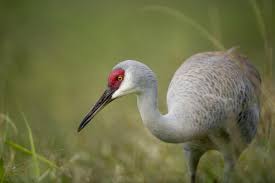
But today’s selection has nothing to do with either of these. It’s a poetic retelling of how the Sandhill Crane got his red mask, by an Iñupiaq poet.  Each year I go to Lodi to see these majestic birds–dust colored with a maroon swatch over the eyes. They make a cranky, creaking sound, like a rusty hinge, and are gorgeous in flight.

Aakuaksrak

One spring, sandhill cranes flew into sight.

Having landed, they became hard to spot,

Their bodies and wings dirt brown,

The color of dead willow leaves.

That fall, the crane wife fed her husband

Cranberries. He balked. He made fun

Of the tiny morsel. That night, while he slept,

She dressed his eyes in red berry pulp.

Staining him for life.


by Marie Tozier


“The American Living Room: A Tract”

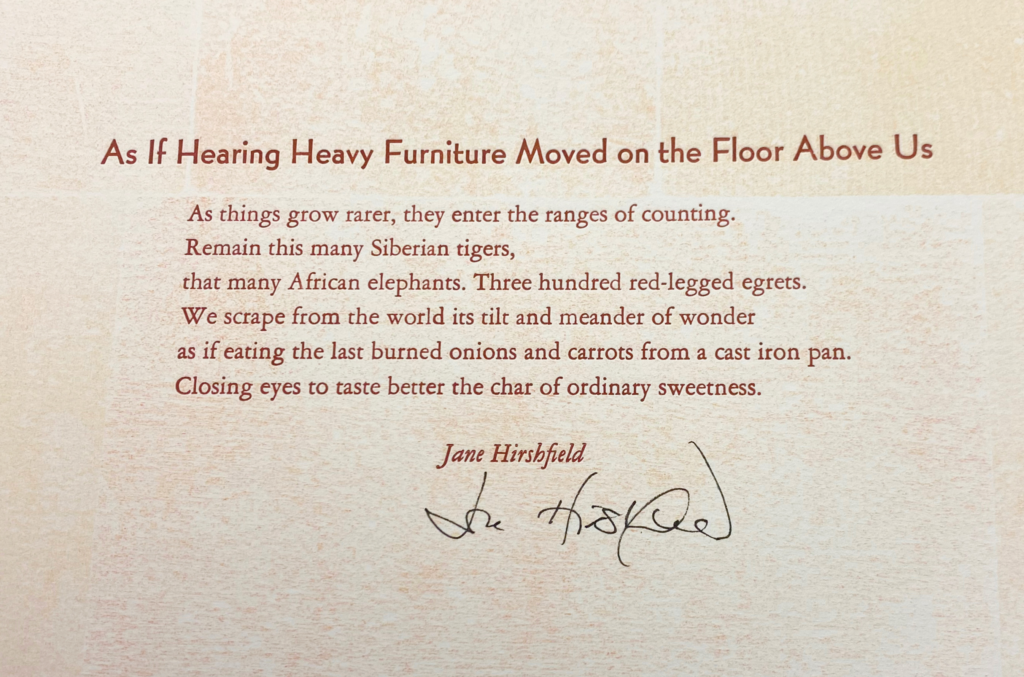
Reading with Jane Hirshfield on Thursday, November 19 @7pm Pacific time

I am so lucky to be reading with the incomparable Jane Hirshfield this week, sponsored by Marin Poetry Canter and Osher Marin JCC.  It’s free, and you can register here.

It’s going to be a back and forth conversation, and I am pretty sure Jane will start with this poem:

A. R. Ammons

I came across this poem and thought it a good one to share with you, even though it references September.  On the East Coast, September is very much like November here.

Day

On a cold late
September morning,
wider than sky-wide
discs of lit-shale clouds

skim the hills,
crescents, chords
of sunlight
now and then fracturing

the long peripheries:
the crow flies
silent
on course but destinationless,

floating:
hurry, hurry,
the running light says,
while anything remains.

A. R. Ammons

A small poem for a tense time

Sometimes I see a poem and just want to translate it for myself. Maybe I don’t like the translation I see, maybe it hasn’t been translated, maybe it just seems a challenge. I can’t remember why I translated this, but it seemed a good poem for this tense week:
 

Consolación

Es tan estrepitoso nuestro día,
Desgarrado por máquinas crueles,
Que el silencio recubre nuestra noche
Como si las alturas estelares
Nos consolaran de habitar la Tierra.

Jorge Guillén

***** Continue reading “A small poem for a tense time” →

Forgotten

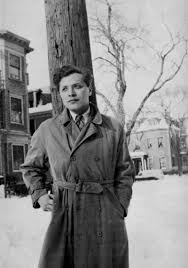
It’s odd how poetic reputations ebb and flow. Delmore Schwartz’ debut book, In Dreams Begin Responsibilities, was a star in 1938 when he was 25, and certainly impressed me when I read it in the late 60’s.  The title story was thrilling, I still remember it. But now he is almost forgotten. I used to know this poem from that book by heart, but faltered when I tried to recite it the other day. It’s worth relearning.
Calmly We Walk through This April’s Day

Calmly we walk through this April’s day,
Metropolitan poetry here and there,
In the park sit pauper and rentier,
The screaming children, the motor-car
Fugitive about us, running away,
Between the worker and the millionaire
Number provides all distances,
It is Nineteen Thirty-Seven now,
Many great dears are taken away,
What will become of you and me
(This is the school in which we learn…)
Besides the photo and the memory?
(…that time is the fire in which we burn.)

(This is the school in which we learn…)
What is the self amid this blaze?
What am I now that I was then
Which I shall suffer and act again,
The theodicy I wrote in my high school days
Restored all life from infancy,
The children shouting are bright as they run
(This is the school in which they learn…)
Ravished entirely in their passing play!
(…that time is the fire in which they burn.)

Continue reading “Forgotten” →

after Louise Glück

Last week I posted a poem by Louise Glück, who won the Nobel Prize, but I wrote this homage long before that happened–earlier this year, really, thinking about the virus:

October

         after Louise Glück

Aren’t the days skimping
on light again,
mornings dark
and darker

doesn’t the time change soon,
shifting the scant light

doesn’t the chill in the air
intensify now

doesn’t it remind you
how everything slows
withers

doesn’t the garden
yield its last sweet tomato
its last cucumber

the basil turns brown
overnight, few eggs
in the nests

doesn’t it seem like this end
might be the end

Meryl Natchez

And the winner is…

Louise Glück won the Nobel Prize in literature this week, and I’m so pleased. I really admire her work. And each book is different. Here’s a sample, from Averno.

October (section 1)

Is it winter again, is it cold again,
didn’t Frank just slip on the ice,
didn’t he heal, weren’t the spring seeds planted

didn’t the night end, didn’t the melting ice flood the narrow gutters

wasn’t my body rescued, wasn’t it safe

didn’t the scar form, invisible above the injury

terror and cold,
didn’t they just end, wasn’t the back garden harrowed and planted—

I remember how the earth felt, red and dense, in stiff rows, weren’t the seeds planted, didn’t vines climb the south wall

I can’t hear your voice
for the wind’s cries, whistling over the bare ground

I no longer care what sound it makes

when was I silenced, when did it first seem pointless to describe that sound

what it sounds like can’t change what it is—

didn’t the night end, wasn’t the earth safe when it was planted

didn’t we plant the seeds,
weren’t we necessary to the earth,

the vines, were they harvested?

Derek Mahon

For those of you who follow such things, the Irish poet, Derek Mahon, died this week. He was 78.  I’ve posted a poem of his before (one that they included in his NY Times obituary, as it happens), but this one if also a favorite, though a very different tone.

Afterlives

(for James Simmons)

          1
I wake in a dark flat
To the soft roar of the world.
Pigeons neck on the white
Roofs as I draw the curtains
And look out over London
Rain-fresh in the morning light.
This is our element, the bright
Reason on which we rely
For the long-term solutions.
The orators yap, and guns
Go off in a back street;
But the faith doesn’t die
That in our time these things
Will amaze the literate children
In their non-sectarian schools
And the dark places be
Ablaze with love and poetry
When the power of good prevails.
What middle-class shits we are
To imagine for one second
That our privileged ideals
Are divine wisdom, and the dim
Forms that kneel at noon
In the city not ourselves.
          2
I am going home by sea
For the first time in years.
Somebody thumbs a guitar
On the dark deck, while a gull
Dreams at the masthead,
The moon-splashed waves exult.
At dawn the ship trembles, turns
In a wide arc to back
Shuddering up the grey lough
Past lightship and buoy,
Slipway and dry dock
Where a naked bulb burns;
And I step ashore in a fine rain
To a city so changed
By five years of war
I scarcely recognize
The places I grew up in,
The faces that try to explain.
But the hills are still the same
Grey-blue above Belfast.
Perhaps if I’d stayed behind
And lived it bomb by bomb
I might have grown up at last
And learnt what is meant by home.
Derek Mahon