Dull subjects

In a humorous essay about poetry, William Matthews suggested there are only four subjects for poems:

1. I went out into the woods today, and it made me feel, you know, sort of religious.

2. We’re not getting any younger.

3. It sure is cold and lonely (a) without you, honey, or (b) with you, honey.

4. Sadness seems but the other side of the coin of happiness, and vice versa, and in any case the coin is too soon spent, and on what we know not what.

lauxSo I looked for a poem today about something outside these categories and here is one by Dorianne Laux:


Finding What’s Lost

In the middle of the poem my daughter reminds me
that I promised to drive her to the bus stop.
She waits a few beats then calls out the time.
Repeats that I’ve promised.
I keep the line in my head, repeat it under my breath
as I look for my keys, rummage through my purse,
my jacket pockets. When we’re in the car, I search
the floor for a Jack-in-the-Box bag, a ticket stub,
a bridge toll dollar, anything to write on.
I’m still repeating my line when she points
out the window and says “look, there’s the poppy
I told you about,” and as I turn the corner I see it, Continue reading “Dull subjects” →

An  Elegy

elephantsA friend leant me Inventions of Farewell, A Book of Elegies, by Sandra Gilbert. This is a wonderful collection and in the introduction she references a passage on “elephant grief” from Fragments on the Deathwatch, by Louise Harmon, which in turn cites a National Geographic article about the mourning behavior of a herd of elephants after the death of an old bull. The elephants “approached his body by twos and threes, ‘sweeping their trunks slowly over him, not touching him for the most part but maintaining an inch of distance between his skin and the moist tips of their trunks. The ritual was more impressive for its silence.’ ’’  Continue reading “An  Elegy” →

A slight departure

AndrewMarvelI realized today that I have avoided putting older poems here–Marvell, Shakespeare, Wordsworth, for example. I’ve selected contemporary poems not only to avoid poems that everyone probably read in high school, but also because they seem more accessible, more alive.

But today I felt like reading Andrew Marvell’s “To His Coy Mistress,” written in the 1650s. You’ll certainly recognize phrases from this poem, even if you didn’t read it in high school. They’ve made their way into daily speech. And though written in strict rhyme and meter, Marvell’s language and syntax (except for the occasional thou and thy and shouldst) seem almost as fresh as a contemporary poem.

To His Coy Mistress

Had we but world enough and time,
This coyness, Lady, were no crime. Continue reading “A slight departure” →

The exemplary sentence

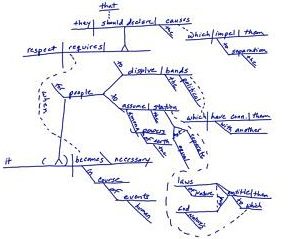
Sentence Diagram

I’ve been reading George Eliot’s Daniel Deronda, or rather skimming much of it. It’s long and rather overwritten, though Eliot can write!

It seems to me a book that would make a wonderful period movie. The plot involves many twists, including a lenghty and interesting perspective on how Jews were seen in 1800s. One focal point of the novel is the evolution of  a heedless, impoverished, but well-intentioned beauty who marries a cold, mean-spirited man named Grandcourt for his money and position.

This little sentence captures Grandcourt’s character perfectly:

It is true that Grandcourt went about with the sense that he did not care a languid curse for any one’s admiration, but this state of not-caring, just as much as desire, required its related object—namely, a world of admiring or envying spectators: for if you are fond of looking stonily at smiling persons, the persons must be there and they must smile…

Lobster on Monday

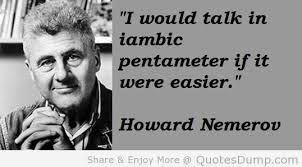
nemerovHoward Nemerov seems almost forgotten as a poet–he died almost 25 years ago. He was not only US Poet Laureate twice, but was also the brother of Diane Arbus. This poem is fairly representative of his style.

The Lobster

Here at the Super Duper, in a glass tank
Supplied by a rill of cold fresh water
Running down a glass washboard at one end
And siphoned off at the other, and so
Perpetually renewed, a herd of lobster
Is made available to the customer
Who may choose whichever one he wants
To carry home and drop into boiling water
And serve with a sauce of melted butter. Continue reading “Lobster on Monday” →

Drought Poem

This is one of the poems I’ll be reading this Saturday for the event at the North Berkeley Library, Poems of Berkeley.  Details here.

oldsGabriel and the Water Shortage

When the water shortage comes along
he’s been waiting all his life for it,
all nine years for something to need him as
the water needs him now. He becomes
its protector–he stops washing, till dirt
shines on the bones behind his ears
over his brain, and his hands blaze like
dark blades of love. He will not
flush the toilet, putting the life of the
water first, until the bowl
crusts with gold like the heart’s riches and his
room stinks, and when I sneak in and
flush he almost weeps, holds his
hands a foot apart in the air and
says do I know there is only about
this much water left! He befriends it, he Continue reading “Drought Poem” →

Poems of Berkeley

duncanAs part of poetry month, Susan Cohen (a fellow poet) and I are orchestrating a reading of poems about Berkeley at the North Branch of the Berkeley Public Library on the afternoon of Saturday, April 25. Gathering poems for the event, I wanted to include something by Robert Duncan, who was a romantic and powerful figure in the poetry scene in the Bay Area in the sixties.  Here he is with Denise Levertov, another poet we’re including., along with Ginsberg, Spicer, Robert Hass, Brenda Hillman, Chana Bloch, and others–hard to narrow it down to 20 poems.

Duncan held dawn readings on Mt. Tamalpias and was part of the legendary Six Gallery reading in San Francisco. Larry has a large broadside of his most famous poem, My Mother Would be a Faconress. But this quieter, mysterious poem of his is one of my favorites.

Often I Am Permitted to Return to a Meadow

as if it were a scene made-up by the mind,
that is not mine, but is a made place, Continue reading “Poems of Berkeley” →

Migratory

Next week I’m heading to New York for the William Dickey Memorial Broadside Contest reading. Mark Doty will be the featured reader.  He’s a marvelous poet.  Here’s  one of my favorites of his poems.

Migratory

Near evening, in Fairhaven, Massachusetts,
seventeen wild geese arrowed the ashen blue
over the Wal-Mart and the Blockbuster Video,

and I was up there, somewhere between the asphalt
and their clear dominion—not in the parking lot,
its tallowy circles just appearing,

the shopping carts shining, from above,
like little scraps of foil. Their eyes
held me there, the unfailing gaze

of those who know how to fly in formation,
wing tip to wing tip, safe, fearless.
And the convex glamour of their eyes carried

the parking lot, the wet field
troubled with muffler shops
and stoplights, the arc of highway

and its exits, one shattered farmhouse
with its failing barn… The wind
a few hundred feet above the grass

erases the mechanical noises, everything;
nothing but their breathing
and the rowing of the pinions,

and then, out of that long percussive pour
toward what they are most certain of,
comes their—question, is it? Continue reading “Migratory” →

Irish poems

824_egrennanThe Irish Times has been running a contest to select the 100 best loved Irish poems (chosen by whomever responds, I guess). You can read the results here. Not surprisingly, Yeats, Heaney, and Kavanagh populate the top ten.

But here’s a poem from a poet who wasn’t included, Eamon Grennan, perhaps because he’s lived most of his adult life in the United States. It seems like a very Irish poem to me.

Edge

When I’d walked out to the sea surfing and spuming
into meerschaum heaps of lettuce-tinted gauze,
breakers becoming light then noise, the ocean raging
and rearranging this long spit of sand like a life
at the mercy of circumstance, I saw the north wind Continue reading “Irish poems” →

An exemplary sentence

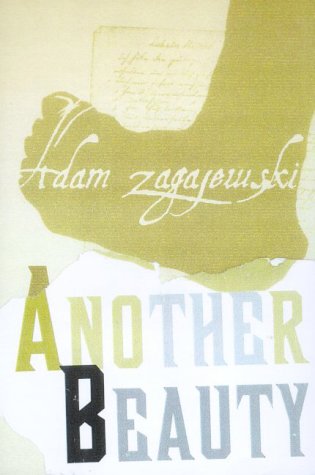
41K5ATQ9E5LAlthough I primarily know him as a poet, I love Adam Zagewski’s prose. Here is a snippet from his memoir of his student days in Krakow, Another Beauty,  beautifully translated by Clare Cavanagh. It’s about the cleaning lady for his student apartment:

She was a magpie, a snoop. I suspected her of regularly rummaging though our things and once left a card that said “Please don’t look here” in my desk drawer. Helena took offense and didn’t speak to me for several days, and then, when her anger had subsided, she reproached me bitterly: “How could you even think such a thing? So you don’t trust me at all.” Continue reading “An exemplary sentence” →

A delightful reading

images-2Last week I drove down to Stanford to hear Ellen Bryant Voigt read. I had heard of her, but not read much of her work. It was worth the long drive through the increasingly dense traffic of the Bay Area. The words that come to mind are vibrant authentic.

Here is a poem from her new book. Unlike her earlier books, these poems dispense with punctuation, but I think you will be able to decipher the poem’s sense without it:

Roof

after a week of heavy snow I want to praise my roof first
the acute angle at which it descends form the ridgepole
and second that it is black the color absorbing
all the other colors so that even now as arctic air Continue reading “A delightful reading” →

Befriending Frankenstein

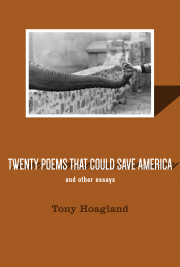
hoaglandI have been reading Tony Hoagland’s newest book of essays, Twenty Poems that Could Save America (published by Graywolf Press, a wonderful imprint). In his first essay, “Je Suis ein Americano: the Genius of American Diction,” he talks about the current direction of American poetry, the experimentation, the fractured language and syntax, the shifts and ruptures of trying to cobble together something fresh.  This is the final paragraph:

“American English is a great experiment in progress, and American poetry is its laboratory on a hill. Several decades ago, Tim Dlugos published a chapbook of poems with the title Je Suis ein Americano, as if making the point of this essay in brief. I suppose the mythic analog might be the story of Frankenstein’s monster. The creature we know as Frankenstein is patched together by a mad doctor, who employs a cut-and-paste method using the recycled parts of executed criminals. The monster escapes, descends from the mountain, and terrorizes the villagers. It sounds a lot like postmodernism, doesn’t it? Yet the big, interestingly fabricated fellow is trying to communicate something—maybe he just wants a hug, but he can’t make himself understood to the frightened townspeople. Their natural-enough tribal reaction is to try to kill him. In American poetry, too, the boundary between the natural and unnatural continues to shift, and American poets keep pushing the limits, searching for a creation at once wide awake and divine.”

So for today, here’s a poem by Dean Young. He plays with set phrases, awkward translations, myths, and most of all expectations. Don’t worry about making sense of it (though I think it has a delightful, deep, cumulative logic). Just revel in his surprising images and word choices, which are always fresh:

Changing Your Bulb

I disconnect the power for at least
five minutes until your bulb is cool
and no longer producing song through
small chewing devices at the end
of its beak.  Clunk goes the tipped-over
pounce-meat.  When I change your bulb,
am I really changing my own?  This concludes
these opening remarks.  Later you will be asked
to repeat them as a test of metal decay.
Now take your steel ring by any sharp
of tool at place of two gap or at least
that’s what the instructions say.
Maybe you were made in Tunisia.
I have loved you longer than my one life.
In the north, Siegfried rests after his hunt.
The new adults go into summer hibernation,
called aestivation but we are just waking.
Wing-wear: always a troublement, but there,
in the Wild Valley and Forest of the Rhine
your new bulb gets installed, acting mainly
as an exacerbation to fuzzy brain function.
I feel like I’m approaching a cliff wrapped
in an enormous kite, cheery as life insurance
and I can’t be sure if the statuary
is of rich citizens or supernatural forces. Continue reading “Befriending Frankenstein” →