 One of the benefits of my week at the Squaw Valley Poetry Workshop was coming home with several books of poems by poets I hadn’t read much (or any) of before. Today I’m printing a poem by a Berkeley poet, Christina Hutchins. Not only did I have a great time with her, I’m happy to print her deft, tender poem, from her book The Stranger Dissolves: Continue reading “New poets, new poems”
Category: Literature
Back at Squaw Valley
 I’ve posted about this intense week of poetry before, so I won’t explain it here. Each time I’ve come, it’s been a giant booster shot for my writing. Yesterday, I listened to an amazing craft talk by Forrest Gander. It was about translation, the origin of words, the decisions we make in translating poetry. For example, in England, the upper classes spoke French, the peasants Anglo-Saxon. So this class distinction persists in the words we we use–the Anglo-Saxon names of animals: deer, cow, swine; the French origin words for the meat: venison, beef, pork.
There was much more of course. By the end of the talk, I realized how little I know, how presumptuous I’ve been in translating. Perhaps I’ll transcribe my notes. But for today, I thought I’d give you one of Forrest’s translations.
And the Intrepid Anthurium
Two bumblebees
extract nectar,
sweet and bitter
from the center
of the rose-colored petals
of a flower
which is not a rose.
Sated,
they thud against the picture window
again and again,
fixed on escaping
with their bounty inside them,
into the air behind them,
incognizant that the path to freedom
has been eclipsed,
incognizant
that they are drawn to an illusion.
With the blood honey
in their guts
already a part
of their rapturous marrow.
And distinct.
Pura López-Colomé
translated by Forrest Gander
Poetry Wednesday
 Alright, I know it’s supposed to be Poetry Monday, but I was busy babysitting.
Here is a poem by Fleur Adcock:
Things
There are worse things than having behaved foolishly in public.
There are worse things than these miniature betrayals,
committed or endured or suspected; there are worse things
than not being able to sleep for thinking about them.
It is 5 a.m. All the worse things come stalking in
and stand icily about the bed looking worse and worse
and worse.
Poetry Monday
 I checked, and it’s been over a year since I posted a Berryman poem. Time for another–sadly prophetic–Dreamsong. The poem mentions Richard & Helen Blackmur. You can read the details of the visit here.
Henry’s Understanding Continue reading “Poetry Monday”
Summer reading
 This category seems to include both worthy projects–that is demanding books one ought to read but never has–and utterly undemanding books one can take the beach and laze away with on a summer’s day. Of course, summer on the coast of Northern California is a typically cold and foggy affair, but the premise still holds, and I fall squarely in the summer reading as confection category.
Top on my list is The Convenient Marriage, by Georgette Heyer, which I finished in an all-day marathon yesterday. It’s thoroughly delicious, with hints of Austen and Pym,. If you like either of these superb satirizers of English manners, Heyer is a true find. The plot hinges on the necessity of a woman of good birth but small means marrying a wealthy man to pay off the family debts–such a common theme, but with a twist. The eldest beauty, though in love with a poor lieutenant, is to sacrifice herself in marriage to the wealthy Lord Rule (perfect name). Her 17-year-old sister, not a beauty and with dark eyebrows a stutter, determines to offer a counter proposal, and goes to speak to Lord Rule herself:
“…It is because of L-Lizzie–my sister. You have offered for her, haven’t you?”
Slightly taken aback, the Earl bowed. Horatia said in a rush: “C-could you–would you mind very much having m-me instead?”
The Earl was seated in a chair opposite to her, absently swinging his eyeglass, his gaze fixed on her face in an expression of courteous interest. The eyeglass stopped swinging suddenly, and was allowed to fall. Horatia, looking anxiously across at him, saw a rather startled frown in his eyes, and hurried on: “Of c-course I know it ought to Charlotte, for she is the elder, but she said nothing would induce her to m-marry you.”
His lips quivered. “In that case,” he said, “it is fortunate that I did not solicit the honour of Miss Charlotte’s hand in marriage.”
“Yes,” agreed Horatia. “I am sorry to have to say it, but I am afraid Charlotte shrinks form the idea of m-making such a sacrifice, even for L-Lizzie’s sake.” Rules shoulder’s shook slightly. “Have I said s-something I shouldn’t?” inquired Horatia doubtfully.
“On the contrary,” he replied. “Your conversation is most salutary, Miss Winwood.”
“You are laughing at me,” said Horatia accusingly. “I daresay you think I am vey stupid sir, but indeed, it is most serious.”
“I think you are delightful,” said Rule. “But there seems to be some misapprehension. I was under the impression that Mis Winwood was–er–willing to receive my addresses.” Continue reading “Summer reading”
I’ve been waiting for this…
I’ve had this Epiphyllum for a long time, but it’s been languishing in the wrong corner of the garden–too much sun or not the right sun. A few months ago I moved it towards the street where it gets filtered late afternoon sun, and I’ve been watching it revive and bud… This morning, the first bloom.

And lots more to come…

All of which made me think of Stanley Kunitz, as I often do when I’m in the garden, as he was almost as famous for his garden as his poetry.
But often, when weeding especially, creating my own little piles (both physical and metaphorical), I think of this poem by Louise Glück…
Purple Bathing Suit
I like watching you garden
with your back to me in your purple bathing suit:
your back is my favorite part of you,
the part furthest away from your mouth.
You might give some thought to that mouth.
Also to the way you weed, breaking
the grass off at ground level
when you should pull it by the roots.
How many times do I have to tell you
how the grass spreads, your little
pile notwithstanding, in a dark mass which
by smoothing over the surface you have finally
fully obscured. Watching you
stare into space in the tidy
rows of the vegetable garden, ostensibly
working hard while actually
doing the worst job possible, I think
you are a small irritating purple thing
and I would like to see you walk off the face of the earth
because you are all that’s wrong with my life
and I need you and I claim you.
Louise Glück
So deceptively simple and darkly complex! Now we’ll wait and see what the deer think of the Epiphyllum–I doubt my feeling if they eat it will be complex at all.
In praise of bad poems
 After finding my childhood diary, I’ve been thinking about the huge numbers of bad poems one must be willing to write to arrive at a few good ones. Even the best poets seem to have to publish a lot of mediocre work and, I’m sure, throw away a lot more to achieve a few dozen gems. While I was thinking about this, I stumbled on this poem by William Matthews that at least partially addresses this very point.
Mingus at the Showplace
I was miserable, of course, for I was seventeen,
and so I swung into action and wrote a poem, Continue reading “In praise of bad poems”
An exemplary sentence
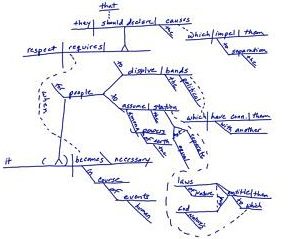 I keep a long list of books to read, and occasionally update it with what I have read. The list mostly comes from book reviews, and once in awhile the review itself has a really great sentence, like this one today from Marilyn Stasio, from her review of Richard Lange’s ANGEL BABY in the NY Times Book Review:
“When you find yourself rooting for the killer in a grisly crime novel, you know you’re in the hands of a real writer.”
This reminded me of my reaction to Evan Connell’s masterpiece, Diary of a Rapist, which I read decades ago. Not that I was exactly rooting for the rapist, but I felt I was seeing him from the inside. Needless to say, Angel Baby is now on my list.
Short Talks
I went to hear Anne Carson read. She is a classical scholar, poet, and essayist. I’m sure there’s a label for what she does–odd syntax, sometimes odd formats, a bit of scholarly snarkiness, and sometimes very beautiful language–you can read a review of her work here. Here’s a sample from a book titled Short Talks: Continue reading “Short Talks”
An exemplary sentence
I’ve been enjoying a book of essays on poetry, Madness, Rack, and Honey, an excellent read for literary-minded. I’ve mentioned the author, Mary Ruefle, before. There are many thought-provoking ideas interlaced in her very conversational, deceptively rambling style. Here’s one I like, from “Someone Reading a Book is a Sign of Order in the World”:
“Once this thought crossed my mind: every time an author dies, out of respect a word should also pass out of being. A word the author loved and used repeatedly in writing–that word should be theirs and die with them. Continue reading “An exemplary sentence”
Two parties for Poetry Monday
 Lisa Alvarez, whose blog The Mark on the Wall often features interesting poems as well as literary events in Orange County, mentioned on Facebook that it was her son’s 11th birthday. Thinking about children’s parties reminded me of two poems by Sharon Olds, who recently won the Pulitzer Prize. These two are from her second book, The Dead and the Living:
Rite of Passage
As the guests arrive at my son’s party
they gather in the living room–
short men, men in first grade
with smooth jaws and chins. Continue reading “Two parties for Poetry Monday”
A Narrative Poem
In the past, poems often told a story. There are great narrative poems like the Odyssey or Beowulf, and many shorter examples up through the 1900s. But in the world of contemporary poetry, narrative is rare. Philip Levine’s work sometimes tells a story, I can think of a few poems of Ed Hirsch, and the famous poem “The Shirt,” by Robert Pinsky. You can probably think of others. But most of what we call poetry now is lyric verse, an image, an impression, a feeling, a puzzling through the complexities of daily life.
 Perhaps this is why this extraordinary poem by Brigit Pegeen Kelley that appears just to tell a story is so powerful. I say “appears” because this may be real or may not, but in either case is enhanced by the language of the telling: