Another poem at least partially about poetry…ekphrastic?

I know it’s been almost a week, but here’s another poem as part of the ekphrastic series, assuming a poem about a poem can be in that category. This one is by Jack Spicer, one of the poets Larry first introduced me to when I came to the West Coast decades ago. Like Lew Welch, Philip Whalen, Gary Snyder, his work was different than anything I’d seen before.

Any fool can get into an ocean…

Any fool can get into an ocean
But it takes a Goddess
To get out of one. Continue reading “Another poem at least partially about poetry…ekphrastic?”

Ekphrastics, take two

In the comments to yesterday’s post on ekphrastic poetry, a reader asked if I’d ever written a poem about a poem. Self-referential creatures that we are, poets often write about poems, and I’m no exception. So here in order, are the poem and the poem referencing the poem:

Nope.

Now that I reread this poem, I don’t want to put mine in the same post.  You can read mine here, and if you like, you can go read (or listen to) the amazing Tony Hoagland poem it references from its more illustrious home on the web, where it deserves to be.

Stuck in the Middle

When we get back from the reading,
I look for the poem
Tony Hoagland didn’t read
and go in to read it to Larry

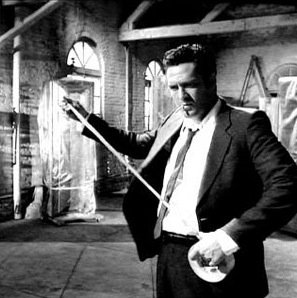
but he’s watching the scene with the knife
and the duct tape from Reservoir Dogs,
grinning and eating pistachios.
I have to look away. Continue reading “Ekphrastics, take two”

Ekphrastics

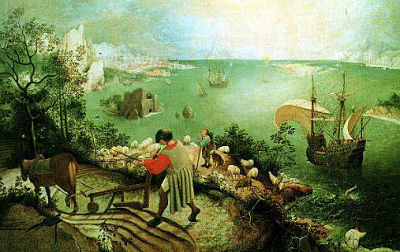
No, they’re not acrostics–ekphrastics (sometimes spelled ecphrastics–but doesn’t it seem more Greek with the k?) are written descriptions of a graphic work of art. Perhaps the most famous ekphrastic poem is Auden’s “Musee des Beaux Arts,” about Breughel’s painting, The Fall of Icarus, in which you can just see his leg to the right of the boat as he falls into the water, but no one is paying particular attention:

Musee des Beaux Arts

About suffering they were never wrong,
The old Masters: how well they understood
Its human position: how it takes place
While someone else is eating or opening a window or just walking dully along;
Continue reading “Ekphrastics”

We’re back

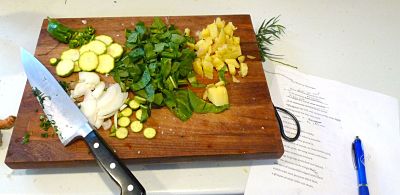
After a long plane ride (this one was 11+ hours!), it often feels to me like I am still trailing molecules of myself along the flight path, and it takes awhile to feel reassembled in one place. Today, three days at home, I finally feel here. I celebrated by working on a poem and making a real breakfast from the garden enhanced with salt from the Camargue.

Both the literary and the culinary work were satisfying, with the hens still contributing a few eggs. Continue reading “We’re back”

Sliver of moon

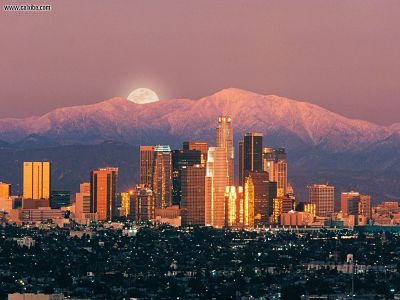
I’ve been thinking about this poem by Martha Ronk. It seems to me to be about a full moon.

The Moon over L.A.

The moon moreover spills onto
the paving stone once under foot.
Plants it there one in front.
She is no more than any other except her shoulders forever.
Keep riding she says vacant as the face of.
Pull over and give us a kiss.
When it hangs over the interchange
she and she and she. A monument to going nowhere,
a piece of work unmade by man. O moon
rise up and give us ourselves awash and weary—
we’ve seen it all and don’t mind.

Martha Ronk

Although the syntax is fractured, it makes perfect sense.  It might be radically accessible or might not. What do you think? Oh and I called this post sliver of moon because what made me think of this poem was the sliver of moon at the horizon tonight, as black clouds scudded against a pale gold sky.

The fascination of translation

I don’t know exactly why translating poetry is so fascinating. For me, it’s a way to work on a poem when I have no ideas of my own. The demands of translation–the fact that a literal translation just won’t do, and that you have to try to somehow capture the spirit of the poem without straying too far from the literal–is the challenge and the art. In some ways, I feel that all poetry is translation–sometimes I’m trying to translate my own glimmers of an idea, sometimes those of someone else.

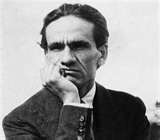
A decade ago, when Bob Hass had his weekly poetry column in a number of daily papers, he printed a translation of a poem by the Peruvian poet Cesar Vallejo. I’ve mentioned these columns before–they’ve been collected into two books, Poet’s Choice and Now and Then–great morning readings, both of them. You can find Bob’s original column on Vallejo in the Washington Post archives.

At the time I didn’t know about the column, and happened to read the one on Vallejo riding home on BART, chancing on it in an abandoned copy of the San Francisco Examiner.  Bob printed the Stanley Burnshaw translation and one of his own. Ed Hirsch, when he did his own version of Poet’s Choice, printed Robert Bly’s translation. Here is the Spanish: Continue reading “The fascination of translation”

A day late

Once in awhile a strong aversion to poetry comes over me, a sort of distaste for its pretentiousness. Like Marianne Moore, I, too, don’t like it. Yesterday was one of those days, and despite reading through a number of things, I couldn’t select one to send out, although it was Poetry Monday.  But this morning I remembered this, by Marie Howe. Her book by the same title is definitely worth owning:

What the Living Do Continue reading “A day late”

Quelle surprise!

In my desultory explorations for new poetry, I opened an anthology over breakfast and found this:

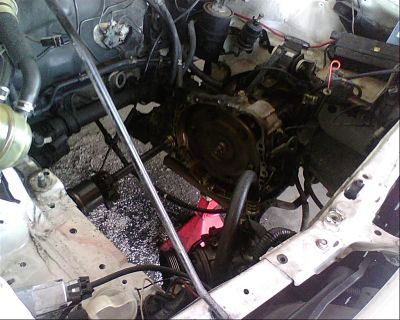
I Pick Up a Hitchhiker

After a few miles he tells me
that my car has no engine.
I pull over, and we both get out
and look under the hood.
He’s right.
We don’t say anything more about it
all the way to California.

Jay Leeming

Continue reading “Quelle surprise!”

Simplicity

There are few poets who can write something as apparently simple as this and make it work, but Bill Merwin is one. As Larry said, when I read it to him–a poem like this really depends on the ending. This one carries the weight effortlessly.

I’ve posted a poem of Merwin’s before, and just found this one to add to the Radically Accessible Poetry collection:

A Contemporary

What if I came down now out of these
solid dark clouds that build up against the mountain
day after day with no rain in them
and lived as one blade of grass
in a garden in the south when the clouds part in winter
from the beginning I would be older than all the animals
and to the last I would be simpler
frost would design me and dew would disappear on me
sun would shine through me
I would be green with white roots
feel worms touch my feet as a bounty
have no name and no fear
turn naturally to the light
know how to spend the day and night
climbing out of myself
all my life

W.S. Merwin

As for the salon yesterday, I think it was an exceptionally fine afternoon that included memoir, a trumpet and piano duet, a sampling of Fleur de Caramel perfume, photos, art, and many poems, not to mention good food and great company.

Four Poets

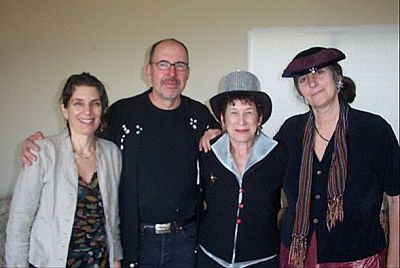
“Luxury is who you’re with,” my friend Maureen said years ago, and one of the true luxuries in my life is to be part of a group of poets I respect who meet regularly to discuss our work. Two of the poets I met at the Squaw Valley Poetry Workshop in 2001, and we have been in various permutations of this group since then. About five years ago, we morphed into this current group of four. We manage to meet once a month despite the myriad events that conspire against it. By now we know each others’ work and are comfortable enough and know enough about our strengths and weaknesses that our criticism is both honest and valuable.

The four of us started hosting a Sunday Salon, dubbed Salon 77, on an irregular basis. Lisa, the letterpress printer among us, prints the invitation, and we each get ten. Poets, writers, musicians, artists, sculptors and appreciators all show up, eat, talk, and have a few minutes each to show their work. Here is a blurry shot of us from the first Salon in 2009.

The next Salon is this Sunday, and as most of you won’t be there, here’s a sample of our work from yesterday’s poetry group:

Continue reading “Four Poets”

More on Jack Gilbert

Littoral Press is printing a new book of poems by Steven Rood, I Say Their Names. Among the poems is this one referencing Jack Gilbert, which he kindly allowed me to post here:
Last Things

The old man still wants to write poems.
But can’t see or make a pen work.
He also repeats things. He asks me
what the tone of my life is. Tone, Jack?
Desperate, fearful, deep, courageous, happy?
Yes, Jack, all of them. That’s good, he says.
And wants to know what the shape
of my life is. Shape, Jack? Drifting,
floating, purposeful, incidental, flowing?
Yes, Jack, all of them. That’s good, he says.
Then asks me what the tone of my life is.
And its shape. I answer more carefully,
so that I really do think I have power, deep, and fear
as my tones, and uncertainty as my shape.
I was frightened, he says, that you would just float.
What do you want to do with the rest of your life? he asks.
Which he asks of everyone in the assisted living facility.
As a result, he thinks, all the residents hate him.
I tell him I love him and the way he asks his questions,
over and over, until an answer begins to clarify
as I stutter and sound stupid trying to make sense
out of myself inside his bewildering
assignments. That’s the way he’s always taught.
The strange mind and immense feeling
twisting himself and me into odd angles.
His tone is truth and will. His shape is helpless.
The rest of his life is grief.

Steven Rood
[for Jack Gilbert]

Interesting how one thing leads to another.