Drought Poem

This is one of the poems I’ll be reading this Saturday for the event at the North Berkeley Library, Poems of Berkeley.  Details here.

oldsGabriel and the Water Shortage

When the water shortage comes along
he’s been waiting all his life for it,
all nine years for something to need him as
the water needs him now. He becomes
its protector–he stops washing, till dirt
shines on the bones behind his ears
over his brain, and his hands blaze like
dark blades of love. He will not
flush the toilet, putting the life of the
water first, until the bowl
crusts with gold like the heart’s riches and his
room stinks, and when I sneak in and
flush he almost weeps, holds his
hands a foot apart in the air and
says do I know there is only about
this much water left! He befriends it, he Continue reading “Drought Poem”

Poems of Berkeley

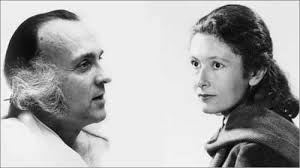
duncanAs part of poetry month, Susan Cohen (a fellow poet) and I are orchestrating a reading of poems about Berkeley at the North Branch of the Berkeley Public Library on the afternoon of Saturday, April 25. Gathering poems for the event, I wanted to include something by Robert Duncan, who was a romantic and powerful figure in the poetry scene in the Bay Area in the sixties.  Here he is with Denise Levertov, another poet we’re including., along with Ginsberg, Spicer, Robert Hass, Brenda Hillman, Chana Bloch, and others–hard to narrow it down to 20 poems.

Duncan held dawn readings on Mt. Tamalpias and was part of the legendary Six Gallery reading in San Francisco. Larry has a large broadside of his most famous poem, My Mother Would be a Faconress. But this quieter, mysterious poem of his is one of my favorites.

Often I Am Permitted to Return to a Meadow

as if it were a scene made-up by the mind,
that is not mine, but is a made place, Continue reading “Poems of Berkeley”

Migratory

Next week I’m heading to New York for the William Dickey Memorial Broadside Contest reading. Mark Doty will be the featured reader.  He’s a marvelous poet.  Here’s  one of my favorites of his poems.

Migratory

Near evening, in Fairhaven, Massachusetts,
seventeen wild geese arrowed the ashen blue
over the Wal-Mart and the Blockbuster Video,

and I was up there, somewhere between the asphalt
and their clear dominion—not in the parking lot,
its tallowy circles just appearing,

the shopping carts shining, from above,
like little scraps of foil. Their eyes
held me there, the unfailing gaze

of those who know how to fly in formation,
wing tip to wing tip, safe, fearless.
And the convex glamour of their eyes carried

the parking lot, the wet field
troubled with muffler shops
and stoplights, the arc of highway

and its exits, one shattered farmhouse
with its failing barn… The wind
a few hundred feet above the grass

erases the mechanical noises, everything;
nothing but their breathing
and the rowing of the pinions,

and then, out of that long percussive pour
toward what they are most certain of,
comes their—question, is it? Continue reading “Migratory”

Irish poems

824_egrennanThe Irish Times has been running a contest to select the 100 best loved Irish poems (chosen by whomever responds, I guess). You can read the results here. Not surprisingly, Yeats, Heaney, and Kavanagh populate the top ten.

But here’s a poem from a poet who wasn’t included, Eamon Grennan, perhaps because he’s lived most of his adult life in the United States. It seems like a very Irish poem to me.

Edge

When I’d walked out to the sea surfing and spuming
into meerschaum heaps of lettuce-tinted gauze,
breakers becoming light then noise, the ocean raging
and rearranging this long spit of sand like a life
at the mercy of circumstance, I saw the north wind Continue reading “Irish poems”

A delightful reading

images-2Last week I drove down to Stanford to hear Ellen Bryant Voigt read. I had heard of her, but not read much of her work. It was worth the long drive through the increasingly dense traffic of the Bay Area. The words that come to mind are vibrant authentic.

Here is a poem from her new book. Unlike her earlier books, these poems dispense with punctuation, but I think you will be able to decipher the poem’s sense without it:

Roof

after a week of heavy snow I want to praise my roof first
the acute angle at which it descends form the ridgepole
and second that it is black the color absorbing
all the other colors so that even now as arctic air Continue reading “A delightful reading”

Befriending Frankenstein

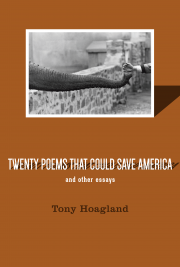
hoaglandI have been reading Tony Hoagland’s newest book of essays, Twenty Poems that Could Save America (published by Graywolf Press, a wonderful imprint). In his first essay, “Je Suis ein Americano: the Genius of American Diction,” he talks about the current direction of American poetry, the experimentation, the fractured language and syntax, the shifts and ruptures of trying to cobble together something fresh.  This is the final paragraph:

“American English is a great experiment in progress, and American poetry is its laboratory on a hill. Several decades ago, Tim Dlugos published a chapbook of poems with the title Je Suis ein Americano, as if making the point of this essay in brief. I suppose the mythic analog might be the story of Frankenstein’s monster. The creature we know as Frankenstein is patched together by a mad doctor, who employs a cut-and-paste method using the recycled parts of executed criminals. The monster escapes, descends from the mountain, and terrorizes the villagers. It sounds a lot like postmodernism, doesn’t it? Yet the big, interestingly fabricated fellow is trying to communicate something—maybe he just wants a hug, but he can’t make himself understood to the frightened townspeople. Their natural-enough tribal reaction is to try to kill him. In American poetry, too, the boundary between the natural and unnatural continues to shift, and American poets keep pushing the limits, searching for a creation at once wide awake and divine.”

So for today, here’s a poem by Dean Young. He plays with set phrases, awkward translations, myths, and most of all expectations. Don’t worry about making sense of it (though I think it has a delightful, deep, cumulative logic). Just revel in his surprising images and word choices, which are always fresh:

Changing Your Bulb

I disconnect the power for at least
five minutes until your bulb is cool
and no longer producing song through
small chewing devices at the end
of its beak.  Clunk goes the tipped-over
pounce-meat.  When I change your bulb,
am I really changing my own?  This concludes
these opening remarks.  Later you will be asked
to repeat them as a test of metal decay.
Now take your steel ring by any sharp
of tool at place of two gap or at least
that’s what the instructions say.
Maybe you were made in Tunisia.
I have loved you longer than my one life.
In the north, Siegfried rests after his hunt.
The new adults go into summer hibernation,
called aestivation but we are just waking.
Wing-wear: always a troublement, but there,
in the Wild Valley and Forest of the Rhine
your new bulb gets installed, acting mainly
as an exacerbation to fuzzy brain function.
I feel like I’m approaching a cliff wrapped
in an enormous kite, cheery as life insurance
and I can’t be sure if the statuary
is of rich citizens or supernatural forces. Continue reading “Befriending Frankenstein”

Eyesight

ammonsDriving up I-5 from LA yesterday, spring had come to California. The hills are briefly green and gold, and the orchards all in bloom. I thought of this poem by A. R. Ammons, and was surprised to find I haven’t posted any of his work.  Here’s a poem to remedy that:

Eyesight

It was May before my
attention came
to spring and

my word I said
to the southern slopes
I’ve

missed it, it
came and went before
I got right to see: Continue reading “Eyesight”

Sharon Olds on Monday

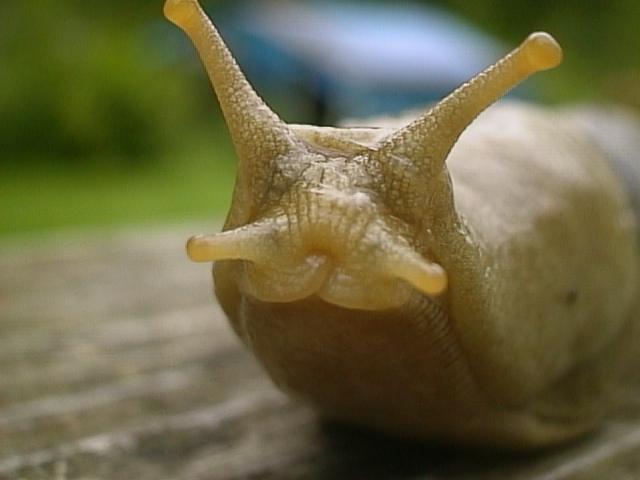
slug6I had forgotten this wonderful poem by Sharon Olds. Then I saw, after the rain last week, one of these big banana slugs in the garden and went to look for it. It didn’t disappoint me:

The Connoisseuse of Slugs

When I was a connoisseuse of slugs
I would part the ivy leaves, and look for the
naked jelly of those gold bodies,
translucent strangers glistening along the
stones, slowly, their gelatinous bodies
at my mercy. Made mostly of water, they would shrivel
to nothing if they were sprinkled with salt,
but I was not interested in that. What I liked Continue reading “Sharon Olds on Monday”

Contemporary poetry

a-e-stallingsI went to a poetry reading at the incomparable University Press Books bookstore (support it!) this weekend, and the subject of accessibility came up. One reader, Rebecca Foust, mentioned that her mother, who never went further than high school, memorized and loved Robert Frost’s poems. Though his poems, to a poet, are layered and complex, Rebecca said her mother went to them for simple comfort.

This is very hard to achieve today, when we have largely shed form, and the adjective “accessible” often denigrates a poem. But here’s a great example of a layered, accessible contemporary poem by A.E. Stallings that includes rhyme, poetic and prosaic allusions, and humor:

Pop Music

Musicfor a new parent

The music that your son will listen to
To drive you mad
Has yet to be invented. Be assured
However, it is approaching from afar
Like the light of some Chaldean star. Continue reading “Contemporary poetry”

Knucklebones

Here’s an odd little poem I came across:

Astragaloi

We know there must be consciousness in things,

In bits of gravel pecked up by a hen

To grind inside her crop, and spider silk

Just as it hardens stickily in air,

And even those things paralyzed in place,

The wall brick, the hat peg, the steel beam

Inside the skyscraper, and lost, forgotten,

And buried in ancient tombs, the toys and games,

Those starry jacks, those knucklebones of glass

Meant for the dead to play with, toss and catch

Back of the hand and read the patterns of,

Diversions to beguile the endless time,

Never to be picked up again…They’re thinking,

Surely, all of them. They are lost in thought.


Mark Jarman, from To The Green Man, Saraband Books

Poet, too

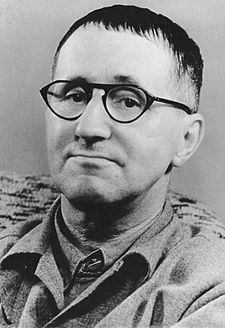
225px-Bertolt-BrechtI think of Bertolt Brecht as a playwright, mostly his collaboration with Kurt Weill and the often performed Threepenny Opera. But he was also a poet, and this poem of his made me laugh as well as think:

The Buddha’s Parable of the Burning House

Gautama the Buddha taught
The doctrine of greed’s wheel to which we are bound, and advised
That we should shed all craving and thus
Undesiring enter the nothingness that he called Nirvana.
Then one day his pupils asked him:
What is it like, this nothingness, Master? Every one of us would
Shed all craving as you advise, but tell us
Whether this nothingness which the we shall enter
Is perhaps like being one with all creation
When you lie in water, your body weightless, at noon,
Unthinking almost, lazily lie in water, or drowse,
Hardly knowing now that you straighten the blanket,
Going down fast–whether this nothingness, then,
Is a happy one of this kind, a pleasant nothingness, or
Whether this nothingness of yours is mere nothing, cold, senseless and void.
Long the Buddha was silent, then said nonchalantly:
There is no answer to your question.
But in the evening, when they had gone,
The Buddha still sat under the bread-fruit tree, and to the others,
Those who had not asked, addressed this parable: Continue reading “Poet, too”