The exemplary sentence

Sentence DiagramI picked up a novel by John D. MacDonald, and while I don’t think he’s in the same class as Raymond Chandler or Dashiell Hammet, he wrote a lovely description of the start of a hurricane:

“It began earlier, and in a timeless way. Flat sea baking under a tropic sun. Water temperature raised by the long summer. The still air, heated by sun and sea, rising endlessly, creating an area of low pressure to be filled by air moving in from all sides to rise in turn. Continue reading “The exemplary sentence”


The exemplary sentence

Sentence Diagram

I’ve been reading George Eliot’s Daniel Deronda, or rather skimming much of it. It’s long and rather overwritten, though Eliot can write!

It seems to me a book that would make a wonderful period movie. The plot involves many twists, including a lenghty and interesting perspective on how Jews were seen in 1800s. One focal point of the novel is the evolution of  a heedless, impoverished, but well-intentioned beauty who marries a cold, mean-spirited man named Grandcourt for his money and position.

This little sentence captures Grandcourt’s character perfectly:

It is true that Grandcourt went about with the sense that he did not care a languid curse for any one’s admiration, but this state of not-caring, just as much as desire, required its related object—namely, a world of admiring or envying spectators: for if you are fond of looking stonily at smiling persons, the persons must be there and they must smile…

An exemplary sentence

41K5ATQ9E5LAlthough I primarily know him as a poet, I love Adam Zagewski’s prose. Here is a snippet from his memoir of his student days in Krakow, Another Beauty,  beautifully translated by Clare Cavanagh. It’s about the cleaning lady for his student apartment:

She was a magpie, a snoop. I suspected her of regularly rummaging though our things and once left a card that said “Please don’t look here” in my desk drawer. Helena took offense and didn’t speak to me for several days, and then, when her anger had subsided, she reproached me bitterly: “How could you even think such a thing? So you don’t trust me at all.” Continue reading “An exemplary sentence”

The exemplary sentence

zagajewskiI picked up a book of essays by Adam Zagajewski, called In Defense of Ardor, an elegant title. The title essay discusses the role of irony in modern writing, and makes a case for less of it, more engagement. It’s worth reading in it’s entirety if that subject interests you.  But the quote today is from the essay “The Shabby and the Sublime,” about the act of writing.

“Maybe we’re not altogether alone in our empty room in our workshop: if so many writers love solitude it may be because they’re not really all that lonely. There really is a higher voice that sometimes–too rarely–speaks. We catch it only in the moments of our greatest concentration. This voice may only speak once, it may make itself heard only after long years of waiting: still, it changes everything… Continue reading “The exemplary sentence”

The immigrant writer

KimaSo many writers and artists have had to leave their country for political reasons. In his wonderful, strange novel, Love and Garbage, the Czech writer, Ivan Klima (translated by Ewald Osers) articulates the problems of exile succinctly. He is at a party at a university in the United States:

“…they all turned out to be pleasant to me and full of smiles as Americans are, and with varying degrees of urgency they asked me to explain what on earth possessed me to want to leave their free and wealthy country to return home, to a poor and unfree country, where they’d probably lock me up or send me to Siberia.  I tried to be equally pleasant. I conjured up some kind of patriotism, some kind of mission, until I hit on a convincing explanation. I said that back home people knew me. Even if I had to sweep up garbage in the streets I would be for them what I was, what I wanted to be to the exclusion of anything else, a writer, whereas here, even if I could drive around in my little Ford, I would always be just one of those immigrants on whom a great country had taken pity. These were my boastful words. In reality I wanted to return home, to the place where there were people I was fond of, where I was able to speak fluently, to listen to my native language.”

Continue reading “The immigrant writer”

The exemplary sentence

Sentence DiagramI am lucky to have read three excellent books in a row, Monsieur Monde Vanishes, by Georges Simenon in a new translation by Jean Stewart, My Brilliant Friend by Elena Ferrante (translated by Ann Goldstein), and The Other Language, a book of stories by Francesca Marciano.

other languageThe stories in the The Other Language are sharply observed vignettes from Italy, Africa, Paris, New York. Almost all have a middle-aged female protagonist. Here are a few lines from “The Presence of Men,” about a very gentle yoga-teacher’s reaction to a husband’s affair:

“Lara stood up from the kitchen table, where they were eating a spinach and beluga lentil salad, and hurled the plate across the room. She saw the crumbled feta scatter in slow motion, then land on his shirt like snowflakes.
She detected a flash of terror in his eyes and knew that at last she’d gained some power over him. She immediately furthered the opportunity and slapped him in the face. Continue reading “The exemplary sentence”

That man can write!

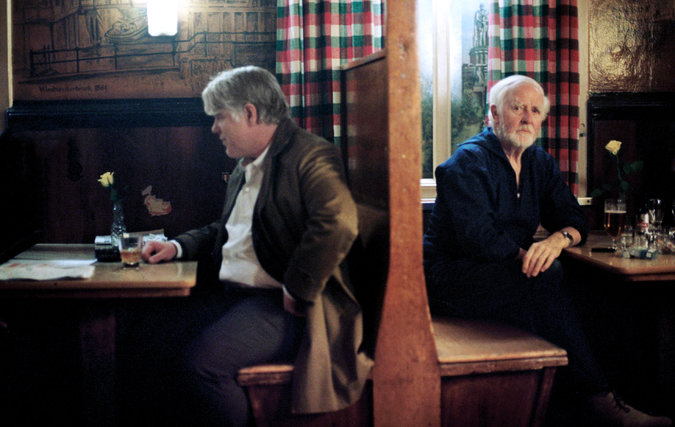
Larry read me an article by John le Carré in the NY Times Suday about Philip Semour Hoffman in the film “A Most Wanted Man,” a remembrance more than an obituary. It was beautifully written.  Here are a few excerpts:

20HOFFMAN-master675Philip took vivid stock of everything, all the time. It was painful and exhausting work, and probably in the end his undoing. The world was too bright for him to handle. He had to screw up his eyes or be dazzled to death. Like Chatterton, he went seven times round the moon to your one, and every time he set off, you were never sure he’d come back, which is what I believe somebody said about the German poet Hölderlin: Whenever he left the room, you were afraid you’d seen the last of him. And if that sounds like wisdom after the event, it isn’t. Philip was burning himself out before your eyes.”

It’s hard now to write with detachment about Philip’s performance as a desperate middle-aged man going amok, or the way he fashioned the arc of his character’s self-destruction…  Philip had to have that dialogue with himself, and it must have been a pretty morbid one, filled with questions like: At which point exactly do I lose all sense of moderation? Or, why do I insist on going through with this whole thing when deep down I know it can only end in tragedy? But tragedy lured Bachmann like a wrecker’s lamp, and it lured Philip, too.” Continue reading “That man can write!”

An exemplary sentence

Sentence DiagramLately I have been enjoying the Saturday “Review” section of the Wall Street Journal a lot more than the NY Times “Book Review.” This is an excerpt of a Polish author,  Marek Hlasko, from a review by Nathaniel Popkin. It’s from Beautiful Twentysomethings, Hlasko’s autobiography. I’m going to have to read the book:

Hlasko“There are few nations who have so many chances for good literature as we, the Poles, do.  We’ve got everything: misfortune, political assassinations, eternal occupation, informers, mystery, despair, drunkenness. By God, what else could you ask for? When I was in Israel, I lived with the scum of the earth, but still I never met people as desperate, detestable, and unhappy as in Poland.”

Continue reading “An exemplary sentence”

An exemplary sentence

Sentence DiagramOnce in awhile a sentence in a newspaper article startles me with its inventiveness, like this one by Natalie Angier from an article on Trilobites in the Tuesday Science Times.

The scientist points to “a flawless specimen of Walliserops, a five-inch trilobite that swam the Devonian seas around what is now Morocco some 150 million years before the first dinosaurs hatched. With its elongated, triple-tined head horn and a bristle brush of spines encircling its lower body, the trilobite could be a kitchen utensil for Salvador Dali.” Continue reading “An exemplary sentence”

More on Diana Moon Glampers, a short rant

I’ve written before about Kurt Vonnegut’s satirical short story, “Harrison Bergeron,” and its Handicapper General, Diana Moon Glampers. She’s the one who makes sure no one stands out as better than anyone else by assigning the appropriate handicap. This doesn’t seem so much like satire in the current environment of political correctness.

imagesI just came across a reaction by Zoë Heller to the proposition posited by Lee Siegel for The New Yorker and Isaac Fitzgerald at BuzzFeed that reviewers should only publish positive book reviews. Siegel and Fitzgerald feel we shouldn’t say anything negative about the poor authors who have worked so hard. Heller makes the case that banning “negativity” is bad for the culture and unfair to authors. I couldn’t agree more. In fact I more than agree. Continue reading “More on Diana Moon Glampers, a short rant”

The Exemplary Sentence

Sentence DiagramI have been reading a book by an anonymous woman, called A Woman in Berlin. It’s a diary of the period between late April and mid-June 1945. It describes the fall of Berlin and its takeover by the Red Army. Society is  in collapse, and the book is amazingly frank, thoughtful, and unsentimental. Much of it details the simple tasks of staying alive, managing not to be raped by too many of the soldiers, finding food and relative safety.

Here are a few snippets:

“These days I keep noticing how my feelings toward [German] men–and the feelings of all the other women–are changing. We feel sorry for them: they seem so miserable and powerless… The Nazi world–ruled by men, glorifying the strong man–is beginning to crumble and with it the myth of ‘Man.’… Among the many defeats at the end of this war is the defeat of the male sex.” Continue reading “The Exemplary Sentence”

Welcome to the Monkey House

vonnegutI’ve been listening to these Kurt Vonnegut stories on DVD after reading them many years ago. Some are cranky and clunky, but many hold up pretty well. The one I remembered was “Harrison Bergeron,” a story set in the future, where everyone is fully equal–the more extraordinary your talents, the greater the handicap you are issued by Diana Moon Glampers, the Handicapper General.

FairnessWhile an exaggeration, we have often invoked Diana Moon Glampers when reading about some act of extreme political correctness, and I remembered the story pretty accurately. Continue reading “Welcome to the Monkey House”