 The New Yorker arrives with relentless regularity even though our subscription expired in July. This week, there are excerpts from a diary Flannery O’Connor kept in when she was in her twenties, recently accepted to the Iowa Workshop. My first reaction was indignation. Clearly these were the private struggles of a young, truly spiritual woman and NOT MEANT TO BE READ by anyone else. Why are they here? And why did they use such an unflattering photo? Poor Flannery. Continue reading “The tortures of the damned”
Category: Prose
Foggy day with kittens
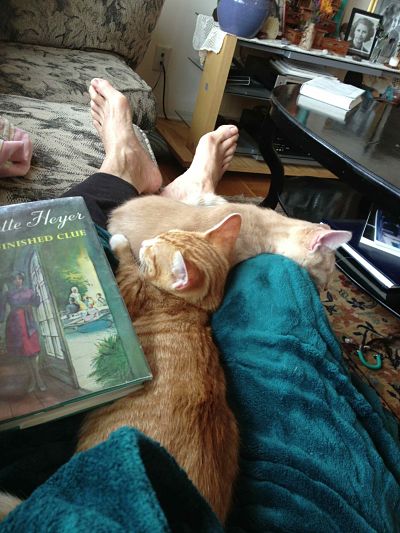 Yesterday was cold, windy and foggy. It might as well have been January. The kittens and I spent most of it on the couch with a good book, another Georgette Heyer novel. A perfect lazy day.
Summer reading
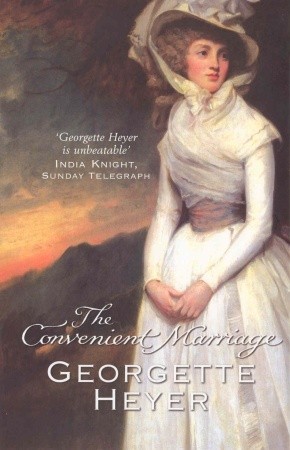 This category seems to include both worthy projects–that is demanding books one ought to read but never has–and utterly undemanding books one can take the beach and laze away with on a summer’s day. Of course, summer on the coast of Northern California is a typically cold and foggy affair, but the premise still holds, and I fall squarely in the summer reading as confection category.
Top on my list is The Convenient Marriage, by Georgette Heyer, which I finished in an all-day marathon yesterday. It’s thoroughly delicious, with hints of Austen and Pym,. If you like either of these superb satirizers of English manners, Heyer is a true find. The plot hinges on the necessity of a woman of good birth but small means marrying a wealthy man to pay off the family debts–such a common theme, but with a twist. The eldest beauty, though in love with a poor lieutenant, is to sacrifice herself in marriage to the wealthy Lord Rule (perfect name). Her 17-year-old sister, not a beauty and with dark eyebrows a stutter, determines to offer a counter proposal, and goes to speak to Lord Rule herself:
“…It is because of L-Lizzie–my sister. You have offered for her, haven’t you?”
Slightly taken aback, the Earl bowed. Horatia said in a rush: “C-could you–would you mind very much having m-me instead?”
The Earl was seated in a chair opposite to her, absently swinging his eyeglass, his gaze fixed on her face in an expression of courteous interest. The eyeglass stopped swinging suddenly, and was allowed to fall. Horatia, looking anxiously across at him, saw a rather startled frown in his eyes, and hurried on: “Of c-course I know it ought to Charlotte, for she is the elder, but she said nothing would induce her to m-marry you.”
His lips quivered. “In that case,” he said, “it is fortunate that I did not solicit the honour of Miss Charlotte’s hand in marriage.”
“Yes,” agreed Horatia. “I am sorry to have to say it, but I am afraid Charlotte shrinks form the idea of m-making such a sacrifice, even for L-Lizzie’s sake.” Rules shoulder’s shook slightly. “Have I said s-something I shouldn’t?” inquired Horatia doubtfully.
“On the contrary,” he replied. “Your conversation is most salutary, Miss Winwood.”
“You are laughing at me,” said Horatia accusingly. “I daresay you think I am vey stupid sir, but indeed, it is most serious.”
“I think you are delightful,” said Rule. “But there seems to be some misapprehension. I was under the impression that Mis Winwood was–er–willing to receive my addresses.” Continue reading “Summer reading”
An exemplary sentence
 I keep a long list of books to read, and occasionally update it with what I have read. The list mostly comes from book reviews, and once in awhile the review itself has a really great sentence, like this one today from Marilyn Stasio, from her review of Richard Lange’s ANGEL BABY in the NY Times Book Review:
“When you find yourself rooting for the killer in a grisly crime novel, you know you’re in the hands of a real writer.”
This reminded me of my reaction to Evan Connell’s masterpiece, Diary of a Rapist, which I read decades ago. Not that I was exactly rooting for the rapist, but I felt I was seeing him from the inside. Needless to say, Angel Baby is now on my list.
Finding a good book
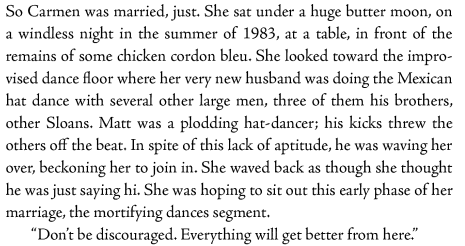
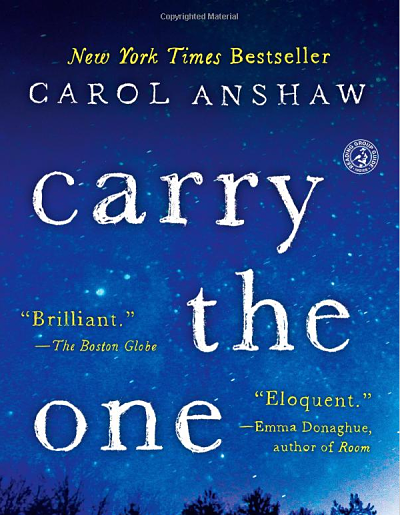 Last week in DC, I sat down in Kramerbooks and read a short story by Carol Anshaw in the the Best American Short Stories 2012. I liked it so much, I immediately bought her novel Carry the One. I wasn’t disappointed. This writing is rich with imagery, the characters are complex, contemporary, and believable, and the moral dilemmas thought-provoking and not easily solved. Here is the opening:
The Exemplary Sentence
Forty years ago or so, I saw the Japanese film, Woman in the Dunes. It made a vivid impression on me, and the other day, I happened on the novel it was made from, by Kobo Abe. Here is a section from the opening chapters of the novel, translated by E. Dale Saunders. The man is wandering through the dunes, searching for insects:
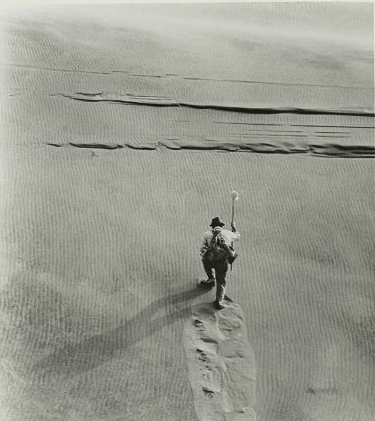
“The barrenness of sand, as it is usually pictured, was not caused by simple dryness, but apparently was due to the ceaseless movement that made it inhospitable to all living things. What a difference compared with the dreary way human beings clung together year in and year out.
“Certainly sand was not suitable for life. Yet, was a stationary condition absolutely indispensable for existence? Didn’t unpleasant competition arise precisely because one tried to cling to a fixed position? If one were to give up a fixed position and abandon oneself to the movement of the sands, competition would soon stop…
“While he mused on the effect of the flowing sands, he was seized from time to time by hallucinations in which he himself began to move with the flow.”
 Of course the man, always unnamed, soon has ample time to reflect on all aspects of sand. I found the novel excruciating! But I still remember the beautiful black and white images of the movie.
Another exemplary sentence
Regular readers will remember this feature, (with a nod to Mark Doty’s blog). The sentence that caught my attention today is from a book I’m wasn’t too crazy about, called Seating Arrangements, by Maggie Shipstead. I didn’t finish the book, but for some reason I loved this little sequence.
 “You ought to go to law school,” Oatsie said decisively, “You’d make a wonderful lawyer. You have beautiful hair.”
“Thank you,” Livia said. When she was old, she wanted to be like Oatsie: imperious, brusque, and given to non sequitur. Continue reading “Another exemplary sentence”
Bad books
 Last week I read through the “notable books of 2012” section of the NY Times Book Review and put in reserves at the library for a bunch of them. So far, I’ve started and given up on five of them in short order:
Shout Her Lovely Name, by Natalie Serber. The stories in this collection felt contrived and the mostly young women heroines seemed imagined, not real. Contrast this to How to Breathe Underwater, by Julie Orringer. The mostly young women heroines in these stories fairly leap off the page with authenticity. Continue reading “Bad books”
What was she thinking?
i s the title of a novel by Zoë Heller that I just finished. The fictionalized story of a 40-year old female teacher at a London high school who has a sexual relationship with a 15-year old boy, it’s told from the point of view of an acerbic, older woman teacher, in the school. Barbara’s observations are unsparing. For example, her description of the school:
“St. George’s is the holding pen for Archway’s pubescent proles–the children of the council estates who must fidget and scrap here for a minimum of five years until they can embrace their fates as plumbers and shop assistants…. Many of the younger reachers harbour secret hopes of ‘making a difference.’ They have all seen their American films in which lovely young women tame innercity thugs with recitations of Dylan Thomas. They, too, want to conquer their little charges’ hearts with poetry and compassion.”
Some thoughts on the common toad
Most of us read 1984 or Animal Farm in high school. But I think it’s in his essays that Orwell is without peer. They’ve just published his diaries, seventy-odd years after his death. Based on the reviews they seem mostly to track his domestic, gardening and husbandry concerns. I was excited to read that he had 10 Moroccan hens, and carefully tracked their egg production.
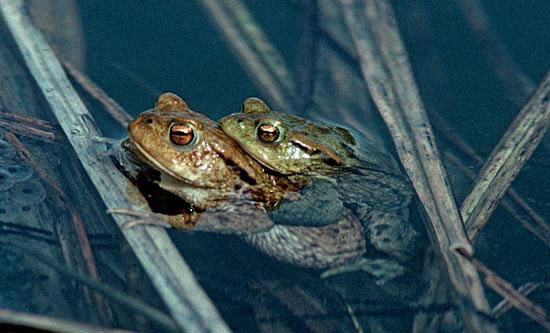 Years ago I bought the four volume set of Orwell’s essays. Volume four is my favorite. It contains essays like “Revenge is Sour,” “Such, Such Were the Joys,” and “How the Poor Die,” along with his “As I Please” columns which ran regularly. My favorite of his essays, though, is “Some Thoughts on the Common Toad.” You can read it and his other essays online. In this one, he talks about toads mating in spring, and about spring in general and its democratic pleasures: “Even in the most sordid street the coming of spring will register itself by some sign or other, if it is only a brighter blue between the chimney pots or the vivid green of an elder sprouting on a blitzed site. Indeed it is remarkable how Nature goes on existing unofficially, as it were, in the very heart of London.” Continue reading “Some thoughts on the common toad”
Lowbrow?
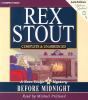 Years ago Larry and his friends conceived of a mythical motorcycle club called the Lowbrows. Their motto was “I’m a lowbrow. You figure it out.” (I never saw their motto written out, but I imagine lowbrows don’t use semicolons.) I don’t think the club had any purpose, it was more of a riff. But it came to mind when I thought about mentioning how much I love the Nero Wolfe mysteries by Rex Stout. I just finished listening to Before Midnight. Continue reading “Lowbrow?”
Virginia Woolf’s exemplary sentences
 Yesterday I got tired of driving around to PBS, SIrius/XM, KCSM, and got several books on CD from the library. (I miss Henderson!) I started with The Voyage Out. I probably read this decades ago, but have no memory of it. That’s the good thing about memory loss, Larry might say, you can hide your own Easter eggs.
But in this case, the pleasure of rediscovery includes reacquaintance with Ms. Woolf’s sly, economical wit. Here are just a few of her gems:
“..she slipped into a fine analysis of him which is best represented by one word, “sentimental,” by which she meant that he was never simple and honest about his feelings.”
What a perfect definition of what’s wrong with sentimentality! Or this, about a man who spent his life contemplating a book he never wrote:
“There never will be a book…That’s what comes of putting things off, and collecting
fossils, and sticking Norman arches on one’s pigsties.”
That’s what gets in my way, dreaming of Norman arches for the chicken coop. Or about her children’s religious education.
“So far, owing to great care on my part, they think of God as a kind of walrus…”
And finally the first one that caught my attention and made me pull over and get out my notebook (the only problem with listening while you drive is it slows your progress):