Morning reading

I set aside David Lipsky’s review of Nabokov’s Letters to Vera in Harper’s to read this morning, and was rewarded by a truly elegant piece of work.  Lipsky doesn’t just review the letters, he provides a succinct and literate overview of Nabokov’s life, his work, his long marriage. “No marriage of a major twentieth-century writer lasted longer,” he quotes from Brian Boyd’s introduction. He manages to cull and quote gems from the 864 pages and relate them to the body of Nabokov’s fiction.
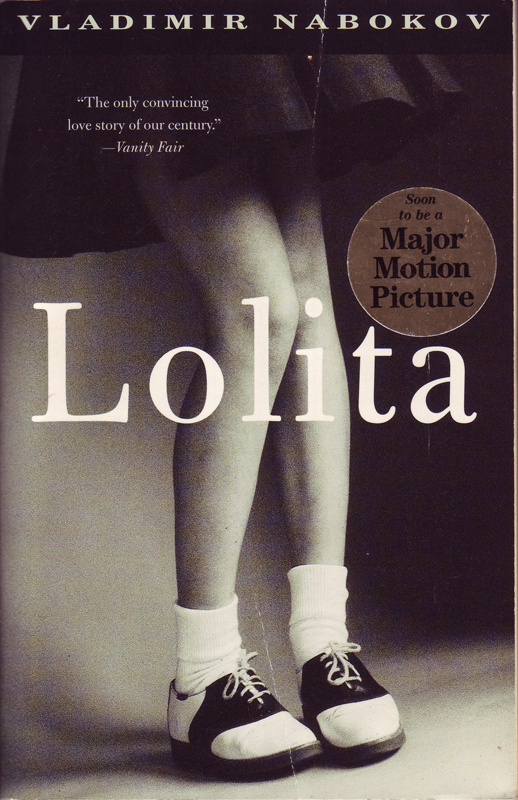
lolita1He notes the shocking intimacy of Nabokov’s work–“The hero takes a sleepy, eye-watering yawn–and the world ‘shivered and dissolved in the prism of his tears.’ …Nabokov’s people are constantly yawning scrunching, nose wiping, bug-bite scratching.”

He’s especially funny about the popular “hurricane” of Lolita, published thirty years into Nabokov’s literary career: “There were Lolita dolls, Lolita cartoons (arriving Martian: ‘Take me to your Lolita’), a Kubrick movie, a San Francisco drive-in serving Lolitaburgers.” And Eichmann–instrumental in the murder of (among others, Nabokov’s brother), who finds the book “unwholesome.”
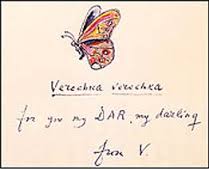
veraThe essay was especially moving to me having visited the Nabokov museum in St. Petersburg–all those many title pages with hand-drawn butterflies dedicated to Vera. Continue reading “Morning reading” →
Two poems about birdsong

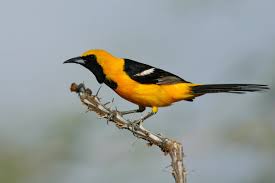
orioleThe first, in sonnet form, by Robert Frost, published in 1942. The second a more contemporary song by Troy Jollimore.

Never Again Would Birds’ Song Be the Same

He would declare and could himself believe
That the birds there in all the garden round
From having heard the daylong voice of Eve
Had added to their own an oversound,
Her tone of meaning but without the words.
Admittedly an eloquence so soft
Could only have had an influence on birds
When call or laughter carried it aloft.
Be that as may be, she was in their song.
Moreover her voice upon their voices crossed
Had now persisted in the woods so long
That probably it never would be lost.
Never again would birds’ song be the same.
And to do that to birds was why she came.

Robert Frost
A Witness Tree

Oriole

A bend in the river.
A flaw in the surface.
How many continents
has this lone oriole
crossed to come balance
on our sagging clothesline,
and what urgent thing
is he trying to tell us?
That those who could translate
his song are lagging
a thousand miles
behind? Or that those
who can speak both his tongue
and ours have not yet
been born, that we will go
into the ground
and a thousand years pass
before their eyes open,
the wayward atoms
of our nests and tongues
having been dispersed,
reassigned, and repurposed
into their bright,
unforeseeable bodies?

Troy Jollimore
Syllabus of Errors

C. K. Williams

williamsC. K. Williams died last year. I hadn’t read much of his work, but liked what I saw in a review of his Selected Later Poems.  His lines are often long, and his poems, too. This is my favorite so far. It totally grabs me in its “syrupy upsoaring netting.”

At What Time on the Sabbath Do Vultures Awake?

Yesterday, at four in the afternoon there were as accurately as I could count sixteen
xxx on fence posts
and branches banking or dive-bombing might be the better term down towards a dead
xxxdeer in a gulley
but this morning at dawn there were none none at all as I trekked by so I thought
   they’d consumed
the corpse or emptied its guts but no there it still was though I didn’t come too close for
xxxthe stench

then later on my way back were first five then at least a half dozen more circling over
xxxtheir quarry
a few scrolling down towards it and how not wonder whether they’d overslept or
xxx
if on Sundays
like this they just like to sit around reading the paper not bothering to get up till
xxxday’s going
full blast and the great pouring clouds of chattering starlings are already in flight
xxxheading south Continue reading “C. K. Williams” →

Poetry readings

I go to a fair number of these. Some are transcendent–moving, dynamic, inspiring. That’s why I go, and go again. But all often, they go more like this:

I Attend a Poetry Readingkowit

The fellow reading poetry at us wouldn’t stop.
Nothing would dissuade him:
not the stifling heat; the smoky walls
with their illuminated clocks;
our host, who shifted anxiously
from foot to foot. Continue reading “Poetry readings” →

Best poetry book from 2015

JollimoreTroy Jollimore’s book, Syllabus of Errors, is my favorite new book of poems from last year. He’s a serious poet, and I find his work brave and lyrical.  He’s also not afraid to poke fun at himself.

Here’s a sample:

Lament

No more swamp existence for you, with all
its pleasures, all that rooting around
in forgotten quarters for forgotten nickels.
No more meretricious jazz piano
eliding your way between gross destinations,
unreviewed memoirs by former conundrums,
videos of venal comebacking musicians
going viral on the spiral screen. No more
slowly starving cathedrals into being,
no more convalescing by feel, no more
nosing out the neglected harmonica part
that was meant to fluff out the flourish but got
buried so deep in the mix you could get
the bends coming up from that. No more Continue reading “Best poetry book from 2015” →

The exemplary sentence

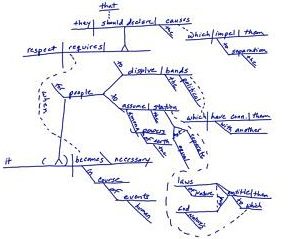
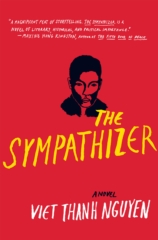
Sentence DiagramHere are a few excerpts from the best book I read this month, The Sympathizer, by Viet Thanh Nguyen.

“Massacre is obscene. Torture is obscene. Three million dead is obscene. Masturbation, even with an admittedly nonconsensual squid? Not so much. I for one, am a person who believes that the world would be a better place if the word “murder” made us mumble as much as the word “masturbation.”

sympathizer“…no one asks poor people if they want war. Nor had anyone asked these poor people if they wanted to die of thirst and exposure on the coastal sea, or if they wanted to be robbed and raped by their own soldiers. If those thousands still lived, they would not have believed how they had died, just as we could not believe that the Americans—our friends, our benefactors, our protectors—had spurned our request to send more money. And what would we have done with the money? Buy the ammunition, gas, and spare parts for the weapons, planes, and tanks the same Americans had bestowed on us for free. Having given us the needles, they now perversely no longer supplied the dope. (Nothing, the General muttered, is ever so expensive as what is offered for free.)”

“My vocabulary was broader, my grammar more precise than the average educated American. I could hit the high notes as well as the low, and thus had no difficulty in understanding Claude’s characterization of the ambassador as a “putz,” a “jerkoff,” with “his head up his ass” who was in denial about the city’s imminent fall.

“I was a card-carrying American with a driver’s license, Social Security card, and resident alien permit. Violet still considered me as foreign, and this misrecognition punctured the smooth skin of my self-confidence…The flawlessness of my English did not matter. Even if she could hear me, she still saw right though me, or perhaps saw someone else instead of me, her retinas burned with the images of all the castrati dreamed up by Hollywood to take the place of real Asian men.”

“I was in close quarters with some representative specimens of the most dangerous creature in the history of the world, the white man in a suit.”


Holiday Break

This will be my last post until the New Year. It’s amazing to me how well the sonnet has held up as a form.  An example appropriate to the darkness of the season:

Noch Einmal, an Orpheus

When the Queen of Darkness heard his voice,
That mortal stranger, saw him lift the lyre
And watched the dull throng of the dead rejoice
To hear him tell of earth and earth’s desire,
Of pain, of longing, she was not amused.
She caught that veiled allusion to the shame
Of her own story and would have refused
Him then and there, had not the shades that came
In droves now clamored so for his request.
“Be rid of him,” she breathed to the immense
Stillness at her side, who thought it best
To play a cruel joke at the man’s expense,
Fated as he was to indecision,
To second thoughts, a lifetime of revision.

George Bradley


Underepresented

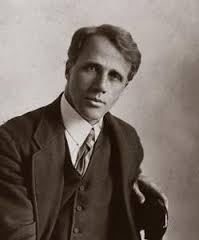
frostI see I’ve only posted one poem by Robert Frost in the history of this blog. Today’s post makes this two. He’s such a master of rhyme–could anyone else rhyme honeysuckle and knuckle without it seeming contrived?

He lived so long, it’s surprising to remember he was born in 1874. We always see the white-haired Frost–the one who read at Kennedy’s inauguration. But he was a young, unknown, driven, and ambitious man for a long time before that.

To Earthward

Love at the lips was touch
As sweet as I could bear;
And once that seemed too much;
I lived on air

That crossed me from sweet things,
The flow of–was it musk
From hidden grapevine springs
Downhill at dusk?

I had the swirl and ache
From sprays of honeysuckle
That when they’re gathered shake
Dew on the knuckle.

I craved strong sweets, but those
Seemed strong when I was young;
The petal of the rose
It was that stung.

Now no joy but lacks salt,
That is not dashed with pain
And weariness and fault;
I crave the stain

Of tears, the aftermark
Of almost too much love,
The sweet of bitter bark
And burning clove.

When stiff and sore and scarred
I take away my hand
From leaning on it hard
In grass and sand,

The hurt is not enough:
I long for weight and strength
To feel the earth as rough
To all my length.

Robert Frost


Airport poems

airportAs many of us will be on planes during this season, I thought I’d include two poems about airports, each named for the gate where it was inspired. Next time your flight is delayed, you can bring this up and pass a little time.

Gate C22

At gate C22 in the Portland airport
a man in a broad-band leather hat kissed
a woman arriving from Orange County.
They kissed and kissed and kissed. Long after
the other passengers clicked the handles of their carry-ons
and wheeled briskly toward short-term parking,
the couple stood there, arms wrapped around each other
like he’d just staggered off the boat at Ellis Island,
like she’d been released at last from ICU, snapped Continue reading “Airport poems” →

An occasional poem

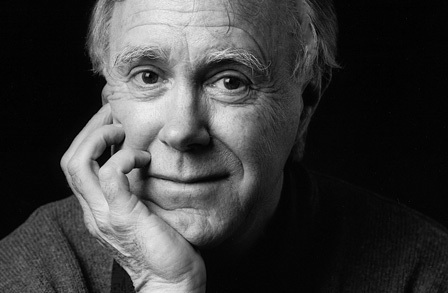
robert-hassI wasn’t looking specifically for a Thanksgiving poem, and this one might not be to everyone’s taste, but I like its realism–the confusion of emotions amid the celebration:

The Feast

The lovers loitered on the deck talking,
the men who were with men and the men who were with new women,
a little shrill and electric, and the wifely women
who had a repose and beautifully lined faces
and coppery skin. She had taken the turkey from the oven
and her friends were talking on the deck
in the steady sunshine. She imagined them
drifting toward the food, in small groups, finishing
sentences, lifting a pickle or a sliver of turkey,
nibbling a little with unconscious pleasure. And
she imagined setting it out artfully, the white meat,
the breads, antipasto, the mushrooms and salad
arranged down the oak counter cleanly, and how they all came
as in a dance when she called them. She carved meat
and then she was crying. Then she was in darkness
crying. She didn’t know what she wanted.

Robert Hass, from Praise