Rain rain beautiful rain

Do you know that song by Ladysmith Black Mambazo? It’s been in my mind these last rainy days after such a long stretch of winter sun.  I love looking out and watching storms move over the bay.

Of course, the chickens don’t share my enthusiasm, and huddle in the roofed area around their house.

I wrote this poem almost three years ago, looking out over the bay after a long stretch of rain.

Grammar

When Nietzsche said we no longer need God
because we have grammar, he was talking about

a morning like this one. The rain has finally paused
and patches of intermittent radiance play over the washed world,  Continue reading “Rain rain beautiful rain” →

The Late Baby

I spent the last few weeks in LA, mostly waiting for a grandson, who was born just a week ago. More about some LA sights later this week. Suffice it to say that there is plenty of weirdness in the sun-drenched streets of Venice.

In the meantime, Larry reminded me of this wonderful poem by Donald Justice. I’ve mentioned him before in these pages:

New Year’s Day Poems

As an act of self-promotion, suicide is hard to beat. Janis Joplin, Jimi Hendrix, most recently Amy Winehouse—their overdose deaths are part of their legend. And would we read Sylvia Plath or Ann Sexton with the same attention without their famous deaths? Of course, suicide is the ultimate desperate act–not a marketing gimmick.

The survivors have a harder time getting known. Maxine Kumin, a close friend and fellow student with Ann Sexton, has lived a more ordinary life: a long-term marriage, children, a farm in New Hampshire. Her poetry often refers to the cycle of growing things—horses, woodchucks, planting and harvesting, the crusty neighbors who last out the long winters. But it also encompasses the complexity of the modern world and struggles to affirm in full knowledge of its imperfection.

I’ve never met Maxine, but years ago I had the temerity to send her a version of her poem “Oblivion,” a poem about those who survive another’s suicide, with an altered ending. Instead of dismissing me as a crank, she wrote me back a gracious note, and we’ve corresponded off and on for several years. You can read or hear another of her poems on surviving her friend’s suicide. Her work, grounded in specifics, moves from these to the larger view the way a camera focuses and then moves back to show the full context.

I want to include three poems of hers in a brief tribute on this first Monday of the New Year.  Continue reading “New Year’s Day Poems” →

Low key

The blog will be taking a short break here, with two winter haiku (or really just very short poems).

Winter Haiku

morning hidden in fog:
a gift wrapped
in cool white tissue

torn wrapping paper
piled by the fireplace
the holiday’s over

Fashion in Poetry

Poets, like hemlines, go in and out of fashion. Poetic styles, too, have their day and then seem shopworn, archaic. For a long time, rhyme was out of style. Poets who rhymed with regularity, the whole cannon of them, were dismissed as too restricted. Free verse, experimental verse, anything but rhyme was in. But rhyme is seeping back. The simple pleasure of it has a charm that still holds. It may be slant rhyme–words that echo instead of chiming exactly; or internal rhyme that occurs in the middle of lines instead of at the ends; or simply irregular rhyming patterns, so the ear is tricked in its expectations.

One of the masters of the sly rhyme is Kay Ryan, who was recently US Poet Laureate. She writes small intricate poems, in which rhyme twists and turns around a point. They are compressed and original, and make you think. This poem especially pleases me, because it is about chickens–metaphorical ones, but chickens none the less:

Home to Roost

The chickens
are circing and
blotting out the
day. The sun is
bright, but the
chickens are in
the way. Yes,
the sky is dark
with chickens,
dense with them.
They turn and
then they turn
again. These
are the chickens
you let loose
one at a time
and small–
various breeds.
Now they have
come home
to roost–all
the same kind
at the same speed.

Kay Ryan

You can hear her read it, if you like. The rhyme here seems straightforward to the ear: day/way (internal), time/home (slant), and finally small/all and breeds/speed, traditional line-end rhyme.  The result is like a puzzle, and charms the ear. At the same time the message of the poem is compelling: you go bumbling along, doing one thing and then another, and then at some point, you see that you have made a certain kind of mistake over and over. Or at least, this is how I read it, and it resonates with me, a kind of soreness, a chagrin at my own actions.

Kay Ryan has a wonderful sense of humor, a dark wit, and a well-tuned poetic ear. Almost all her poems are short and accessible. Just now, she’s in fashion, though for a very long time she was not. Her newish selected poems, The Best of It, is the one I selected to take with me over the holidays–not too demanding, easy to pick up and dip into, and yet a book that makes you ponder.

Blake Garden

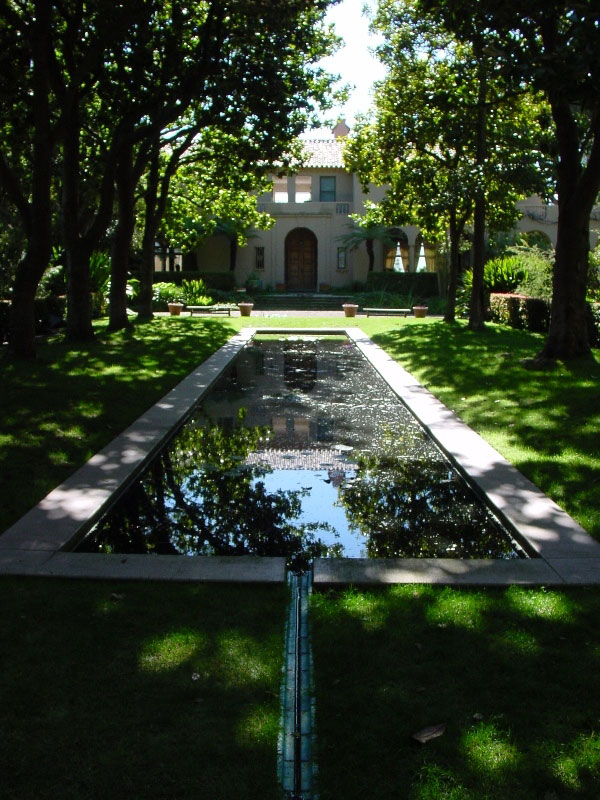
In North Berkeley, tucked off Arlington Avenue across from the library, is a street called Rincon Road. If you turn onto it, after a few hundred yards you come upon an imposing gate, behind which is the Blake Garden created in the twenties by the wife of then UC President Anson Blake and Mabel Symmes, a landscape architecture student. Today it’s run by a conservancy and linked with the landscape architecture school at UC.

The garden is a wonderful mix of the formal–pillars, reflecting pool, and the whimsical (in the album below). On any non-holiday weekday, the gate opens at 8 am, and you can wander the woodland or grassy paths, look at the reflecting pool and the gardens, and see one of the ongoing projects the students create. It’s a wonderful amble any time of year, and right now there are some particularly entrancing projects to look at–the vegetable garden with its pole-bean teepee, a tule-grass canoe (where is baby Moses?), a sinuous reed tunnel for crawling through, a bamboo culvert to a water tank:

%%wppa%%
%%album=5%%

And it occurs to me that Stanley Kunitz, a former poet laureate of the US who lived almost to his 100th birthday, was also famous for his garden. He celebrated it in a book published about five years ago, The Wild Braid: A Poet Reflects on a Century in the Garden.  My favorite poem of his, though, is about his father’s suicide and its impact on his life. I first heard this recited by Marie Howe: Continue reading “Blake Garden” →

A new look, a new poem

I was getting tired of the heading for the blog, and also have enough posts that some might want to browse by categories. Melissa Donovan whose skill, patience, and advice were so helpful in setting up the blog in the beginning, did the update last night.  Hope you like it.

To inaugurate the new look, I want to share a poem by Deborah Friedman, one of the poets of Salon 77 and of my writing group. She’s been doing some terrific writing lately, mostly about her father, who died after a long fight with brain cancer. Here is his picture. Though the topic is dark, her poetry has been so tender and moving. When she read this to our group last Monday, I was sorely jealous.

Where the Deer and the Antelope Continue reading “A new look, a new poem” →

Bob Hass and Jim (Royal Dick) Rathmann

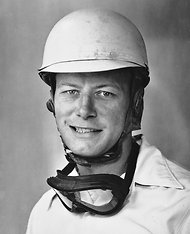
These two people have nothing in common, one a famous poet and teacher the other a renowned race car driver, except that I was reading first the obituary of Jim Rathmann in the NY Times this morning, and then Bob’s poem “Shame: an Aria.”

Larry was reading to me Jim Rathmann’s obituary over breakfast (vegetable hash–yummy–let me know if you want the recipe). He started racing before he was legally eligible, so used his brother James’ ID.  Hence his career as Jim Rathmann, record breaking race car driver, whose given name was “Royal” but whose family name was Dick. It must have been confusing, as his older brother was a decent racer, too. The part Larry read was: “He earned renown in Southern California drag-racing circles, receiving 48 traffic tickets before he was 18 — four during one lunch break.” But my favorite part was the last paragraph of the article.  He became friends with the astronauts, and one taught him to fly:

Gordon Cooper, one of the original members of NASA’s Mercury program, told him never to fly under a seagull lest the bird excrete on the plane. Rathmann made the mistake of laughing.

Colonel Cooper proceeded to prove his point, flying so low under a flock of gulls that a terrified Rathmann could hear the propellers cutting marsh grass. On landing, Cooper jumped from the plane and pointed to the spattered roof.

“I told you,” he said. Continue reading “Bob Hass and Jim (Royal Dick) Rathmann” →

More about William Dickey

There are so many good poets who write in relative obscurity. Bill Dickey (whose poem I posted yesterday), was part of Berryman’s famous class at Iowa and taught poetry for over 30 years at San Francisco State. Don’t confuse Bill with another poet, James Dickey, who is very well known (and in my view a much lesser poet).  Bill published 15 volumes of poetry, and was well thought of by fellow poets, but his work is almost unknown to the general public. Larry was lucky enough to study with him in 1968, and then again in the late 70s. He says of Bill: Continue reading “More about William Dickey” →

Poetry reading

A few weeks ago I was wondering if there was anything worse than a bad poetry reading–sitting captive in a low-ceilinged room in an uncomfortable chair listening to words that don’t seem to relate any meaning. The person I was complaining to asked why I go.  I go for the kind of experience I had on Thursday, listening to Dana Gioia read his work at Falkirk House (the wonderful historic building where I read last summer) in San Rafael, courtesy of the Marin Poetry Center. I’ve written here before of Dana’s excellent critical prose, and of a “Verse,” a critical homage to Donald Justice that Dana told me last night will now be an ebook. Continue reading “Poetry reading” →