In the toilet

I have forgotten to include in this blog my most prestigious credential to date. I was selected as Poet Laureate of the World Toilet Organization. This seems like an honor appropriate to my station. It came about in this way. Friends in rural California had been living a trailer while they built a new house—a project of several years duration. During that time, they had an outhouse, and finally, when the house was finished, they had a flush toilet. To honor the occasion, I wrote an Ode to the Commode. Somehow this poem came to the attention of an official of the World Toilet Organization, whose mission is “improving sanitation globally.” He contacted me, and asked if I’d like to be their poet laureate, and I gladly accepted. His next request was to come up with some T-shirt slogans. I asked Larry for help, and he came up with “Flushed with Pride” and one other that I can’t remember, which I promptly emailed.  This was all at least six years ago.  I never heard back from WTO, but I assume, as I haven’t been informed to the contrary, that my appointment remains.  I guess by now, you’re curious as to the poem that bestowed such honor upon me, and here it is:

Ode to the Commode

Wise peasants cart their night soil to the fields
to make manure from the stink.
But in the modern west, fierce nature yields
its grip to toilet bowl and sink.
All sorry squatters in the far off woods
can rest their weary buttocks, sigh
and loose their load of well digested food
into the bowl. They fear no fly,
no noxious smell. A single flush, it’s gone.
Oh, commodious commode, gleam on.
Your white and shapely tank, your whirlpool song,
the faithful seat we sit upon,
your simple parts, your satisfying whoosh,
are just what’s needed for the tender tush.

I entered this today in the Howard Nemerov Sonnet Award contest. It cost $3, plus a postage stamp to enter. It is a genuine sonnet, and scans as alternating pentameter (5-beat), and tetrameter (4-beat) lines.  My favorite line is “Oh, commodious commode, gleam on.” Whether or not A.M. Juster (the contest judge likes it) remains to be seen. It hangs, framed, in my friends’ bathroom. And when I went looking for the link to the WTO, I found that Clorox has adopted this title for it’s “potty” line of products! That’s quite enough fame for now.


Ann Patchett

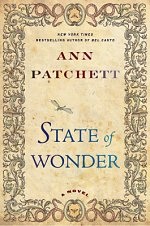
I came to Bel Canto late because I don’t usually like best sellers. But Ann Patchett is a terrific writer. She really knows how to spin a plot, and creates wonderful images. I read her new book, State of Wonder on my trip back east. Is there anything more reassuring when one travels than to have an engrossing novel to turn to in the plane, on the train, in a strange bed in a hotel? This book is the story of a woman research scientist, Marina, who abandoned her initial career as an OBGYN intern after a traumatic incident. There are echoes of Conrad’s Heart of Darkness, as she has to head to the Amazon to find and confront her old mentor and her past. I love the weaving of the story, the complexity of the questions it raises, and the believability of Marina’s transformation in the jungle. Continue reading “Ann Patchett” →

Submitting my work

I’ve had a very ambivalent relationship to submitting poetry to magazines for publication. I don’t read small literary magazines, so why submit to them? And if you pay the reading fee to enter a contest, they just pile up unread on the shelf, an unpleasant reminder of the problems of publication.

On the other hand, a friend recently had a poem of his published in the New Yorker, which I do read, and said he simply submitted it online.  Of course, he studied with the current poetry editor, so that helps. But I decided to submit one.

The online submission page said something like “due to the volume of submissions, it may take three or four months for us to respond.” However, I received a rejection note the very next day. I guess they really didn’t like it. But undaunted, I am printing it here.

In Praise of Research

Here’s to the researcher’s neck arched over his microscope
with the single-mindedness of a horse bent to its oats
hour after year in the bright box of the lab
decoding the origin of a sub-family of mosquito
that only lives sealed in the London underground.
Or Marie Curie burning her hands over and over
in the luminous blue-green glow of the radium
she extracted before anyone knew it was there
or what it could do.
Or the scholar holed up in the library carrel
working on the meaning of the “the.”

Quinine, x-rays, meaning itself, the way the world
is constructed of waves and particles and a something else
we can’t agree on, that time stretches and light bends,
and like horses in traces
impelled by the will of our kind
we bend our necks to it
as hungry for knowledge
as for grain from a loving hand.

*                      *                         *

I hope you like it better than the editors at the New Yorker. I think I’ll just keep sending them poems. Like Sylvia Plath, I could create wallpaper with rejection slips.


Rainy day in New England

It’s cold and rainy today with a definite feel of the coming of winter. It reminded me of this poem by Robert Mezey (one of that amazing group of students of John Berryman’s at Iowa).  His is a California fall poem, and it always gives me a shiver when I come to the last lines. I especially like the image of fire’s many small teeth, and the sun narrowed to a filament. The poem is full of the feeling of death that waits for all living things and that fall exposes.

Touch It

Out on the bare grey roads, I pass
by vineyards withering toward winder,
cold magenta shapes and green fingers
and the leaves rippling in the early darkness.

Past the thinning orchard the fields
are on fire.  A mountain of smoke
climbs the desolate wind, and at its roots
fire is eating dead grass with many small teeth,

When I get home, the evening sun
has narrowed to a filament.  When it goes
and the dark falls like a hand on a tabletop,
I am told that what we love most is dying.

The coldness of it is even on this page
at the edge of your fingernail.  Touch it.

Robert Mezey
 

Lucky in lunch

How lucky to live in the Bay Area, with its surfeit of poetry events. Today, I heard Bob Hass talk about and read from the work of Tomas Tranströmer and Czesław Miłosz. The one-hour event is from a series at UC called “Lunch Poems,” and was billed as Hass reading from the work of Miłosz. News had just come in that Tranströmer had won the Nobel Prize and Bob talked about and read a few of his poems, too. He has translated both poets, and said that the three of them once had a meal together in Paris.

It was wonderful to hear Bob’s exposition on both these poets. I don’t have copies of exactly the poems he read, but soon the reading and Bob stories will be on YouTube, you can search for it.  In the meantime, here is a famous poem by Miłosz, who lived in exile from his native country for several decades in Berkeley. Until he received the Nobel Prize in 1980, he was almost unknown here, a professor of Polish literature at UC, writing in Polish, not largely translated.

This poem is fairly typical, starting with an event, seeming to meander along, almost prose, in reminiscence.  The “magic mountain” itself is a reference to Tomas Mann’s novel by that name, about a man exiled to a sanitorium for tuberculosis. But as the poem meanders it gathers to a fierce anger–the poet blazes out at his lack of recognition, the absence of fame, his inability to change the world. From there it moves to acceptance, endurance, and a wonderful couplet about how the work of poetry itself is a kind of salvation:

With a flick of the wrist I fashioned an invisible rope,
And climbed it and it held me.

Then, the poet is back in the real world, a little self-mocking, a little disdaining of the pomp of caps and gowns. He returns to July in Berkeley, hummingbirds and fog. It must have been hard for a poet whose work over and over seems extraordinarily alive to place to have lived most of his life estranged from home.

A Magic Mountain

I don’t remember exactly when Budberg died, it was either two years
ago or three.
The same with Chen. Whether last year or the one before.
Soon after our arrival, Budberg, gently pensive,
Said that in the beginning it is hard to get accustomed,
For here there is no spring or summer, no winter or fall.

“I kept dreaming of snow and birch forests.
Where so little changes you hardly notice how time goes by.
This is, you will see, a magic mountain.”

Budberg: a familiar name in my childhood.
They were prominent in our region,
This Russian family, descendants of German Balts.
I read none of his works, too specialized.
And Chen, I have heard, was an exquisite poet,
Which I must take on faith, for he wrote in Chinese.

Sultry Octobers, cool Julys, trees blossom in February.
Here the nuptial flight of hummingbirds does not forecast spring.
Only the faithful maple sheds its leaves every year.
For no reason, its ancestors simply learned it that way.

I sensed Budberg was right and I rebelled.
So I won’t have power, won’t save the world?
Fame will pass me by, no tiara, no crown?
Did I then train myself, myself the Unique,
To compose stanzas for gulls and sea haze,
To listen to the foghorns blaring down below?
Until it passed. What passed? Life.
Now I am not ashamed of my defeat.
One murky island with its barking seals
Or a parched desert is enough
To make us say: yes, oui, si.
“Even asleep we partake in the becoming of the world.”
Endurance comes only from enduring.
With a flick of the wrist I fashioned an invisible rope,
And climbed it and it held me.

What a procession! Quelles délices!
What caps and hooded gowns!
Most respected Professor Budberg,
Most distinguished Professor Chen,
Wrong Honorable Professor Milosz
Who wrote poems in some unheard-of tongue.
Who will count them anyway. And here sunlight.
So that the flames of their tall candles fade.
And how many generations of hummingbirds keep them company
As they walk on. Across the magic mountain.
And the fog from the ocean is cool, for once again it is July.

Berkeley, 1975

Lit crit

I’ve been slowly reading through a 1992 issue of a British literary magazine called “Verse,” which Larry found amid his books. It features Donald Justice, a poet I really like. I memorized this sonnet of his, which he wrote to get into John Berryman’s seminar at Iowa. According to Larry, who told me this story, many more students than the seminar could accommodate showed up the first day. Berryman assigned a sonnet, and only a few even tried–fewer were accepted.

I like the mysteriousness of this sonnet about Adam and Eve eating from the tree of knowledge. It plays on a story we all know, and yet makes it happen anew. I especially admire how “the first omen” is that they “can find no flaw/ in all of Eden.” We humans don’t seem to be able to bear perfection very long! And “the first omen” sounds so full of dread, followed by the dream of the lion sharpening its claw. We know what’s going to happen and this sets it up. I also like how it takes us right up to the moment of exile and leaves us in dread.

The Wall

The wall surrounding them they never saw;
The angels, often. Angels were as common
As birds or butterflies, but looked more human.
As long as the wings were furled, they felt no awe.
Beasts, too, were friendly. They could find no flaw
In all of Eden: this was the first omen.
The second was the dream which woke the woman.
She dreamed she saw the lion sharpen his claw.
As for the fruit, it had no taste at all.
They had been warned of what was bound to happen.
They had been told of something called the world.
They had been told and told about the wall.
They saw it now; the gate was standing open.
As they advanced, the giant wings unfurled.

Donald Justice

When I memorized this poem, I decided to switch a line, so that the poem ended “As for the fruit, it had no taste at all.”  The rhyme scheme still works that way, and I liked ending it with the sense of futility that line gives. But of course, that’s not Mr. Justice’s version, and he’s no longer around to discuss it. If he were, I’d write to him. I wonder what you think?

Meanwhile, although I admire Dana Gioia and William Logan enormously, the kind of literary criticism that appears in this volume seems beside the point (six different essays on his verse!). Either you like Donald Justice’s rather formal poetry or you don’t; discussing its format, analyzing its meter, and probing its origins doesn’t enhance my enjoyment of the poems. Au contraire. A surfeit of lit crit is one of the reasons I’m on my extended leave of absence from college.

As Larry said this morning, “If all the literary criticism in the world were to disappear overnight we would be not one whit poorer.”

You might have noticed that there hasn’t been much “Stuff Larry Sez,” lately. He was gone, then I was gone. Larry went to the Ponderosa Stomp in New Orleans, a celebration of roots music that featured Big Jay McNeely, Lazy Lester, and many other colorful musicians. Larry is going to talk about this and give away some autographed photos on Mal Sharpe’s “Back on Basin Street” radio show on KCSM on Sunday, October 9, at 9 pm.


Hawk Hill

The hawks are headed South mostly, though the Audubon lecturer at Hawk Hill mentioned that they put a monitor on a Red-tailed Hawk who traveled up to eastern Oregon instead. Despite this outlier, if you live in the Bay Area, you can take an hour or two and go to the Marin Headlands, just beyond the Golden Gate Bridge, and pretty much be guaranteed to see raptors soaring across the hills or over the bay: Red-tailed, Cooper’s, Sharp Shinned, Falcons, Turkey Vultures, all gliding, flapping, dipping over the valleys or the azure or fog-grey water.

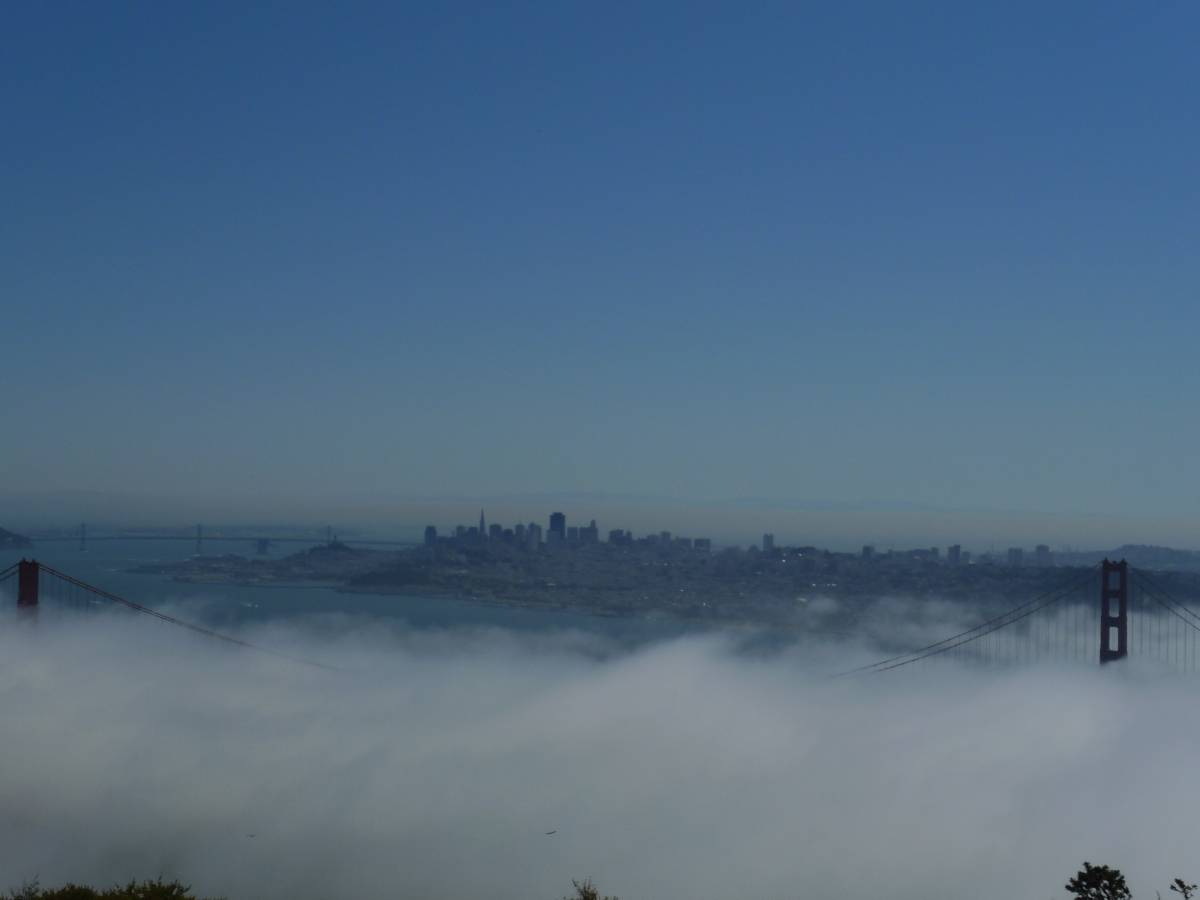
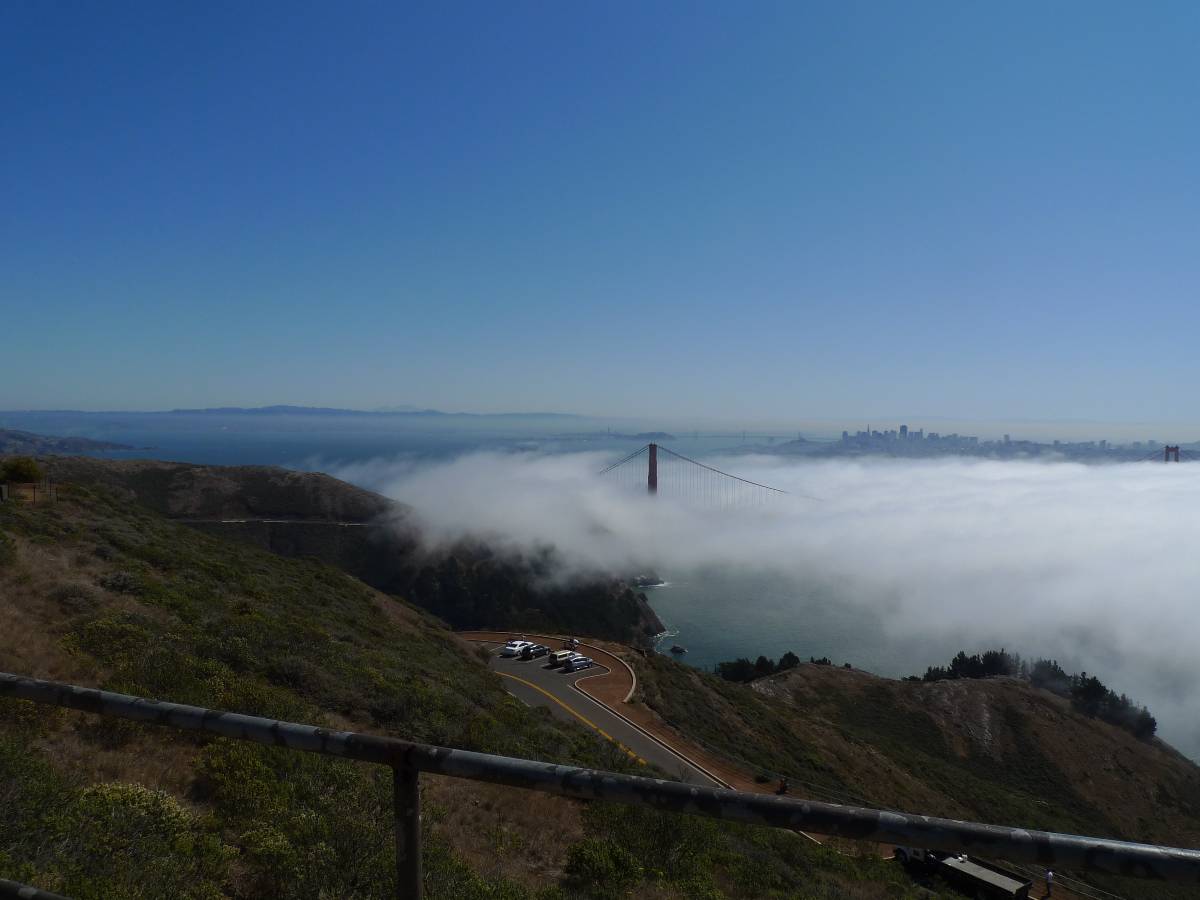
All summer, the marine layer has smothered the bay area with fog  This week, the fog retreated out beyond the Golden Gate, its white cloudy puffs flirting with the bridge like a girl drawing the edge of her petticoat up and then letting it fall back. This most scenic spot (when not fogged in) is a magnet for tourists, teachers with their small flocks learning about nature, and the hawk counters, who watch each of the cardinal directions and track the annual numbers. They call to each other as the birds head from their quadrant to towards the next. They call to the monitor who tallies the numbers. And behind it all, the strange drone of the fog horns. Here are some images…

The walk up to Hawk Hill, and a tree along the way:

Here is one view from the top:

Can you just make out the image of a vulture against the fog in the center bottom of the photo? In the next one, looking East, you can see Mt. Diablo across the bay:

And finally, here are some North Quadrant hawk counters and their gear:

As a bonus, here is a poem by the now often neglected pioneering poet of the wild California coast, Robinson Jeffers:

Rock and Hawk

Here is a symbol in which
Many high tragic thoughts
Watch their own eyes.

This gray rock, standing tall
On the headland, where the seawind
Lets no tree grow,

Earthquake-proved, and signatured
By ages of storms: on its peak
A falcon has perched.

I think here is your emblem
To hang in the future sky;
Not the cross, not the hive,

But this; bright power, dark peace;
Fierce consciousness joined with final
Disinterestedness;

Life with calm death; the falcon’s
Realist eyes and act
Married to the massive

Mysticism of stone,
Which failure cannot cast down
Nor success make proud.

Robinson Jeffers

Random poetry

Although I sometimes do it, I think it’s kind of rude to give a copy of your book of poems to someone who hasn’t asked for it. I experience receiving an unsolicited book by a poet I don’t know as a burden. I feel obligated to turn my full attention to it, and mostly it’s a disappointment. I find that I read a new poem by an author I know and like with a much more welcoming attitude than one from a poet I don’t know. I’m all set to dislike a new poet, sad as that seems.

So it was with some trepidation that I picked up a book from Paper Kite Press that arrived mysteriously on my desk. I had never heard of Jack DeWitt, and had no idea where the book came from. But the first poem, “Ferranti’s Ford” pleased me, and I have been reading happily through the first section. Mr. DeWitt lives up to the wit in his surname, and as a bonus grew up in Stamford Connecticut about the same time I grew up 15 minutes down the road in suburban NY. He listened to Murray the K and WINS, both of which were the background of my teen years. So even though I was not fascinated with hot rods, and didn’t see Rebel Without a Cause till I was in my 20s, the references in his poems resonate for me. Here is a taste:

James Dean

I had just seen James Dean
in Rebel Without a Cause
& wanted everyone to know
that it was about me so
I bought a red nylon jacket
and wore it with the collar up
over a tight white tee-shirt.
I went to Jack’s Army & Navy
for the engineer boots.
My hair was perfect too,
even down to the calculated
cowlick. One day as I waited
in the school yard, looking perfectly cool
Alan showed up in his blue school
jacket. Sue Skigen turned to me
as he walked across the ball field:
“Don’t you think Alan looks
Just like James Dean?”
*           *           *

Ferranti’s Ford

Ferranti’s Ford slid slowly around City Hall
like a sea creature
                 searching for prey.
Its curved teeth
    were from a DeSoto. They drew the sun into its mouth.
                                              The color
was Titian red (pronounced “Tahitian” by the car guys):
                  no rose
          only jewels know such color
                               bright, deep, perfect–
Its chopped convertible top white, taut, low
                     –the way a shark rolls its eyes tight
                                   before it strikes
I followed it to Main Street
          –my heart pumped with each pop from its pipes.
I jumped with the wheels when he hit second gear.
                       As it rolled past the Plaza Theater
I stopped to catch my breath.
                       Then it was gone. The world was quiet.
I looked around.
                       Nothing had changed except my life.
Jack DeWitt

I give a fig

Well, the fig poem project has been fun. Of course, the fig is the leaf that Eve and Adam use to cover their nakedness. It’s been around a long time.  I wondered, what about that expression “I don’t give a fig.”? I looked it up and discovered:

The saying is based on the Spanish Fico (= Fig) which gave its name to a traditional gesture of contempt made by placing the thumb between the first and second fingers… Making the Fig of Spain is called in Spanish “dar una higa.” But the Spanish for “fig” is “not “higa” but “higo”. There is a pun here, because “higa” means the female genitals – which is what the thumb peeping out between the fingers of the closed fist is meant to represent.

Given all this, I thought that there must be other fig poems. I did a quick search and found several. One of Edna St. Vincent Millay’s books is called Figs and Thistles, and the famous quatrain:

My candle burns at both ends;
It will not last the night;
But ah, my foes, and oh, my friends—
It gives a lovely light!

is called “First Fig.” Less well known is “Second Fig”:

Safe upon the solid rock the ugly houses stand:
Come and see my shining palace built upon the sand!

Of course, these don’t have much to do with figs. In fact few of the poems I found dealt as particularly with the fig as the blackberry poems do with the blackberry. So here is my effort to write a fig poem that is really about (or at least mostly about) the fig.

Consider the Fig

Why do poets seek the black art
of the berry when the fig parts
the leaves like a talisman,
slips into the outstretched palm?
A one-thumbed glove,
the fig has nothing to prove.
Soft as a scrotum,
smooth as a baby’s bottom,
smug as a full house
where wasps drowse
and raccoons wait
to plunder by night.

Spun gloss of end of summer,  concentrate
of lush long days: late
slanted shadows, sleepy children
loll in their parents’ arms,
toys scattered, lawn chairs akimbo,
hammocks swing empty. Slow
dusk drapes the landscape
and fig seeds detonate
on the tongue in one last bright
blaze of honeyed light.

Meryl Natchez

In my brief scan of the poetic fig world, I did find two figgy offerings worth sharing. The first by Louise Gluck, is about faith:

from Vespers

Once I believed in you; I planted a fig tree.
Here, in Vermont, country
of no summer. It was a test: if the tree lived,
it would mean you existed.

By this logic, you do not exist. Or you exist
exclusively in warmer climates,
in fervent Sicily and Mexico and California,
where are grown the unimaginable
apricot and fragile peach. Perhaps
they see your face in Sicily; here we barely see
the hem of your garment. I have to discipline myself
to share with John and Noah the tomato crop.

If there is justice in some other world, those
like myself, whom nature forces
into lives of abstinence, should get
the lion’s share of all things, all
objects of hunger, greed being
praise of you. And no one praises
more intensely than I, with more
painfully checked desire, or more deserves
to sit at your right hand, if it exists, partaking
of the perishable, the immortal fig,
which does not travel.

Louise Gluck

And (happily) I discovered a poet new to me, a Scotsman, Roddy Lumsden.

My Life

The fig was full of worms.
The joke was on me.
The joke went over my head.
I made myself hollow for others.
I took delight in the sight of a trap.
I learned to lie with grace.
I tried to hide horned animals in a sack.
I ate the food and then the food ate me.
And when at last I danced the music stopped.
The cream was skimmed too soon.
My wings and tail were plucked.
My mouth was primed with mud.
My larynx was a shrine.
I left the room to talk about the others.
The thorn in time extracts the thorn.
My years were two of yours.
No bird was of my feather.
I was blait and toom and fykesome.
The rice just wouldn’t fluff.
I never lived it up
and never lived it down.
The fish was full of bones.
The skunk curled on my lap.
I was torn in the bush of ghosts.
The point was not worth proving:
the proof was in the pudding
in the form of a split penny.
The jellyfish was in my mouth.
The landslide happened in my mouth.
I pressed and pressed the button
but Truth wouldn’t happen.
Time wasted me and I wasted time,
like the night lost in the wynds
and back lanes, searching for a strut
that will take my weight when the time is right.

Roddy Lumsden

I like the playful seriousness of this poem, and the word play. There are a few strange words of Scots origin. I couldn’t find “blait” anywhere, but toom means empty and fyke is a fishtrap. Roddy may have made up fykesome, which based on various definitions might mean  restless like a fish caught in a trap, or full of insincere flattery, or a combination of both. A third difinition of “fike” (noted as the root) is fig!

A bushel of blackberry poems

Even though I have been unsuccessful in my efforts to find and pick enough blackberries for jam, or even a pie, I have gathered five of my favorite blackberry poems, each somewhat characteristic of its author.
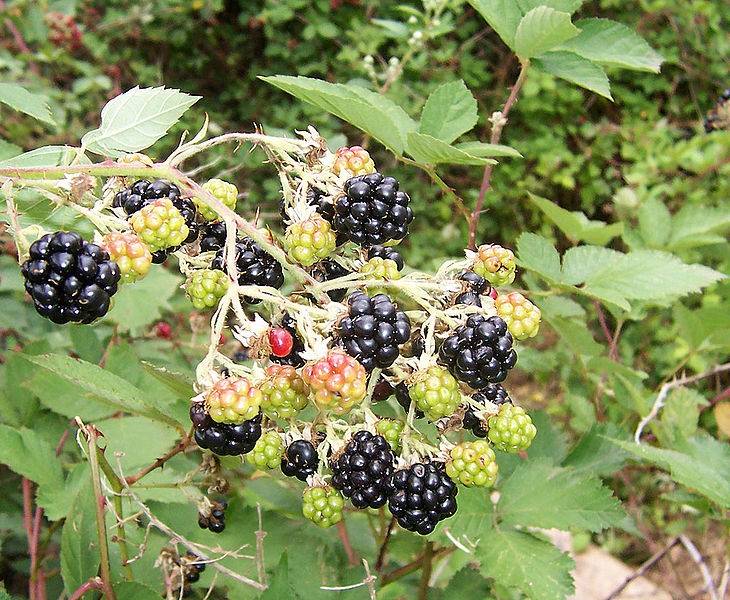
First is Sylvia Plath, whose vision of blackberries is personal–a blood sisterhood, dark, menacing full of hooks:

Blackberrying

Nobody in the lane, and nothing, nothing but blackberries,
Blackberries on either side, though on the right mainly,
A blackberry alley, going down in hooks, and a sea
Somewhere at the end of it, heaving. Blackberries
Big as the ball of my thumb, and dumb as eyes
Ebon in the hedges, fat
With blue-red juices. These they squander on my fingers.
I had not asked for such a blood sisterhood; they must love me.
They accommodate themselves to my milk bottle, flattening their sides.

Overhead go the choughs in black, cacophonous flocks —
Bits of burnt paper wheeling in a blown sky.
Theirs is the only voice, protesting, protesting.
I do not think the sea will appear at all.
The high, green meadows are glowing, as if lit from within.
I come to one bush of berries so ripe it is a bush of flies,
Hanging their bluegreen bellies and their wing panes in a Chinese screen.
The honey-feast of the berries has stunned them; they believe in heaven.
One more hook, and the berries and bushes end.

The only thing to come now is the sea.
From between two hills a sudden wind funnels at me,
Slapping its phantom laundry in my face.
These hills are too green and sweet to have tasted salt.
I follow the sheep path between them. A last hook brings me
To the hills’ northern face, and the face is orange rock
That looks out on nothing, nothing but a great space
Of white and pewter lights, and a din like silversmiths
Beating and beating at an intractable metal.

Sylvia Plath

Seamus Heaney’s poem focuses on the rot at the heart of the sweetness–a metaphor for Irish politics, or just a childhood memory? Either way, a disturbing poem from the glossy purple clot of the berry to the rat-grey fur of the mold:

Blackberry-Picking

Late August, given heavy rain and sun
For a full week, the blackberries would ripen.
At first, just one, a glossy purple clot
Among others, red, green, hard as a knot.
You ate that first one and its flesh was sweet
Like thickened wine: summer’s blood was in it
Leaving stains upon the tongue and lust for
Picking. Then red ones inked up and that hunger
Sent us out with milk cans, pea tins, jam-pots
Where briars scratched and wet grass bleached our boots.
Round hayfields, cornfields and potato-drills
We trekked and picked until the cans were full
Until the tinkling bottom had been covered
With green ones, and on top big dark blobs burned
Like a plate of eyes. Our hands were peppered
With thorn pricks, our palms sticky as Bluebeard’s.
We hoarded the fresh berries in the byre.
But when the bath was filled we found a fur,
A rat-grey fungus, glutting on our cache.
The juice was stinking too. Once off the bush
The fruit fermented, the sweet flesh would turn sour.
I always felt like crying. It wasn’t fair
That all the lovely canfuls smelt of rot.
Each year I hoped they’d keep, knew they would not.

Seamus Heaney

Mary Oliver’s is pure transcendence, with a thick paw of self reaching for more:

August

When the blackberries hang
swollen in the woods, in the brambles
nobody owns, I spend

all day among the high
branches, reaching
my ripped arms, thinking

of nothing, cramming
the black honey of summer
into my mouth; all day my body

accepts what it is.  In the dark
creeks that run by there is
this thick paw of my life darting among

the black bells, the leaves; there is
this happy tongue.

Mary Oliver

For Bob Hass, the blackberry evokes so much else: loss, longing, love, tenderness, metaphysics. His thought reaches out like intractable blackberry vines, covering all available ground, coming to rest with the vibrant specific fruit. I especially love the line “a word is elegy to what it signifies” and the image of the “thin wire of grief” in a friend’s voice. There is so much to admire in the journey this poem makes between the meditative and the specific:

Meditation at Lagunitas

All the new thinking is about loss.
In this it resembles all the old thinking.
The idea, for example, that each particular erases
the luminous clarity of a general idea. That the clown-
faced woodpecker probing the dead trunk
of that black birch is, by his presence,
some tragic falling off from a first world
of undivided light. Or the notion that,
because there is in this world no one thing
to which the bramble of blackberry corresponds,
a word is elegy to what it signifies.
We talked about it late last night and in the voice
of my friend, there was a thin wire of grief, a tone
almost querulous. After a while I understood that,
talking this way, everything dissolves: justice,
pine, hair, woman, you and I. There was a woman
I made love to and I remembered how, holding
her small shoulders in my hands sometimes,
I felt a violent wonder at her presence
like a thirst for salt, for my childhood river
with its island willows, silly music from the pleasure boat,
muddy places where we caught the little orange–silver fish
called pumpkinseed. It hardly had to do with her.
Longing, we say, because desire is full
of endless distances. I must have been the same to her.
But I remember so much, the way her hands dismantled bread,
the thing her father said that hurt her, what
she dreamed. There are moments when the body is as numinous
as words, days that are the good flesh continuing.
Such tenderness, those afternoons and evenings,
saying blackberry, blackberry, blackberry.

Robert Hass

And finally, Galway Kinnell’s inimitable voice, squinching the joy from the fruit onto our tongues:

Blackberry Eating

I love to go out in late September
among the fat, overripe, icy, black blackberries
to eat blackberries for breakfast,
the stalks very prickly, a penalty
they earn for knowing the black art
of blackberry-making; and as I stand among them
lifting the stalks to my mouth, the ripest berries
fall almost unbidden to my tongue,
as words sometimes do, certain peculiar words
like strengths or squinched,
many-lettered, one-syllabled lumps,
which I squeeze, squinch open, and splurge well
in the silent, startled, icy, black language
of blackberry-eating in late September.

Galway Kinnell

A pint of plain…

In the rarified intellectual world of boarding school, I arrived as a naïf in 10th grade. I was lucky to make a friend who later became a translator of Octavio Paz. He was always willing to explain a poem or a line to me. I remember clearly asking him to explain several passages of Prufrock when I first read it.  What did it mean to “prepare a face to meet the faces that you meet”? And his answer—”That one’s so easy—it means to put on the mask you wear in public.”

He had a scathing wit, and for a few years after high school he was the secretary for our classes alumni notes section. He kept in touch with many alums, and his descriptions were not always kind. They were always fun to read, though. Unfortunately, the more sensitive of my classmates were offended, and he was asked to resign, which he did.

All of which brings me to the criticism of William Logan, whom I’ve mentioned briefly before. Most poetry criticism reads like a sanitized version of alumni notes—bland, kind, praising small achievements. The world of poetry is a small and cozy one, and few want to risk alienating their peers. But in the midst of this vapid sea of faint praise, there is an island of acerbic wit called William Logan. Though he writes and publishes verse, he seems to have no qualms about pricking the pretensions of the most lauded poets, and the poetry establishment itself. Here’s an excerpt from his 2009 review of Billy Collins’ book, Ballistics:

“When comedians stop being funny, they must invent themselves anew or retire for good. A number of poems here mention divorce in a roundabout way… Indeed, the most hilarious poem in the book is titled “Divorce,” and it’s also the shortest:

Once, two spoons in bed,
now tinned forks
across a granite table
and the knives they have hired.

If Collins can become the bitter philosopher of such lines, there’s hope yet. Otherwise, Poetry must do what Poetry does when a poet runs out of gas, or screws the pooch, or jumps the shark—give him a Pulitzer and show him the door.”[1]

Lucille Clifton used to say “Poetry is a house of many rooms,” meaning that there is room for a wide variety of style and form. But unlike a house, whose builders need to demonstrate a minimal level of carpentry skill for the house to stand, anyone at all can claim to be a poet, whether skilled or not. Here’s where knowledgeable critics help.  William Logan, Dana Gioia, and Robert Hass have each written some wonderful prose about poetry and are all worth reading. Dana Gioia’s essay “The Successful Career of Robert Bly” in Can Poetry Matter? is one of my favorites of his work. Robert Hass’s collections of newspaper columns, Now and Then, and Poet’s Choice are both worth owning, and if you like these, you might want to go on to the more difficult Twentieth Century Pleasures.  But no one makes me laugh as reliably as William Logan, and that’s worth a lot in this world of woe.

If you’re looking for biting wit, for someone who can pierce the veil of pretentious obfuscation poets so often draw about themselves, a pint of Wm. Logan is your only man.  I’d rather be skewered by him, and have my eyes opened to what’s flabby and phony in my work than be praised by a thousand fans. But I wouldn’t have fired my friend as secretary to our class, either.


[1] From “Verse Chronicle,” The New Criterion, June 2009

A penny for your prayer

I really try to ignore the political scene. It’s just too depressing, and like the changing of time for Daylight Savings and back, feels totally outside my control. But after reading today about prayer breakfasts on Capitol Hill, I felt moved to compose this:

Prayer’s a very private thing—
a scouring of the soul, a reckoning,
a probing of just what is meant,
a clarifying of intent.
And anyone I’ve seen to pray
in any kind of public way
who makes a show of piety,
advertises their propriety,
shows up, on examination
to be a card-carrying member
of the hypocrite nation.

Larry, on reading it, shrugged and said “too unsubtle,” and came up with a pithier, more succinct version:

If it’s public it ain’t a prayer.

It’s bon mots like this that keep those gourmet meals coming.

In the same NY Times article, they referenced David Orr’s selection of poems to assign to Congress. Here are two I’d choose:

Sailing to Byzantium by Wm. Yeats

Cantatrice by John Berryman.  As I can’t find this online, here it is, Dream Song #233

Misunderstanding. Misunderstanding, misunderstanding.
Are we stationed here among another thing?
Sometimes I wonder.
After the lightning, this afternoon, came thunder:
the natural world makes sense: cats hate water
and love fish.

Fish, plankton, bats’ radar, the sense of fish
who glide up the coast of South America
and head for Gibraltar.
How do they know it’s there? We call this instinct
by which we dream we know what instinct is,
like misunderstanding.

I was soft on a green girl once and we smiled across
and married, childed. Never did we truly take in
one burning wing.
Henry flounders. What is the name of that fish?
So better organized than we are oh.
Sing to me that name, enchanter, sing!

*                    *                *

How about that for a prayer?