So much to read, so little time

But if you’re looking for a easy-to-read mystery with a twist, try Out of the Blackout, by Robert Barnard, which I learned about from Harriet Devine’s blog–a terrific resource. In this well-paced and unusual story the murder may or may not have happened, but doesn’t enter in till the middle of the suspense. It starts as an extra boy appears in a group of evacuees from London during the blitz. About five years old, the boy calls himself Simon Thorn. No one ever claims him, and his origins remain mysterious until he investigates them himself as an adult.
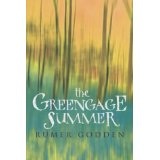
And Harriet’s blog (featuring Rumer Godden at the moment) reminded me how much I love Greengage Summer, the story of a family stranded at a hotel in southern France for a summer, due to their mother’s falling seriously ill on the journey. The children fend for themselves, and the two oldest girls each come of age in their own way.  A perfect summer read. This is her best book, I think, though she and her sister Jon wrote a number of readable novels.

Is there anything better than reading in a hammock on a hot summer afternoon? Which reminds me of of another favorite, this James Wright poem:

Lying in a Hammock at William Duffy’s Farm in Pine Island Minnesota

Over my head, I see the bronze butterfly,
Asleep on the black trunk,
blowing like a leaf in green shadow.
Down the ravine behind the empty house,
The cowbells follow one another
Into the distances of the afternoon.
To my right,
In a field of sunlight between two pines,
The droppings of last year’s horses
Blaze up into golden stones.
I lean back, as the evening darkens and comes on.
A chicken hawk floats over, looking for home.
I have wasted my life.

James Wright

You can hear him read it, if you like. I love the specificity of his images, and how he telescopes the process of horse droppings to fertilizer to golden wild flowers in two lines. A short poem that builds dramatically to the conclusion. Happy August!

Poetry or Freecell?

Yesterday I read a few poems at this event, at the Expressions gallery in Berkeley near the Ashby BART.  It included several poets from Squaw Valley Community of Writers poetry workshop.

I’d decided to accept all invitations to read; I enjoy reading and it’s a way to test how a poem holds up. For joint readings, I usually stick to short poems with some humor. I read a few poems from Jade Suit, and a few new poems, including one I wrote yesterday (in keeping with the Squaw tradition).  I was editing right up until I read it, and am sure it will change further, but here it is in the form I read:

Ode to Freecell

According to my computer
I’ve played thirteen hundred and thirty-six games of Freecell
and won eleven hundred and eighty-seven.
I’ve gotten better over time.

It’s calming to watch the cards fit together
in a way the world never does.
Sometimes I go into a sort of trance of Freecell
each move the perfect sequential unlocking of the puzzle.
Other times, I just give up.

How can the world contain
debt as uncountable as the stars
and the golden hair of young corn
that glistens even in fog?
Rhetoric and bouillabaisse?
Scientists and Sharia law?

No wonder my fingers seek the keyboard
again and again
to watch
one more time
the cards stack neatly
one on top of the other
as if order were possible.

The cradle

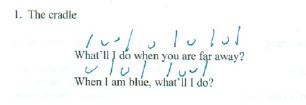
A reader asked for more information on the stresses in the “cradle” example in the earlier discussion on prosody.  So here it is, diagrammed:

Bob Hass noted that while you can argue about exactly what is stressed in a line, generally in English, if you have an adjective before a noun, the noun is stressed. In the phrase, “a black bird,” for example, bird is stressed. If the adjective is added to the noun, making it a compound noun, the adjective is stressed. If you say “a blackbird,” the stress is on black.


Narnia or poetry workshop?

As a child, I was always looking for the door at the back of the wardrobe to get into another world. I believed that I could be transported to Narnia if I just knew where to find the door. As an adult, the poetry workshop at Squaw Valley has been the closest to that magical world for me. I first went in 1986. It was a very small gathering then, perhaps 30 or 40 poets, divided into three workshops each day, taught by Bob Hass, Sharon Olds, and Galway Kinnell. Galway was the Director until a year or two ago, and his generous spirit shaped the experience (a spirit Bob Hass continues to manifest).

With four children and a demanding job, I hadn’t written a poem in years, and the first evening I discovered we were to write a poem that night, and read it in a workshop the next morning. The terror I felt was probably what I’d feel standing at the open door of a plane for my first parachute jump. But somehow, poetry was waiting patiently for me, and that week the poems kept coming, one after another.

The process at Squaw is simple: everyone, including the “staff poets” writes a new poem each day and reads it in the morning workshop. After each poet reads, someone jumps in and says something about what works in the poem for them. A brief discussion follows, with no criticism unless the poet asks for specific feedback on something. At first I thought, “How dumb to only say nice things.” And Dean Young, who has been a staff poet, sometimes refers to it as the “petting zoo.”

But these poems are fresh, and we don’t know each other’s work. Pointing out what is working in the poem does several things. It focuses the writers on their strengths. It encourages them to can keep moving in that direction. There really is no need to say what’s wrong; the focus on what’s working implies what isn’t. And poetry is so much a matter of personal taste–different things move different people. As Lucille Clifton, another staff poet, often quoted, “the house of poetry has many rooms.”

Most of all, though, the spirit of the workshop encourages experimentation. Writers feel safe. No one presumes to “teach” you how to write a poem. Instead, everyone is trying hard to do their best work. Of course we each want to impress everyone with our skill, that’s a given. But over the week, everyone’s work improves.
It’s thrilling to watch and to experience. It’s like living in a poem. Everything informs the process. The place itself is part of the magic, but most of it has to do with the indefinable nature of community–a temporary community, to be sure–but one that makes so much possible.

I’ve been back several times. This year, while I didn’t attend, I went for the final evening, an amazing dinner at the home of Barbara Hall. Oakley Hall was one of the founding forces of this program (there are fiction and screen-writing sessions, too, although these are managed differently). The Hall family, especially Brett Hall Jones, make the ongoing workshops a reality. After dinner, anyone who wants recites a poem from memory. Sometimes, with a familiar poem like Jaberwocky or Lake Isle of Innisfree, many poets join in. I love this experience. It seems to me like watching the living voice of poetry jump from throat to throat, sometimes in different languages, always with a different voice. So that’s where I’ve been.

As a bonus, I got to hear Bob Hass talk about prosody. Someone had asked what role rhyme, meter and form play in poetry, and Bob’s answer was essentially that poetry is made of what you know. The more widely you read, the more is available to you. If you are moved by a poem, you might explore it, analyze it to see how it’s done. He had a handout that started with a line from an Irving Berlin song that haunted him:

What’ll I do when you are far away?
When I am blue, what’ll I do?

He talked about the stresses in the phrase “What’ll I do,” a stressed syllable followed by two unstressed ones, then a final stress. This pattern is called a cradle, as the two stressed syllables “hold” the unstressed ones. It’s shape goes a long way to the power of these song lines.  If any of you want my notes, and the full handout, leave me a comment, and I’ll send them your way. Or you might want to hear Bob read one of my favorites of his poems.

Two more poems from Saturday’s Salon

Both of these are by Lisa Rappoport:

Czeslaw Milosz Buys Lion or Tiger Urine at the Oakland Zoo

—or so it has been reported: or rather, so goes the report
of his intent, unaccompanied by any definitive evidence
of whether he did so, or no. He loved the deer, he loved
their musky attendance at his dwelling in exile on the Western
coast of this country, in the hills above Berkeley, at the edge
of the regional park called Tilden. But he loved also his garden,
the trees, the new life that both burgeoned and was encouraged
to burgeon; and the deer loved these also, but after their fashion,
which tended toward destruction. So other than building
eight-foot-high fences to exclude the visitors, the best
modern alternative to discourage their appetite
was to spread the urine of their enemies
about the perimeter of the property.

Although I cannot say whether the intended purchase was made,
the end of the story is that on the morning when news arrived
of Milosz’s faraway death in his once homeland, deer congregated
in the small yard, more than had ever been seen there. I like
to imagine them pushing and milling, crowding, stamping, bidding
a cervine farewell to a poet and a century, creating presence
in a place of absence.

The Death of Longing

In that alternate universe
where desperation is an aphrodisiac,
happiness is visible, palpable, and smells
like bubblegum; but poetry has shriveled
and you see people barfing all day long
from their disgust at reading, viewing,
and living a life of schmaltz. The word
longing means going for a lengthy walk,
and to miss someone is as rare and outmoded
as to contract a case of the vapors. Hearts
don’t break, they bend, like malleable rubber
balls that bounce without bruising themselves
or their targets. The more one is hurt, the more
confidence he gains, and slights are regarded
as compliments and exercise opportunities. Instead of
black holes physicists discuss white mounds: places
of infinite lightness, outside of the pull of gravity,
which reflect and turn back all that approaches.
The few remaining poets write mainly about latitude, longitude
and trigonometry, and are read only by the few remaining
librarians, those specialists whose job descriptions do not forbid
the reading of banned books. Some inhabitants have never returned
from their youthful longings.

Polenta Pizza & Some Highlights from the Salon

Here is the Polenta Pizza recipe from the Salon, as promised:

Polenta Pizza

1½ C Polenta
6 C stock
¼ tsp red pepper flakes
¼ C butter
salt to taste

Roasted vegetables

Heat the stock to boiling and gradually stir in the polenta. Add red pepper flakes and a little salt. Simmer and stir occasionally until thick (about 20 minutes). Add the butter and stir. Check for salt and add if necessary. Spread on two or three large, lightly oiled cookie sheets with rims and bake at 425 until set, about 8 minutes.  Crust should be about ¼” thick.

Slice vegetables and toss with olive oil and whatever herbs you like. I roast about 30 minutes at 425, turning once as they tend to brown on the bottom first. Roasted red and yellow peppers, cauliflower, parsnips, carrots, anything goes on the pizzas. I like lots of onions, and I usually just slice these thin and sauté them in olive oil on the top of the stove, then let them dry on paper towels. It’s good to have heaps of vegetables. If in season, figs make a nice addition. I slice them and roast them with a little butter and ginger—use tinfoil on your pan for these, easier to clean. If you want meat, you can add fried pepperoni or sausage. If you want cheese, you can crumble a little feta or grated parmesan.

You can make the crust and/or roast the vegetables beforehand and assemble on the crust just before serving. Then just warm for a few minutes in a hot oven. Also good cold.

Also a few highlights from the salon:

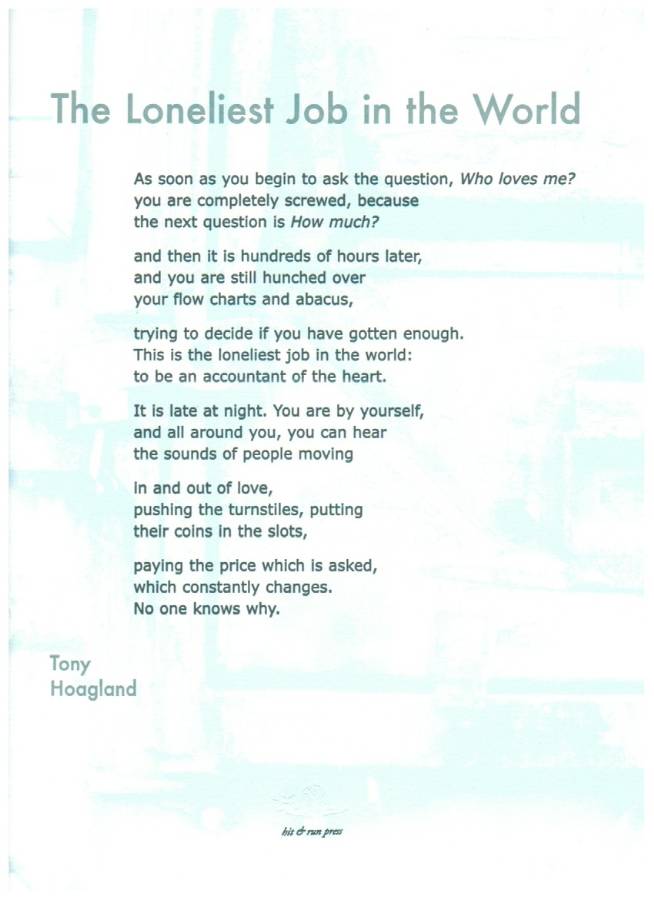
Larry showed two broadsides he did recently with Lisa of Littoral Press, one of a Tony Hoagland poem (scanner bed a little too narrow to do it justice), and one of a poem by a friend and master potter, Jack Sears, who died just about a year ago:


And here is Jackie’s original composition, Dark Flight, on the violin, though she played a piano version for us.


Salon Saturday

For the past year or so, four of us have been hosting more-or-less quarterly salons–with letterpress invitations from Littoral Press and a diverse group of artists, poets, writers, and musicians attending and reading or performing or showing their work. Each of us gets 10 invitations, and about 30+ people attend. We’ve had everything from bronze and clay sculpture to handmade dresses to series of sketches and paintings to original music in addition to stories, poems, novel, play and memoir excerpts. Our only rule is no more than five minutes per person. Otherwise it just gets too long.

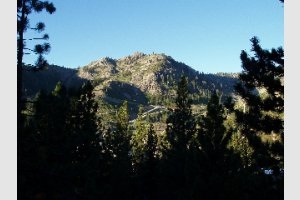
Yesterday happened (by coincidence) also to be the first day of the Squaw Valley Poetry Workshop, where three of the four of us met. This is a truly inspirational week in the Sierras, writing every day, and reading your fresh poem in workshops. I’ve been several times, and last time took one of my favorite signs, which we use now for the salon.

Our invitations say “inspired attire admired but not required,” and I usually wear a thrift shop item. This time was no exception.

The hat had a poofy furbelow on top that really deserves its own photo.


We had a strange artifact that had fallen out of a magazine called “Outsider 4/5” published by Loujon Press.  It was a pressed and laminated flower picked “within a mile of Geronimo’s grave.”

It had a letterpress note attached, explaining that it was not for sale, but was one of 500 distributed free (money would break the spell) with the hardcover edition of the magazine.  The note suggests you tap “dead center” seven times and say “I’m alive” something wild will happen to you within seven days “if you let it happen…”

Of course, I (and several others) walked to the center of the labyrinth and did so. On her way home, one guest already had something wild happen. As she unlocked her car door, she heard something behind her and turned to see a buck with a full head of antlers behind her!

I’d be happy to publish others’ contributions from the salon if anyone likes–just send them to me, or put a link in the comments. Here’s the poem I wrote that morning, inspired by my new hat:

Prayer or Question

I drop the carefully repaired refrigerator drawer
just as I’m about to insert it back into its slot
and I am suddenly in a Dean Young poem
where even the dictionary is agonizing
over meaning and objects have a singular
malevolence? I didn’t mean it
when I said this refrigerator is a piece of shit.
I take it back. Just let the drawer work
so that life can go back to normal.
Let normal be recognizable.
Let it be calm as a cat
curled on the red synthetic velour blanket
weaving its orange fur into the fabric
just by the impression of its body.
Let it be serviceable
as a hat to a pin,
though hats have fallen out of fashion.
Even rhyme can’t save them
with their dotted veils,
their frolicsome furbelows.
The spell check insists we have to frolic
without the help of the letter k,
its presence quirky as a kleptomaniac.
When you stand in the center of the outfield
you see everything baseball has to offer.
The grass is greener there.
They use a lot of chemicals,
paradoxically. No one wants to be out,
or miss out, out in the cold.
A refrigerator is a humming box
of cold in the center of the warmest room
in the house. Hum and function
so that I, too, may hum and function
after my fashion.

Another Loujon Press artifact is a letterpress edition of diary entries by Henry Miller, mostly about an artist named Hans Reichel, in Paris before the second world war (1937-1938). It’s a beautiful multicolored letterpress edition, with a final note by Henry Miller. The end of the note reads:

Out of this potpourri of food and fun some writing got done, some painting, and a lot of living. It’s hard now to tell which was more important. They went together, that is all I can say. And what better can one say? That his paintings are now coveted by collectors and museums means nothing to Reichel now. He would be just as wonderful if no one had ever heard of him.                               Henry Miller 5/8/66

I couldn’t have written a better description of our salon myself. I’ll post the Polenta Pizza recipe tomorrow.


The hocus-pocus gnosis of this world

This is from the final two lines of “Song,” in Dean Young’s new book, Fall Higher. I love the unique way he expresses the odd juxtapositions that somehow create what we perceive as meaning–the hocus-pocus gnosis.

He’s not an easy poet; his poems tend to be long, his images dense and unusual. He tweaks language and imagery to break through our assumptions–advertising slogans, instructions, the language of the everyday is stood on its head so that we are forced to examine it.

Sprinkled through his poems are brave assertions that few poets would dare to make, a quest for meaning, and a quirky sense of humor. A few samples:

There is a part of the spirit that cannot be destroyed.

or

It only gets dark
half the sky at a time.

or

Do you think the dictionary ever says to itself
I’ve got these words that mean completely different things
and it’s tearing me apart?

or, as a book title:

First Homosexual in Space

One of my favorites is “I Know My Friends Will Laugh,” from his book Strike Anywhere. I can’t seem to make the indentations come out exactly right (the lines under the first line in the stanza should all be indented), so for the full effect, you’ll need to buy the book:

I Know My Friends Will Laugh

but I think there’s so much spirit-stuff in this world that even
the dust kicked up on the trail above Tomales swirls and
maneuvers and gestures, alive for an instant because to be
alive is always for an instant.

My friends will say I’ve been in California too long but within
the dust there’s some further puffing up as the love in any
of us puffs up for the ineffable because love is always for
the ineffable even when she’s giggling in your arms, your
tongue in her ear.

Not the likelihood of not loving enough—stone dark with
condensed fog—although that too is spirit’s residing,
another lease, detective novels abandoned on the shelf,
pages falling out, binding crust, silverfish flashing.

Because when the spirit is divided, torn apart as it seems it
must be, the head keeps singing in the lion’s mouth even as
the body, fallen to its knees, pats the ground for some
dropped key, some broken jewelry, each tooth and claw
mark a new mouth, new eyelids opening on the next world.

I’m not even sure there is a next world.

Perhaps death is just unloosening, release, the way the rose
petals all drop at once just as Christina said they would.

Part of me says nothing like these petals and dust, part of me
says everything petals and dust.

By now my friends are nearly choking on their beers but part of me
sees my father’s chawed face the day they brought him
home from the golf course like something God bit, didn’t
like, threw back.

Part of me sees supper laid out while I shake snow from my coat.

Sees dusk ignite cattails into sheaves of light.

Sees the ant’s entrance through the smashed owls eye into
Byzantium.

My friends, what should I believe?  Even the lice are trembling.

Dean Young

Because he recently had a heart transplant, you can also donate to the fund that is helping defray expenses for this.

Friday Poetry

This poem arrived in my email this morning:

Doubled Mirrors

It is the dark of the moon.
Late at night, the end of summer,
The autumn constellations
Glow in the arid heaven.
The air smells of cattle, hay,
And dust. In the old orchard
The pears are ripe. The trees
Have sprouted from old rootstocks
And the fruit is inedible.
As I pass them I hear something
Rustling and grunting and turn
My light into the branches.
Two raccoons with acrid pear
Juice and saliva drooling
From their mouths stare back at me,
Their eyes deep sponges of light.
They know me and do not run
Away. Coming up the road
Through the black oak shadows, I
See ahead of me, glinting
Everywhere from the dusty
Gravel, tiny points of cold
Blue light, like the sparkle of
Iron snow. I suspect what it is,
And kneel to see. Under each
Pebble and oak leaf is a
Spider, her eyes shining at
Me with my reflected light
Across immeasurable distance.

Kenneth Rexroth

I love how this poem seems to move so simply, almost like a prose paragraph. But every detail is exact, moves the poem forward from a late night on a particular road into immeasurable distance.

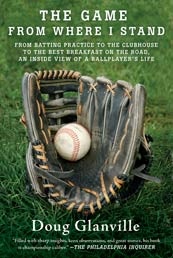
And poetry from an unexpected source appeared as an editorial in the NY Times on Derek Jeter by Doug Glanville that Larry read to me. Here’s a sample: “You speed through much of your time just hoping to keep the ooze moving forward, worrying that it may swallow you whole the minute you let up.” Several passages made us almost teary. Not surprisingly, he’s written a book, The Game from Where I Stand, which I just ordered.


Whose poem is this?

Sometimes I can’t remember whether something in my notes is original or cribbed from somewhere.  For example, did I write this? or was it possibly Lorine Niedecker?

Changed two words.
What I call
a morning’s work.

It’s very like some of her short work:

Remember my little granite pail?
The handle of it was blue.
Think what’s got away in my life—
Was enough to carry me thru.

*                    *                   *

Popcorn-can cover
screwed to the wall
over a hole
so the cold
can’t mouse in

Both those are hers, and I can’t remember for the life of me whether that three-line stanza is mine or hers. Someone might know…

In any case, I thought of it, because my day’s work today was to come up with the phrase “the darning needle of dread,” which came out of reading Robert Kroetsch. His mother called dragon flies darning needles. I liked that idea, and so it goes. Though I’m not too crazy about his prose so far. A little too Hemingway-wannabe? a little too peppered with self-consciously quotable phrases? I’m not sure just what I am finding off-putting. I haven’t gotten to the poetry yet. But I do like Lorine Niedecker! An underrated poet, I think. She lived into her late sixties, but I couldn’t find a good later photo. She wasn’t as secluded and little known as Emily Dickinson, but you don’t get too famous if you live a quiet life in the wetlands of Wisconsin.

Monday, Monday

A friend spent the night last night, and added to our breakfast conversation by reading aloud from the Monday Metropolitan Diary section of the New York Times:

“Practice, practice, practice may be the way to Carnegie Hall, but is it worth it if no one remembers your name, much less the hall itself?
Recently overheard from a couple settling into their seats behind me before a concert: “This is where we heard that guy play the piano, isn’t it?”

That’s the problem with fame in a nutshell!

Then Larry said that there was a place called The Royal Roost in New York where Charlie Parker, Dizzy, Miles, Kenny Durham and other jazz greats used to play that was nicknamed The Metropolitan Bopera House.

Then I got to the work of the morning. Every Monday I send a poem to a little group of poets who trade poems each week. We’ve been doing this almost 10 years now! We each have a day. Sometimes we send our poems, but most often a poem we’ve encountered that we like a lot. Today I sent out a poem by Tony Hoagland, one of my favorite poets.

I love the way he mixes humor and the overpowering emotions we each feel, how he takes a situation everyone can recognize—the desire to seduce someone—and elevates it. Then he brings us back to earth, reminding us that we live here, amid the base, confusing and overpowering passions, no matter how much we love literature.

The Collaboration

That was the summer I used The Duino Elegies
in all of my seductions,
taking Rilke from my briefcase

the way another man might break out
candlelight and wine.
I think Rilke would have understood,

would have thought the means
justified the end, as I began to read
in a voice so low it forced my audience

to lean a little closer,
as if Rilke were a limestone bench
stationed on a hillside

where lovers gathered to enjoy the vista
of each other listening.
What a chaperone,

and what a view—is it Susan
I am thinking of?—
how, in the middle of the great Ninth Elegy,

in the passage where the poet
promises to memorize the earth,
her tanned and naked knee

seemed the perfect landing platform
for any angels in the vicinity.
I think Rilke would have seen

the outline of an angel
in the space between our bodies
just before we kissed,

then seen it vanish
as we clashed together
and commenced our collaboration

on another chapter
of the famous, familiar and amusing
saga of human relations—choosing

heat instead of grace,
possession over possibility—trading
the kingdom of heaven

one more time
for two arms full
of beautiful, confusing earth.

This poem is from Sweet Ruin, like all of Tony’s books, worth owning! For those interested in poetics, his book of essays, Real Sofistikashun, is a treat.

Morning meander

Foggy Berkeley summer mornings abet the lazy web discovery process. What a treasure the internet is. How delicious that the military invented it, didn’t really know what to do with it, and gave it to us.

Here is a short poem I found on Samizdat Blog this morning by Robert Kroetsch:

A lemon is almost round.
Some lemons are almost round.
A lemon is not round.

So much for that.

This led me to search for his work at UC Library and reserve several items for pickup Monday. His date of death (June 21, 2011), still an open dash in the library catalog, is already updated on Wikipedia!

For those of you who cut recipes from the newspaper and actually cook them, here’s a winner from Wednesday’s NY Times that I made to use the plethora of peas bursting from the garden. I used a small Thai chili and three kinds of peas (snap, snow, and English) as that’s what I had, but otherwise followed the recipe almost exactly. Couldn’t resist adding a squeeze of lemon at the end. It was cut and on the counter…

And for those within shopping distance of Berkeley Bowl, you can get fresh turmeric, black mustard seeds, and even Kaffir lime leaves there.